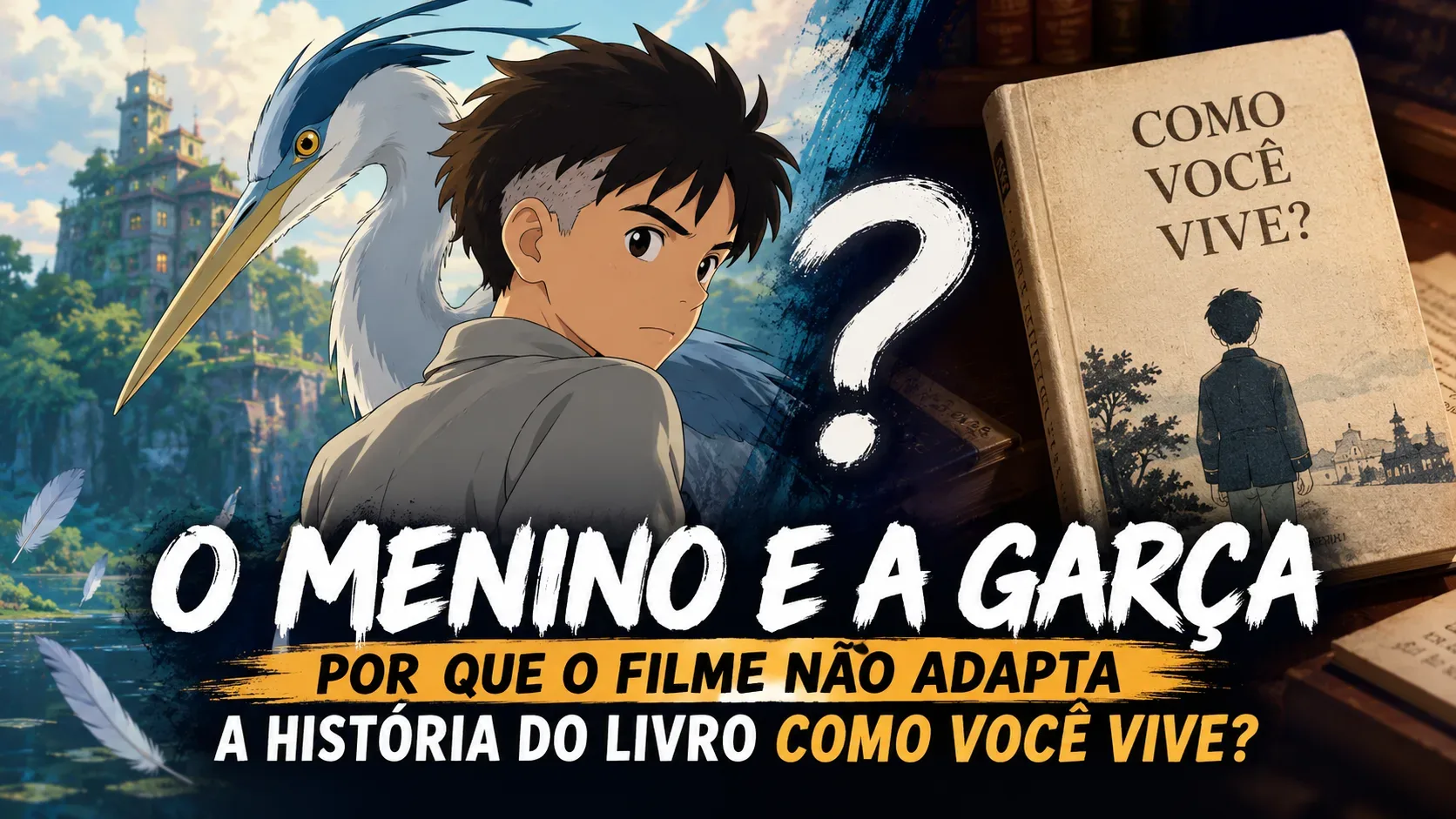
The Boy and the Heron (2023) does not adapt the plot of How Do You Live?, Genzaburō Yoshino's 1937 novel. Hayao Miyazaki borrowed the book's Japanese title and its question about how to live, but created different characters, conflicts, and events. Studio Ghibli itself confirms the distinction and identifies the feature as an original story by the director.
What did Studio Ghibli say about the book?
The film's Japanese title, Kimitachi wa Dō Ikiru ka, is also the title of Yoshino's novel, commonly rendered in English as How Do You Live?. In a statement dated January 10, 2023, Studio Ghibli explained that Miyazaki had read the book as a child, been deeply moved by it, and borrowed its title. The studio also described the film as Miyazaki's original creation.
It repeated that explanation on July 10, 2023, four days before the Japanese theatrical opening on July 14. The official account made the distinction explicit: the film and the novel share a title but not a plot. Studio Ghibli's film entry credits Miyazaki with the original work, screenplay, and direction. Calling the film a faithful adaptation or a retelling of Yoshino's narrative therefore conflicts with the studio's own description.
How do Copper and Mahito's stories differ?
The novel follows Junichi Honda, a fifteen-year-old nicknamed Copper after Copernicus. Following his father's death, he navigates friendship, personal conduct, and social inequality in everyday school life. Between these episodes, his uncle writes reflections in a notebook, encouraging him to think about responsibility, knowledge, and people's place in the world. Publisher Hachette describes the book's alternating structure of Copper's experiences and his uncle's writing.
The film follows Mahito Maki, a boy whose mother has died during World War II and who moves to the countryside with his father and new family. A gray heron and a mysterious tower draw him toward a fantastical realm. When his stepmother disappears, his search for her becomes intertwined with his grief. This is the premise presented by distributor GKIDS, not Copper's journey retold with different names.
| Aspect | 1937 novel | 2023 film |
|---|---|---|
| Protagonist | Copper, or Junichi Honda, age 15 | Mahito Maki, a grieving boy |
| Family loss | Death of Copper's father | Death of Mahito's mother |
| Structure | School life interwoven with reflective writing by an uncle | A fantasy journey involving a heron and a tower |
| Guidance | Conversations and notes from Copper's uncle | Family relationships and encounters during Mahito's journey |
| Shared question | How can one act ethically and find a place in the world? | How can one go on living after loss and choose a path forward? |
Why did Miyazaki keep the question How Do You Live?
The strongest connection is philosophical rather than narrative. Yoshino examines friendship, moral awareness, and responsibility through ordinary events. Miyazaki revisits a young person's confrontation with suffering and choice, but expresses it through fantasy. This thematic parallel is a comparative interpretation supported by the two premises, not evidence that every creature or symbol in the movie came from the novel.
The distinction matters: sharing an underlying question does not make two works versions of the same plot. The heron, the tower, and the extraordinary realm have no established counterparts in the publisher's account of the novel, so they should not automatically be treated as adaptations of Yoshino's characters or scenes.
Does the book actually appear in the movie?
Minor spoiler warning: the next paragraph mentions an important object in the story but does not disclose the ending.
Yes. Mahito discovers a copy of How Do You Live? left as a gift by his mother. This detail is documented by Graeme McMillan in a December 6, 2023 Popverse article and by the Oklahoma City Museum of Art. It is a concrete link between the works: Yoshino's novel exists within Miyazaki's fictional world and serves as a point of reference for Mahito. The book's appearance on screen, however, does not mean the film dramatizes Yoshino's chapters.
Why was it described as an adaptation?
The connection became public long before audiences knew the film's story. Miyazaki revealed the title in 2017, while Studio Ghibli disclosed very little plot information during production and its Japanese promotional campaign. Without a detailed synopsis, some assumed the novel would supply the film's events. Popverse documented the confusion; a Brazilian guide published in 2020 about books associated with Ghibli, for example, used the label adaptation.
Those earlier descriptions and later promotional shorthand need to be weighed against Studio Ghibli's clarifications from January and July 2023. The more precise distinction is this: the book inspired the choice of title and provides a thematic conversation; the film tells its own story. Readers can turn to Yoshino to explore the philosophical question further, but knowing Copper's journey is not necessary to follow Mahito's adventure.
Sources and references
- Studio Ghibli: July 2023 newsletter on the borrowed title and original story
- Studio Ghibli: January 2023 newsletter on the connection with the novel
- Studio Ghibli: official 2023 film record
- Hachette: publisher description of How Do You Live?
- GKIDS: synopsis of The Boy and the Heron
- Popverse: Graeme McMillan report, December 6, 2023
- Oklahoma City Museum of Art: discussion of the book-film connection
- Studio Ghibli Brasil: 2020 book and film guide (example of earlier classification)