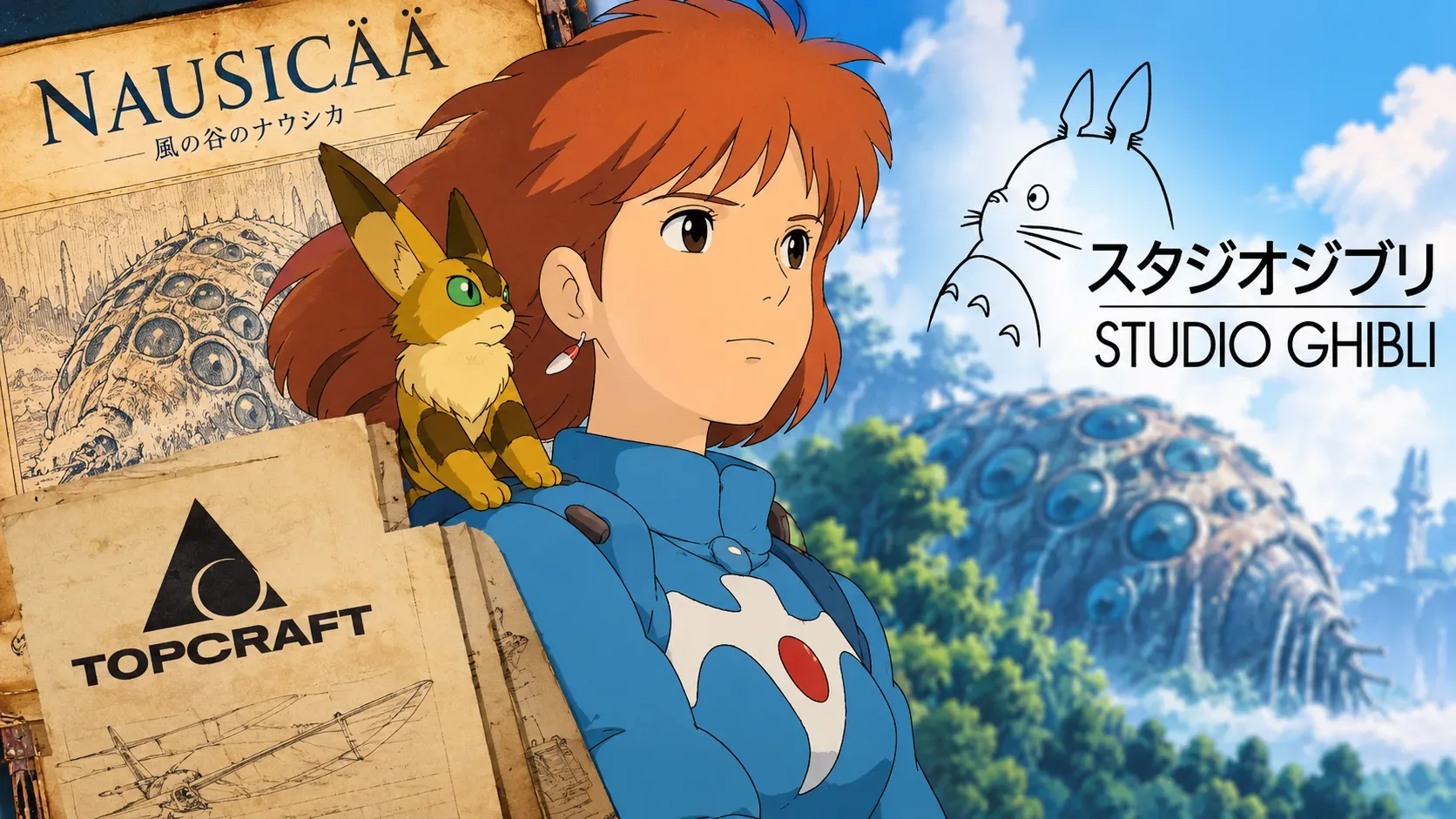
Nausicaä of the Valley of the Wind (1984) is included in Studio Ghibli's official catalogue, but its original animation was produced by Topcraft. The film opened in Japanese cinemas on March 11, 1984, while Ghibli opened its studio in June 1985. Both statements can be true because they answer different questions: who made the film at the time, and how it is presented in the studio's filmography today.
This distinction is not a fan theory. Ghibli's own Japanese website lists Nausicaä among its works and explicitly names Topcraft as the production studio on the individual film page. The accurate answer recognizes both names rather than choosing only one.
What does Studio Ghibli itself say about Nausicaä?
The official page identifies the film by its Japanese title, Kaze no Tani no Naushika (風の谷のナウシカ), dates it to 1984 and lists its principal credits: Hayao Miyazaki as creator of the source material, screenwriter and director; Isao Takahata as producer; and Joe Hisaishi as composer. It also records Toei as the original distributor and March 11, 1984, as the Japanese release date.
The decisive detail is a note on that same page stating that Topcraft produced the work. That note appears within Ghibli's own film section. Claims that the studio conceals Topcraft's involvement therefore do not match the official record consulted here.
What did Topcraft do on the 1984 film?
Topcraft was the animation studio responsible for making Nausicaä before Studio Ghibli existed. It already had experience with earlier animation projects: the British Film Institute highlights its work on The Last Unicorn (1982), associated with Rankin/Bass, and notes that its animators later worked on Nausicaä and helped found Ghibli.
The animation studio's role should not be confused with the film's directing and creative production credits. Miyazaki wrote and directed an adaptation of his own manga; Takahata is credited as producer on the official film page; Hisaishi composed the score. Publisher Tokuma Shoten played a central part in the project and, according to Ghibli's historical account, later led the creation of the new studio. Toei is listed as distributor for the Japanese theatrical release.
These separate responsibilities explain why one film can be connected to different companies and artists without any contradiction. Topcraft deserves credit for the original animation even when the movie appears in collections carrying the Ghibli name.
The timeline: the film came before the studio
| Date | What happened | Why it matters |
|---|---|---|
| March 11, 1984 | Nausicaä of the Valley of the Wind opened in Japan. | Topcraft produced its animation before Ghibli opened. |
| June 1985 | Studio Ghibli opened its studio in Kichijōji, Tokyo. | This is the institutional milestone recorded in Ghibli's official chronology. |
| August 2, 1986 | Castle in the Sky opened in Japan. | It was the first feature made by the established studio. |
Ghibli's official timeline records all three milestones. It also prevents a common mistake: Nausicaä is the oldest title in Ghibli's official filmography, but that does not retroactively make it a production by a company that did not yet exist in 1984.
Why is Nausicaä included in Ghibli's catalogue?
Because the film is closely tied to the studio's origins. In the history published by Ghibli itself, Nausicaä's artistic and commercial success is identified as the impetus for establishing an organization devoted to further animated features. Tokuma Shoten, the publisher involved in Miyazaki's work, played a central role in the foundation, which occurred as Castle in the Sky was being prepared.
There is also creative continuity: Miyazaki and Takahata worked on the 1984 film and went on to become central figures in the new studio. The involvement of professionals associated with Topcraft helps explain the transition between those periods. That makes Nausicaä a precursor to Ghibli without requiring the claim that Topcraft and Ghibli were the same company in 1984.
In practice, the official filmography encompasses both the studio's production history and a film fundamental to its creation. Ghibli does not hide the distinction; its website states it explicitly.
Are catalogue inclusion, distribution and copyright the same thing?
No. A catalogue identifies the works Ghibli presents among its films. Production credits identify who made the animation and who worked on the film. Distribution concerns a movie's release in a particular territory and period. Copyright notices provide another, separate layer of information.
On its official copyright notice page, revised in February 2024, Ghibli gives Nausicaä the credit © 1984 Hayao Miyazaki/Studio Ghibli, H. The Ghibli name appearing in that current notice does not change the studio's founding date or its own statement that Topcraft made the original animation.
Nor can that notice alone establish the complete chain of ownership, licensing contracts or which party holds each distribution right in different countries. Those questions would require specific additional documents. It is therefore wrong to infer from a copyright line alone that Ghibli already existed as an animation studio in 1984.
So does Nausicaä count as Studio Ghibli's first film?
It depends on the criterion, which should be made explicit. If the question is which title is the oldest in Ghibli's official catalogue, the answer is Nausicaä of the Valley of the Wind (1984). If the question is which feature was the first produced by the studio after its founding, the answer is Castle in the Sky (1986).
A description that respects both records is: a Hayao Miyazaki film animated by Topcraft, released before Studio Ghibli was founded and included in its official filmography. This credits the people who made the 1984 film and explains why Nausicaä rightly appears in lists and collections of Ghibli works.