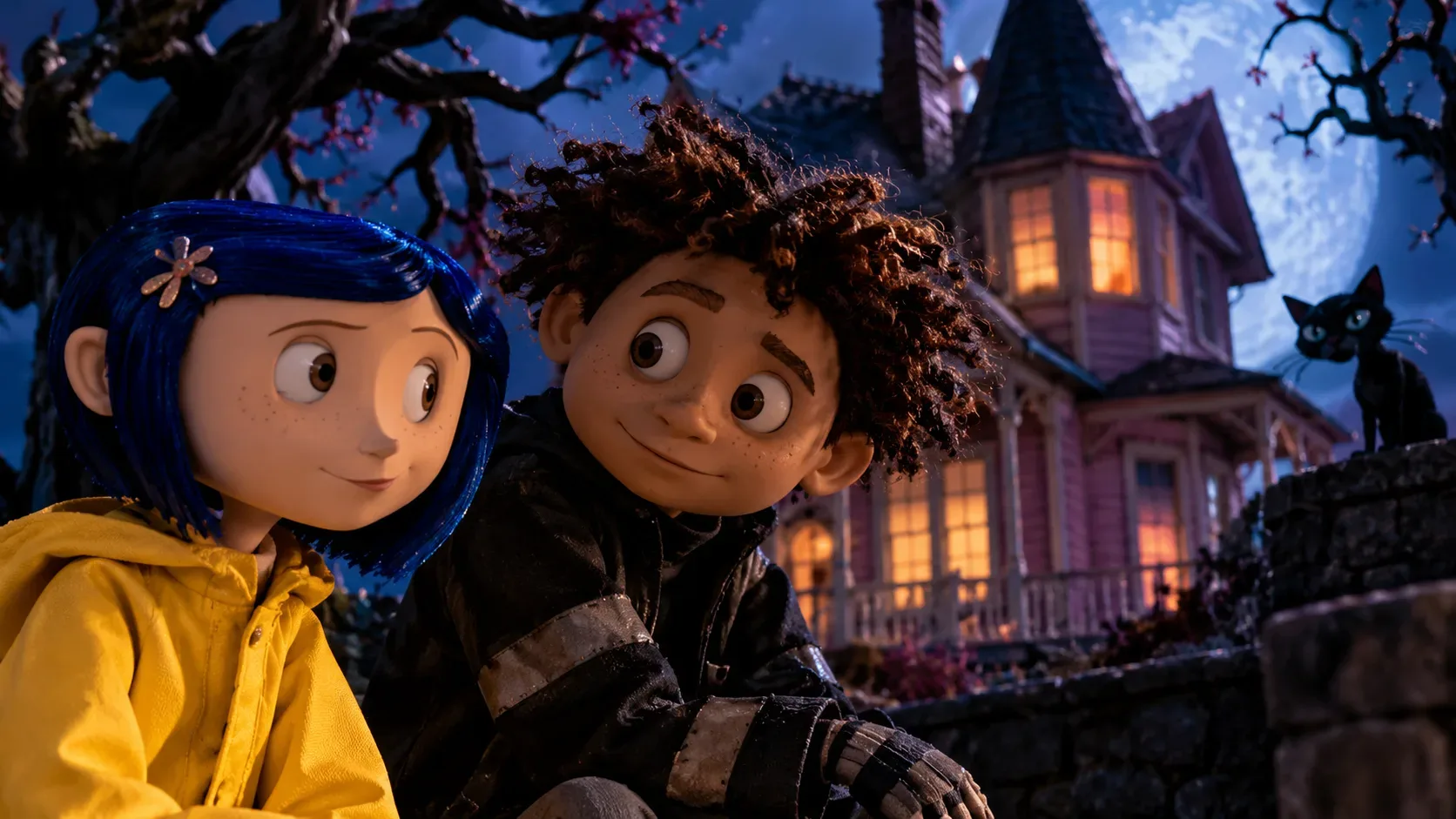
Wybie is absent from Neil Gaiman's 2002 book Coraline because the character was created by Henry Selick for the 2009 animated film. The writer-director needed someone Coraline could talk to and clash with in the real world. Thoughts and reactions that work naturally in prose could then take shape as dialogue and visible action on screen.
Selick himself gave this explanation in interviews before the film's release and again in 2024. Wybie was not removed from a particular edition of the novel, nor does he come from a lost storyline. He is an adaptation choice, devised to tell the same story in a different medium.
An initial screenplay that followed the book too closely
In an interview published by FirstShowing.net on February 5, 2009, Selick recalled receiving the manuscript before it was published and initially trying to turn it into a script that stayed very close to the original text. In his assessment, the result lacked the pacing and scene structure he wanted from a film. He therefore decided to rewrite it more freely.
Wybie emerged during that rewrite. Instead of continually relying on narration, Coraline had someone close to her own age whom she could challenge, talk to and distrust. Selick also relocated the adaptation to the United States, but that was a separate screenwriting decision, not the sole reason for inventing the boy. In the interview, he said Gaiman liked the revised version.
Speaking to DiscussingFilm in an interview published in September 2024, Selick again described his original draft as overly close to the book. For him, keeping the spirit of the work meant reorganizing its storytelling rather than simply putting the pages on screen.
How Wybie takes over some of the novel's inner dialogue
The novel can follow Coraline's perspective through narration: readers understand her boredom, curiosity and suspicions without her having to explain them aloud to another child. Film must communicate that information through performance, images, sound and, when useful, conversation. The director explicitly pointed to this difference between the two media when explaining the change.
In an October 2008 interview with Anime Superhero, Selick identified inner dialogue as a particular challenge in adapting the story. The cat was already important, but it could not talk to Coraline in the real world. Creating the neighbor offered a direct relationship, including room for irritation and humor, without turning every thought the protagonist has into a speech addressed to the audience.
This does not mean the Coraline of the book needed a helper or that Wybie was invented to fix her personality. His initial purpose was a storytelling one: to make some of her reactions visible. In the same interview, Selick stressed that he wanted to preserve the protagonist's skepticism, courage and resourcefulness.
Wybie grew beyond a screenwriting device
Spoiler notice: the next passage reveals a detail about Wybie's counterpart in the Other World.
As the screenplay developed, the character acquired ties to the history of the house. Selick said in 2008 that Wybie began as a way to develop Coraline but ultimately became an important character with a family backstory connected to the property.
The movie also introduces a counterpart to Wybie in the Other World who cannot speak. In his 2024 DiscussingFilm interview, Selick noted the irony that Coraline likes this silent version better. The idea uses a trait of the newly created character to distinguish the two worlds rather than simply duplicating the same companion in both.
What actually changes between the book and the movie?
There is no equivalent Wybie in the novel: Coraline's journey unfolds without the conversational partner created for the screen. In the movie, encounters with the neighbor express some of what literary narration could convey. His presence changes interactions and adds a relationship to the adaptation, but Coraline remains the protagonist, and her choices in the face of the Other World remain the story's core.
The distinction also clarifies Neil Gaiman's role. The book is Gaiman's; Selick wrote the movie's screenplay. According to the filmmaker, Gaiman responded positively to the proposed changes. Wybie's origin is therefore a decision owned by the adapter, not evidence that the book accidentally left out a character who belonged in it.