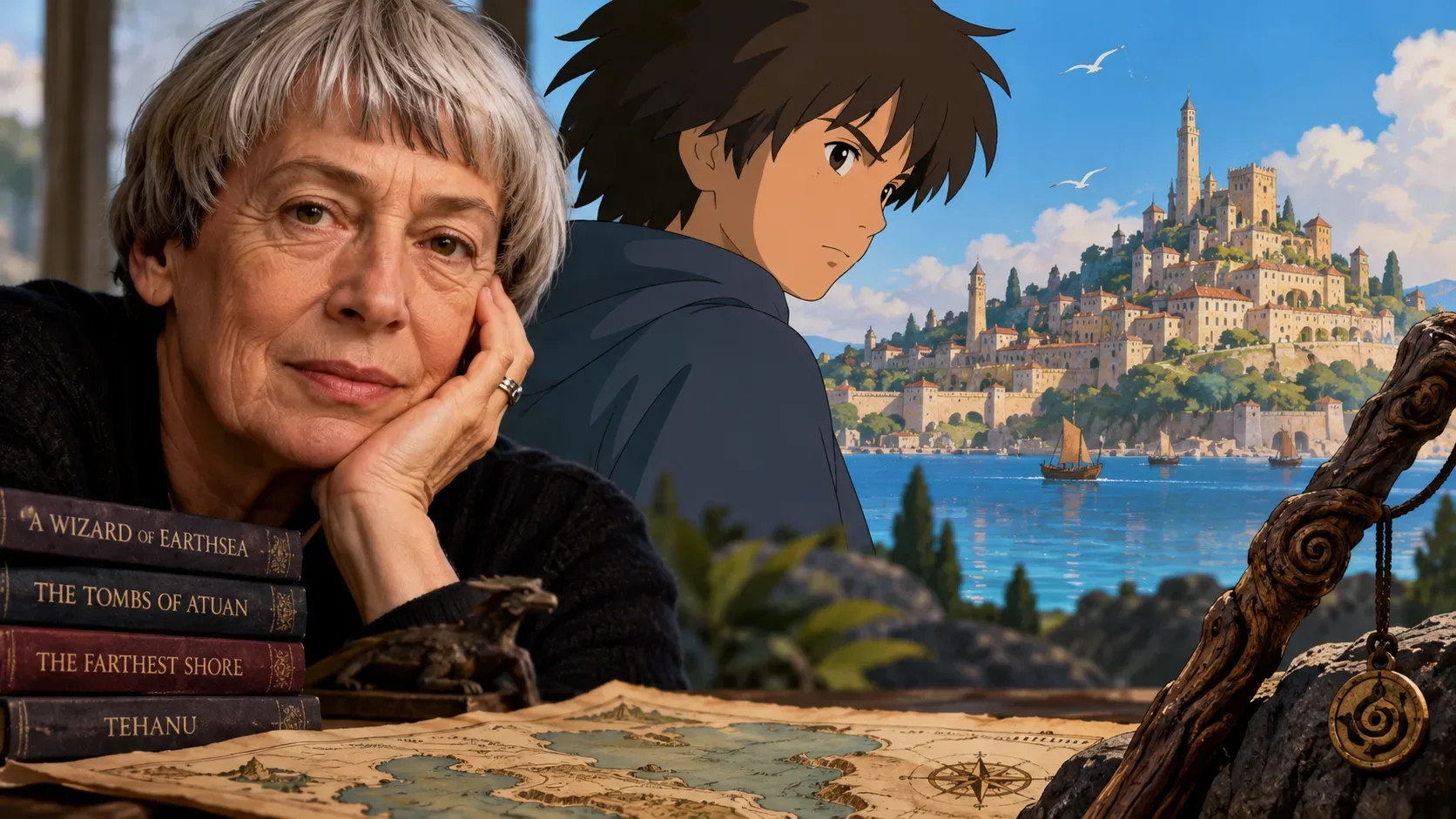
Ursula K. Le Guin criticized Studio Ghibli's Tales from Earthsea (2006) because she felt the adaptation replaced the ethical complexity of her novels with a more violent plot, reshaped characters, and turned ideas about the balance of life, death, and inner darkness into lessons insufficiently supported by the action. There was also disappointment before release: she had agreed to the project believing Hayao Miyazaki would oversee its development, but the film was ultimately directed by Gorō Miyazaki without that involvement, according to her account.
The disagreement is documented in the author's own statement, producer Toshio Suzuki's interviews, and the director's diary. Le Guin acknowledged the film's visual strengths and did not argue that an adaptation must reproduce the novels exactly. Her central objection was the gap between what the books meant and what the screen version appeared to communicate.
From the initial refusal to the Studio Ghibli agreement
- Early 1980s: Hayao Miyazaki expressed interest in adapting Earthsea. Le Guin refused because she was not yet familiar with his animation, as she later explained.
- Years later: after watching My Neighbor Totoro on Vonda N. McIntyre's recommendation, the author became an admirer of Miyazaki. Through Japanese translator Masako Shimizu, she indicated that she would welcome a conversation about a film.
- During negotiations: Le Guin cautioned against radical changes and even suggested an original Ged adventure set between the first two books as a legitimate space for creative freedom.
- 2005: Suzuki and Hayao visited Le Guin and her son, who was involved in administering Earthsea rights. According to the author, she was told that Gorō, then inexperienced as a feature-film director, would take over. She reluctantly agreed, understanding that Hayao would approve the project.
- 2006: the film opened in Japan on July 29. The author saw a private screening on August 6 and subsequently published her detailed response.
The documents differ slightly on the date of the 2005 visit: Le Guin placed it in August, while Suzuki placed it in June in an interview republished by Ghibli. Rather than insist on one month, it matters to distinguish their accounts. Suzuki said Hayao had pledged to look at the screenplay but ultimately did not; Le Guin said she realized he was not involved in production and was disappointed.
What changed between the books and the film?
The Japanese title is Gedo Senki. Gorō Miyazaki directed, and he co-wrote the screenplay with Keiko Niwa. Suzuki explained that the team chose the third novel, The Farthest Shore, as its main foundation. The adaptation also uses characters and ideas from other installments, particularly Tehanu. This is not a complete filming of any single novel, nor a direct adaptation of the separate story collection titled Tales from Earthsea.
| Element | In the books | In the 2006 film |
|---|---|---|
| Ged and the shadow | In A Wizard of Earthsea, the shadow grows out of Ged's choices and forms part of his journey toward self-knowledge. | The idea of a shadow or other self reappears in connection with young Arren, with a different explanation. |
| Arren and the conflict | The Farthest Shore follows Arren and Ged through a crisis involving magic, mortality, and a world out of balance. | The screenplay changes Arren's history and places more weight on his inner distress and violent events. |
| Tenar and Therru | Their life together and care for an injured child are central to Tehanu, the fourth novel. | The characters appear in a story rearranged around Arren's journey. |
| Balance and death | The theme emerges through choices, consequences, and the characters' limits across extended stories. | In Le Guin's view, these ideas are stated more directly than they are dramatized. |
Why did Le Guin object to the violence and the moral message?
Notice: the examples below reveal an event near the beginning of the film, but do not recount its ending.
The author identified four problems in her public response:
- Arren's motivation: in the film, the prince kills his own father. Le Guin regarded the act as arbitrary and found the later explanation involving his shadow unconvincing.
- The relocated shadow: she contrasted this device with the first novel, which develops the origin and meaning of Ged's shadow throughout the story.
- Evil concentrated in an antagonist: in Le Guin's reading, the wizard Cob/Kumo reduces ethical conflict to an enemy who can be eliminated, unlike the novels' rejection of easy answers about good and evil.
- Statements about balance: she found the speeches on life and death didactic because they did not arise organically from characters' actions and relationships.
These are the author's judgments, not a neutral statement of how every viewer must interpret the film. An essay originally published in Foundation and later republished by The City of Lost Books offers a more sympathetic reading of some of Gorō's choices. The disagreement underscores the distinction between an author's criticism and an indisputable fact about a work's meaning.
What did 'It is not my book. It is your movie' actually mean?
As they said goodbye after the August 6 screening, Gorō asked whether Le Guin had liked the film. She replied: “Yes. It is not my book. It is your movie. It is a good movie.” The director recorded this in his diary and said he received it gratefully. The author later explained that it was a private answer given under delicate circumstances and that she had not wanted it turned into a public declaration of unqualified approval.
The order of the documents matters. The diary records Gorō's impression of the meeting; Le Guin's essay gives her fuller reaction after the screening. Reading that isolated remark as either total condemnation or wholehearted endorsement erases the difference between personal courtesy and artistic judgment.
What did she praise, and how did she discuss the characters' appearance?
Le Guin found many images beautiful, admired the way the dragons folded their wings, and singled out scenes of everyday work, such as plowing, caring for animals, and drawing water. To her, those moments restored the grounded calm of Earthsea. At the same time, she considered the animation uneven next to My Neighbor Totoro and Spirited Away.
She also noted that she had written many Earthsea inhabitants as dark-skinned to challenge conventions of European fantasy. She explicitly criticized racial whitewashing in an earlier American television adaptation. With the Japanese anime, however, she was more cautious: she acknowledged her limited knowledge of Japanese audiences' racial perceptions, discussed anime's visual conventions, and noticed some variation in skin tones. Her comments about the two adaptations should not be treated as identical accusations.
How did the Japanese response become part of the debate?
On August 19, 2006, Le Guin posted a letter from a correspondent in Japan describing viewers split between disappointment and a strong emotional connection to the film. This was one person's account selected and reproduced by the author, not a representative survey of Japanese opinion or a statement she herself wrote about each viewer.
The documented dispute therefore has three distinct dimensions: the contractual and creative expectations surrounding Hayao Miyazaki, Le Guin's interpretation of the changes to her books, and competing audience readings. Her criticism was not a personal allegation against Gorō, but a defense of the characters, context, and narrative philosophy she considered essential to Earthsea.
Sources and references
- Ursula K. Le Guin, original response to the film
- Studio Ghibli, official Gedo Senki film credits
- Studio Ghibli, Toshio Suzuki interview
- Gorō Miyazaki, diary on the Le Guin screening
- Le Guin, Japanese correspondence dated August 19, 2006
- Simon & Schuster, official Tehanu book description
- The City of Lost Books, critical essay on the film