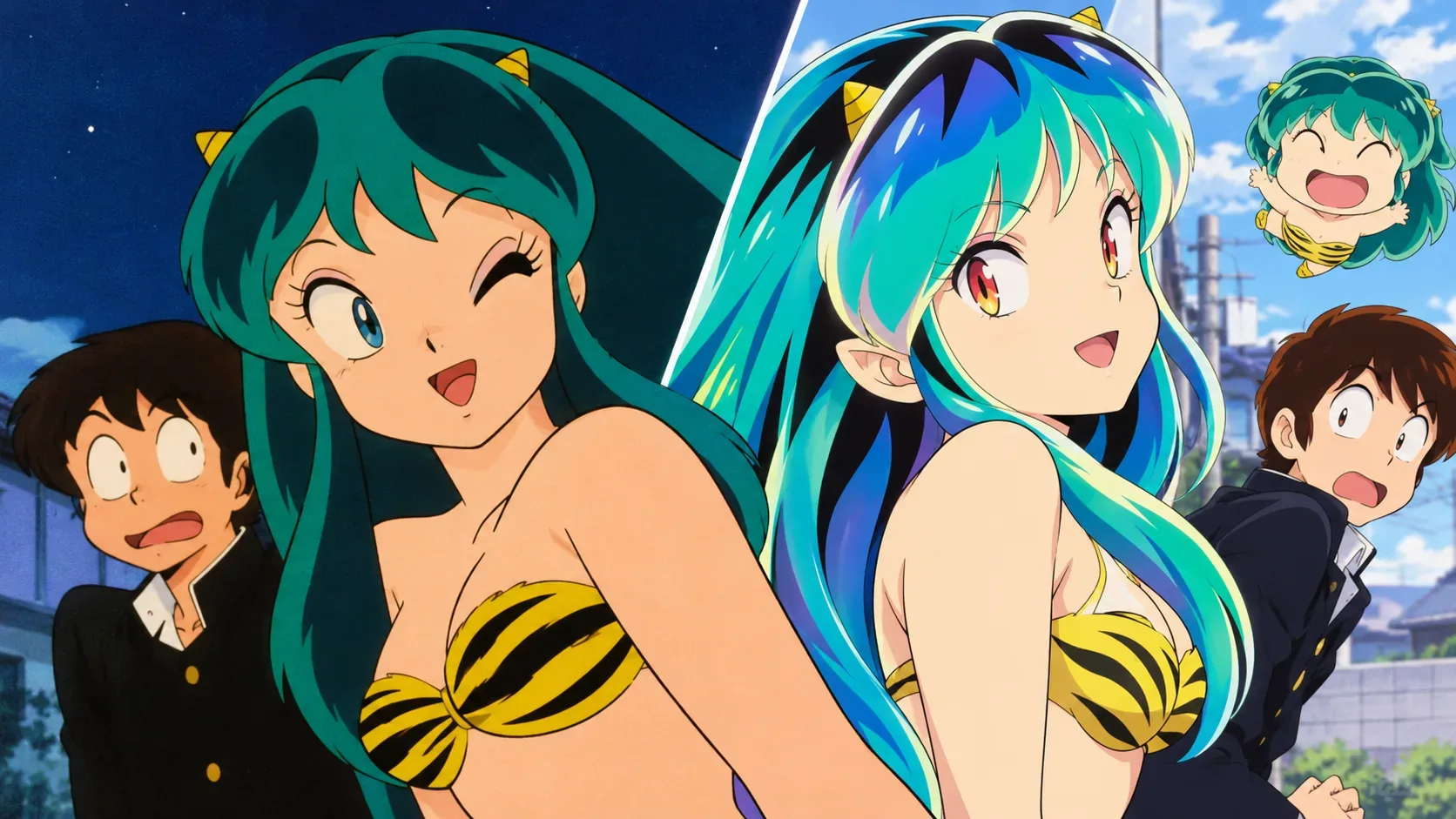
The Urusei Yatsura anime that began in 2022 ended in 2024 after 46 episodes, split into two 23-episode seasons. It is neither a sequel to the 1981 production nor a complete replacement for it. Instead, it is a new adaptation selecting stories from the same Rumiko Takahashi manga. The original television series ran for far longer and developed its own directing choices and material.
This distinction matters when deciding where to begin. The newer version offers a shorter route through Ataru and Lum’s relationship; the older one opens up a wider range of adventures and the creative style of a production that continued throughout much of the 1980s. Either can be watched independently.
Why did the 2022 anime have 46 episodes?
From the outset, Fuji TV described the project as a selection of manga stories spread across four cours, television programming blocks roughly equivalent to a quarter of a year. In July 2022, the official website stated that the first two cours would air consecutively. That plan was not a promise to animate every chapter in the manga’s 34 collected volumes.
As broadcast, season one ran from October 2022 to March 2023 with 23 episodes; season two followed from January to June 2024 with another 23. The official episode guide identifies episode 46 as the finale. Thus, 46 counts complete television installments produced and aired, not manga chapters adapted or individual story segments within those installments.
There is an important limit to the explanation: the announcements reviewed confirm the story-selection approach and four-cour format, but do not spell out why the final order was exactly 46 rather than 48 or 52 episodes. The number alone is not evidence of cancellation or proof that the staff meant to adapt the entire manga.
1981 vs. 2022: what actually changed?
| Aspect | 1981 anime | Anime launched in 2022 |
|---|---|---|
| Relationship to the manga | The first TV adaptation, developed across several years. | A new adaptation of selected stories from the same manga, not a sequel. |
| Japanese broadcast | 1981 to 1986. | 2022 to 2024, across two seasons. |
| Episode count here | 195 broadcasts in JBox’s historical account; some catalogs omit a retrospective special. | 46 television episodes, 23 plus 23. |
| Production | Kitty Films, with animation handled in different periods by Pierrot and Deen. | David Production, with a renewed voice cast and creative team. |
| Scope and approach | More room for episodic stories, detours, and the original show’s own approaches. | A more concentrated story selection rather than an episode-by-episode recreation. |
| Starting point | An entry point for experiencing the first adaptation’s distinctive style. | A self-contained starting point that does not require the classic series. |
Sharing a narrative starting point does not mean sharing an edit. The 2022 production returns to Ataru and Lum’s initial situation, then reworks selected source material at a different pace with a different creative team. The 1981 run, by contrast, includes staging choices and installments conceived for its own television format. Watching the 46 new episodes therefore does not amount to seeing everything the older series has to offer.
Why is the older series listed as both 194 and 195 episodes?
JBox lists 195 episodes for the animation broadcast between 1981 and 1986. A Japanese comparison of broadcast records and editions explains that this count includes a retrospective broadcast near the end of the run; certain remastered editions leave it out and list 194 instead. Rather than declaring one total incorrect, check whether the catalog counts that repeat-based installment.
Counting half-hour broadcasts is also different from counting shorter stories contained within them. Early in the classic run, one broadcast often included two segments. Separately aired specials, movies, and OVAs are different categories and should not automatically be added to the regular episode total. The useful comparison between 1981 and 2022 concerns television formats, not a simple subtraction of manga chapters.
Does the newer anime cover the entire manga? Does the classic one?
No. Fuji TV’s own introduction explicitly says that the newer anime selects stories from the source material. It visits different parts of the manga and reaches the arc known as Boy Meets Girl in episode 46, as shown in the official episode guide. That does not mean all the stories in between were animated. One manga chapter does not necessarily equal one television episode, either.
The 1981 adaptation has more room for everyday situations, recurring jokes developed in different ways, supporting characters, and decisions unique to its production. That does not make it a complete, page-for-page rendering of Takahashi’s work. Feature films and OVAs associated with the classic era also need to be distinguished from the television series. Comparing only 46 with 195 misses the way material was distributed across these different formats.
Where should you start watching Urusei Yatsura?
- Want a shorter introduction through a recent adaptation? Start with the 2022 series and watch its two seasons in order. It introduces the cast without requiring knowledge of the original anime.
- Want the 1980s television experience, changes in approach, and more stories featuring the ensemble? Begin with the 1981 version, treating its films and OVAs as related productions rather than regular TV episodes.
- Want to see what each adaptation chose, omitted, or changed? Read the manga as its own reference point and compare matching stories instead of assuming episode numbers line up.
In Brazil, the name Turma do Barulho appears in the release and broadcast history documented by JBox. That historical title is not evidence that either version is currently available on a particular streaming service: catalogs, seasons, and territory-specific rights require separate checks. For choosing a viewing experience, the key remains that these are two independent adaptations with different scope and style.