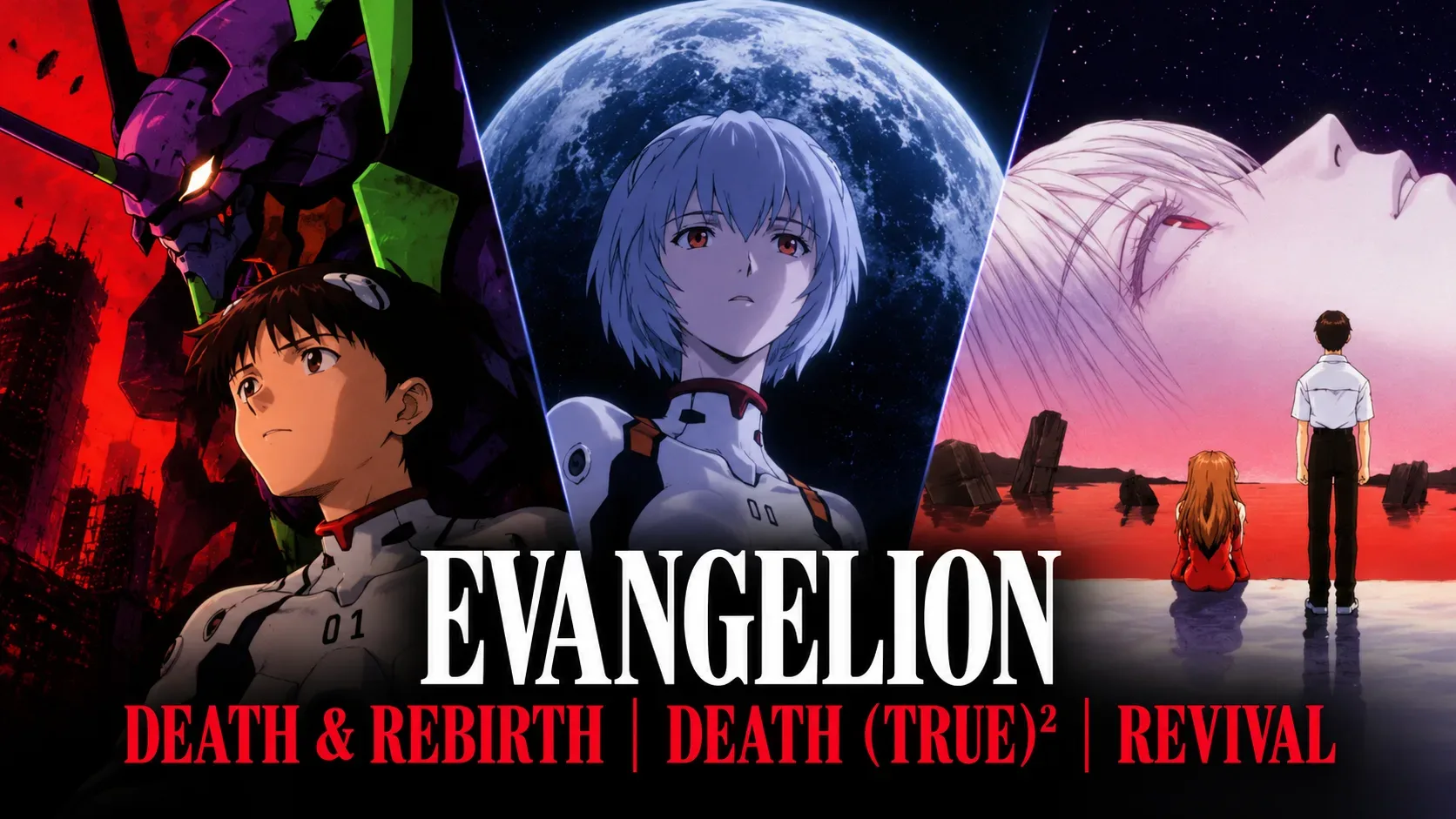
No. Evangelion: Death & Rebirth (1997) pairs a recap of the TV series with part of the upcoming theatrical ending; Death (True)² is another edit of the recap; and Revival of Evangelion (1998) combines that edit with the complete The End of Evangelion. These are different presentations of related material, not three independent endings.
Minor spoiler warning: this comparison identifies the structure of the concluding episodes and where an early edit stops, but does not reveal the characters' fates.
What each 1997-1998 release actually contains
| Release | What it contains | Does it provide a complete ending? |
|---|---|---|
| Death & Rebirth (March 15, 1997) | DEATH reworks episodes 1-24, including material created for that edit; REBIRTH contains only the opening portion of the future theatrical episode 25, Air. | No. The Rebirth segment stops before the story is finished. |
| The End of Evangelion (July 19, 1997) | Theatrical episodes 25, Air, and 26, Magokoro wo, Kimi ni, together forming the cinema ending. | Yes. This is the complete theatrical ending, presented differently from the conclusion of the TV series' 26 episodes. |
| Death (True) (January 1998) | A re-edited DEATH prepared for broadcast by Japan's WOWOW channel. | No. It remains a recap. |
| Death (True)² (1998) | Another revision of DEATH, used in Revival; it revisits events from episodes 1-24. | No. The superscript ² denotes the edit, not a second ending. |
| Revival of Evangelion (March 7, 1998) | Death (True)² followed by Air and Magokoro wo, Kimi ni, or the complete The End of Evangelion. | Yes, because it contains The End of Evangelion, not because it adds a later ending. |
The release sequence and contents are described in the official works overview, the Japanese notice for the return of Revival, and Khara's home-video specifications. Package titles can differ across theatrical, broadcast and physical-media releases; to compare the material, the name of the specific edit matters.
Why Rebirth is not a third ending
The name Rebirth can make it sound like a self-contained movie, but the official description limits it to the first portion of theatrical episode 25. That material was carried forward and developed in The End of Evangelion. Watching Rebirth followed by the finished movie therefore means seeing the start of this arc twice, even though the edits are not necessarily identical in every detail.
The continuation missing from Rebirth is not hidden in Death (True)². It appears in the two theatrical episodes that make up The End of Evangelion. The TV series also has its own conclusion, but these three release names do not create a third ending.
Death, Death (True) and Death (True)²: three edits of the recap
The original DEATH segment, released alongside Rebirth, rearranges events from the first 24 episodes and incorporates additional footage, including a framing device involving characters playing musical instruments. It was then re-edited for WOWOW as Death (True) and revised again as Death (True)². These are different cuts of a retrospective, not three new paths for Shinji.
The distinction also appears in official home-video listings. Khara separately identified DEATH + REBIRTH, DEATH (TRUE) + REBIRTH, and DEATH (TRUE)² + Air / Magokoro wo, Kimi ni. A package simply labeled Death may therefore fail to specify the exact cut. Checking the subtitle of the included material is safer.
Is Revival a new movie or a combination of earlier releases?
Revival of Evangelion is a combined presentation released in 1998. As the official 2020 notice about its return to theaters explains, it joins Death (True)² to the theatrical conclusion first released in July 1997. That is why it is longer and structured differently from a stand-alone recap.
If you have already watched The End of Evangelion, the latter part of Revival does not supply a subsequent narrative ending. What changes is the presentation of the recap before the feature, not the eventual outcome of the story.
What should you watch to avoid repeating footage?
- Want the theatrical conclusion after the TV series? Watch The End of Evangelion. Neither Rebirth nor a recap is required first.
- Want a short refresher before the ending? Choose Death (True)² followed by The End of Evangelion, or watch Revival, which already combines them.
- Already seen Revival? You do not need to rewatch Death (True)² or The End of Evangelion in search of a different ending. The core material was included.
- Interested in the original 1997 release? Watch Death & Rebirth to study those historical edits. Expect overlap with the revised recap and the beginning of Air.
The useful distinction is between a recap and a complete ending. Death (True)² belongs to the former category; The End of Evangelion to the latter; Revival includes both. This comparison covers the Japanese 1997-1998 release history and does not assume that each cut is available on a particular platform in Brazil.