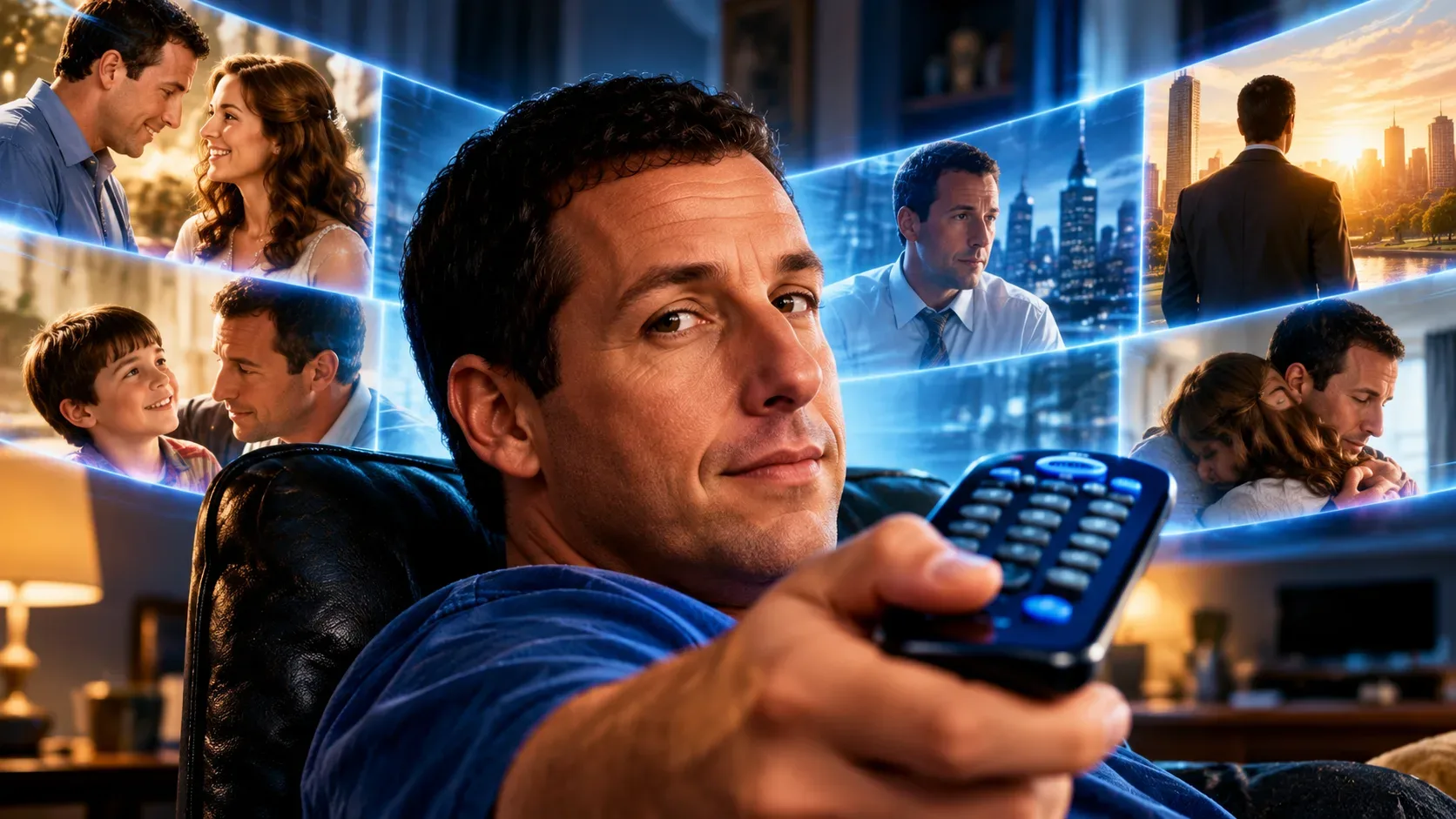
Spoiler warning: this article reveals the entire plot of Click (2006), including its ending.
In Click (2006), Michael Newman tries to speed past life’s unpleasant moments using a magical remote control. He advances his career, but understands the cost only after realizing how much of his family’s life he has skipped. In the theatrical ending, Michael wakes up at the point when he found the device and is given a second chance to live differently.
Directed by Frank Coraci, the film stars Adam Sandler as Michael, Kate Beckinsale as Donna and Christopher Walken as Morty. Its mix of comedy, fantasy and drama turns on one crucial distinction: the future Michael experiences under the remote’s influence and the fresh start shown in the final sequence.
How does Michael Newman’s remote work?
After postponing a family camping trip to please his boss, John Ammer, Michael goes shopping for an ordinary universal remote. In a mysterious department of a Bed Bath & Beyond store, Morty gives him a prototype for free, warning that it cannot be returned.
The device can pause events, mute people and sounds, replay scenes from the past and fast-forward through time. However, rewinding lets Michael watch what already happened, not change earlier decisions. During fast-forward, his body runs on autopilot: other people continue interacting with him, but his conscious mind does not experience that part of his life.
The trap is that the remote learns its owner’s habits. Because Michael routinely skips arguments, illnesses, inconveniences and stretches of work, it starts recognizing similar situations and advancing automatically. Those years do not literally disappear for everyone else: Michael misses living through them consciously, while his autopilot behavior still has consequences.
Click timeline: the major time jumps
The story starts in 2006. This timeline lays out the years encountered along Michael’s accelerated path without mistaking that future for the fresh start disclosed in the last sequence.
| Point in time | What Michael discovers | Consequence |
|---|---|---|
| 2006, beginning | Work takes precedence over the camping trip and time with Donna, Ben, Samantha and his parents. | He accepts the remote and begins skipping everyday annoyances. |
| 2007 | After asking to reach his promotion, he wakes roughly one year later. | His career has progressed, but his marriage is strained and the family dog, Sundance, has died. |
| 2017 | An automatic jump of about ten years finds him wealthy, with teenage children and separated from Donna. | His former wife is dating Bill; Michael has missed family milestones and never finished the treehouse. |
| 2023 | After another six-year leap, he wakes in a hospital and learns about serious health problems. | Donna has married Bill; Ben now works at the company, and Michael learns that Ted died in 2021. |
| 2029 | The remote takes him to Ben’s wedding; Michael suffers a heart problem and is hospitalized. | On learning that Ben would sacrifice his honeymoon for work, he tries to stop the cycle. |
| 2006, new start | He wakes in the store before receiving the device and reunites with his family. | He chooses time together, finds the remote with Morty’s note and throws it away. |
The intervening dates are stages in the future Michael travels through, not a sequence the final act declares inevitable. The year 2021 matters in particular: it marks Ted’s death, which Michael only learns about later.
Why is the scene with Michael’s father so important?
After learning Ted has died, Michael wants to rewind to the farewell, but the feature cannot take him to a moment in which he was not present. Instead, he replays his last encounter with his father. Focused on work, he coldly brushed off Ted’s attempt to spend time together.
The scene does not rewrite the past. Michael can only witness his indifference and understand that he traded an irreplaceable relationship for tasks he considered urgent. At the cemetery, Morty reveals that he is the Angel of Death. This helps explain his role in Michael’s fate, but it does not mean Morty caused every bad choice the architect made.
Ending explained: did Michael die or get a second chance?
At Ben’s wedding, Michael confronts how far he has drifted from his family. After a heart attack, he is taken to hospital. Although seriously weakened, he follows his son outside when he learns Ben intends to delay his honeymoon for work. Michael collapses in the rain in front of his family and urges Ben to put his family first. In that future, the sequence depicts Michael’s death.
The theatrical movie does not end with that death. Michael wakes up on a bed in Bed Bath & Beyond, back in 2006, shortly before meeting Morty. He visits his parents, shows affection to Donna and the children, and restores plans to spend time together. Initially, he believes it was all a dream.
Back home, however, the remote turns up with a note from Morty indicating that he knows about the experience and trusts Michael to make the right choice. Michael throws the remote in the trash, and this time it does not return to his hand. This distinguishes the ending from an ordinary inconsequential dream: within the film’s fantasy logic, an intervention has given him a genuine opportunity to choose differently.
What does the film establish, and what is interpretation?
What is shown: the remote takes over automatic decisions; Michael witnesses years he let pass, suffers losses and dies along that path; he then awakens at the starting point, finds the note and rejects the device. What the creators explained: in a SYFY Wire interview published on June 23, 2026, members of the filmmaking team describe the experience as a vision provided by Morty to offer Michael a second chance.
Editorial interpretation: the remote represents the temptation to treat difficulties and relationships as disposable parts of a video. Professional success itself is not the problem; using work as a reason to disengage from life is. Michael’s last decision does not erase the years he witnessed. It shows that he does not have to repeat them.
Was there a different ending for Click?
Yes, but it is not the ending of the theatrical release. In the oral history published by SYFY Wire in 2026, director Frank Coraci and screenwriter Steve Koren explain that a cut shown to test audiences had Michael die for real and arrive in a version of Heaven resembling his home, where he met his father again.
According to the filmmakers, test audience responses led the team to reshoot the ending so Michael could remain alive. That resolves a frequent point of confusion: the death in the rain is part of the future shown by the remote, while the released movie ends with a return to the beginning and a second chance. The heavenly ending belongs to the alternative cut described by the creators, not to the events of the released version.