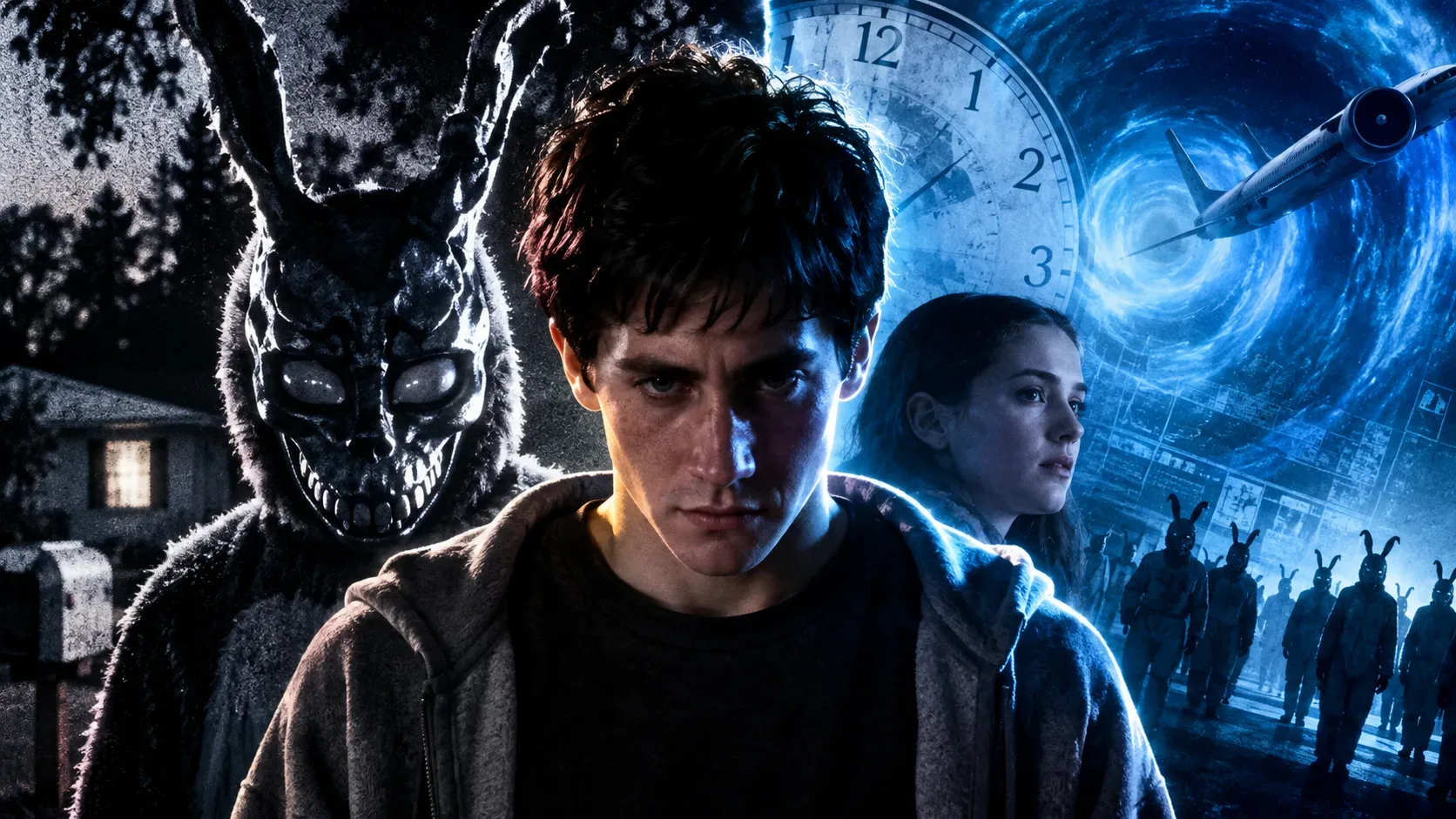
The 2004 Director's Cut of Donnie Darko does not replace the ending of the 2001 film. Its biggest change is how the story leads viewers there: writer-director Richard Kelly inserted explanations from the fictional book The Philosophy of Time Travel, restored character material and rearranged songs. The theatrical cut puts more weight on the puzzle; the expanded edition offers a more explicit science-fiction framework without eliminating all ambiguity.
Spoiler warning: the comparison below reveals plot developments, Frank's identity and the ending of both cuts.
2001 and 2004: two cuts of the same story
According to 20th Century Studios, Donnie Darko opened commercially in the United States on October 26, 2001. Its theatrical running time is approximately 113 minutes. The Director's Cut appeared in 2004 and was registered at 134 minutes by the Australian classification authority. That is a difference of roughly 20 minutes; exact runtimes may vary slightly across copies and catalog records.
Arrow Films released a 4K restoration presenting both cuts on separate discs, supervised by Kelly and cinematographer Steven Poster. The release demonstrates that the 2004 edition did not officially replace the 2001 film. In later interviews, Kelly argued that the two viewing experiences should coexist.
The differences, side by side
| Element | Theatrical cut (2001) | Director's Cut (2004) |
|---|---|---|
| Approximate runtime | 113 minutes | 134 minutes in the Australian classification record |
| Time-travel information | Roberta Sparrow's book appears in the story, but its rules are not laid out through equivalent explanatory pages. | On-screen passages from The Philosophy of Time Travel make the Tangent Universe rules more explicit. |
| Characters and scenes | Family relationships and parts of the classroom storyline are more condensed. | Restores material involving Donnie's parents, teacher Karen Pomeroy and other interactions, including a disclosure about his pills. |
| Opening song | The Killing Moon by Echo & the Bunnymen. | Never Tear Us Apart by INXS. |
| Party sequence | Under the Milky Way by The Church is prominent in this part of the sequence. | The Killing Moon returns at a different point, connected with the party; the choices and placement of songs are rearranged. |
| Ending | Donnie dies after the return to the original timeline. | The essential ending is unchanged, but the surrounding explanation is expanded. |
Why does the time travel seem easier to understand?
In the theatrical cut, Donnie receives a book attributed to the mysterious Roberta Sparrow from his teacher. Viewers know that the text matters but must infer many of the rules behind his visions, the jet engine and Frank's countdown. In the 2004 edition, pages from the book appear on screen, framing the narrative through a more openly described time-travel system.
The passages describe an unstable Tangent Universe branching away from a Primary Universe. The engine becomes the displaced object that needs to be returned, while Donnie serves as the receiver tasked with restoring the order of events. Frank can consequently be understood through the universe's rules rather than solely as a possible hallucination. That is the explanatory model presented in the cut, not scientific proof or the only permissible interpretation of every image.
In a 2004 Fresh Air interview, Kelly said the Director's Cut more clearly expressed his science-fiction intentions. In the same conversation he acknowledged that ambiguity was built into the film. The extended version therefore provides a more direct way to read the story, not a definitive answer to every question about where the phenomenon originated.
Does Donnie Darko have a different ending?
No. After the events in the Tangent Universe, the story returns to the point when the engine crashes into Donnie's bedroom. This time he remains in bed and dies; the final sequence suggests emotional traces of what happened among those who survive. The 2004 cut does not give Donnie a different fate or substitute an alternate finale.
What changes is the context. The added book pages provide a clearer causal framework for returning the engine to the original timeline and for Donnie's sacrifice. The reading that he helps prevent the collapse of an unstable reality now has more textual support within the film itself. Kelly told Fresh Air that the ending was unchanged, and in an interview with Dread Central he described some of his cosmological explanations as possible theories rather than exclusive answers.
Why was The Killing Moon removed from the opening?
The clearest musical switch happens within the first few minutes. Donnie's bicycle ride is accompanied by The Killing Moon by Echo & the Bunnymen in the 2001 cut, but by Never Tear Us Apart by INXS in the 2004 version. The Echo & the Bunnymen song was not simply erased; it moved to a passage around the party, which also has different musical sequencing.
Kelly explained the reason in a July 2004 Campus Circle interview. He said the opening had originally been planned around Never Tear Us Apart, but music-licensing costs and budget constraints during the original production and release led to changes. The Director's Cut allowed him to revisit that intention and adjust the sound design. This is the filmmaker's account of his creative intentions, not proof that one pairing is objectively superior.
What additional scenes actually matter?
Restored material gives more attention to Donnie's relationship with his parents, teacher Karen Pomeroy's role and discussions of Watership Down in class. Visual additions include close-ups of Donnie's eyes and other effects emphasizing changes in his perception. Kelly told Dread Central that he had wanted these dramatic threads to connect more closely with the ideas in the time-travel book.
One particularly consequential addition is the disclosure that the pills prescribed to Donnie by his therapist are placebos. This weakens a possible reading of the film as solely an account of a psychiatric condition. It is not, however, a general medical claim about real mental disorders. It is a scripted narrative detail and part of the interpretation Kelly outlined in interviews.
Which cut should you watch first?
Richard Kelly has offered his own recommendation: in an interview with Nightmare Magazine, he advised watching the theatrical cut first and using the Director's Cut to explore more of the book and character relationships. He also told Slant Magazine that the longer version should feel like an extended remix, not a competitor that makes the original obsolete.
The choice is ultimately about storytelling. The 2001 cut relies more on implication, while the 2004 cut foregrounds some of its rules, restores smaller dramatic connections and changes the film's musical identity. Both tell the same tragedy, but they guide the audience through it differently.
Sources and references
- 20th Century Studios
- Arrow Films: Donnie Darko 4K UHD
- Australian Classification: Director's Cut
- SYFY Wire: theatrical cut versus director's cut
- Fresh Air: entrevista com Richard Kelly
- Campus Circle: entrevista com Richard Kelly em 2004
- Dread Central: entrevista com Richard Kelly em 2004
- Nightmare Magazine: entrevista com Richard Kelly
- Slant Magazine: entrevista com Richard Kelly
- IMDb: Donnie Darko FAQ (soundtrack comparisons)