Full spoilers for Episode 12 of Season 1 of Delicious in Dungeon (Dungeon Meshi). This explanation reveals Falin’s condition and Marcille’s decision.
Falin could not simply be taken to the surface because the Red Dragon had destroyed almost all of her body. In Episode 12, "Red Dragon II" ("炎竜2" in Japanese), Marcille explains that the bond between Falin’s soul and her remains has become so fragile that moving them could sever the connection needed for resurrection. The safer course at that point was to try to revive her where she lay, inside the dungeon.
Why did Falin’s condition make moving her dangerous?
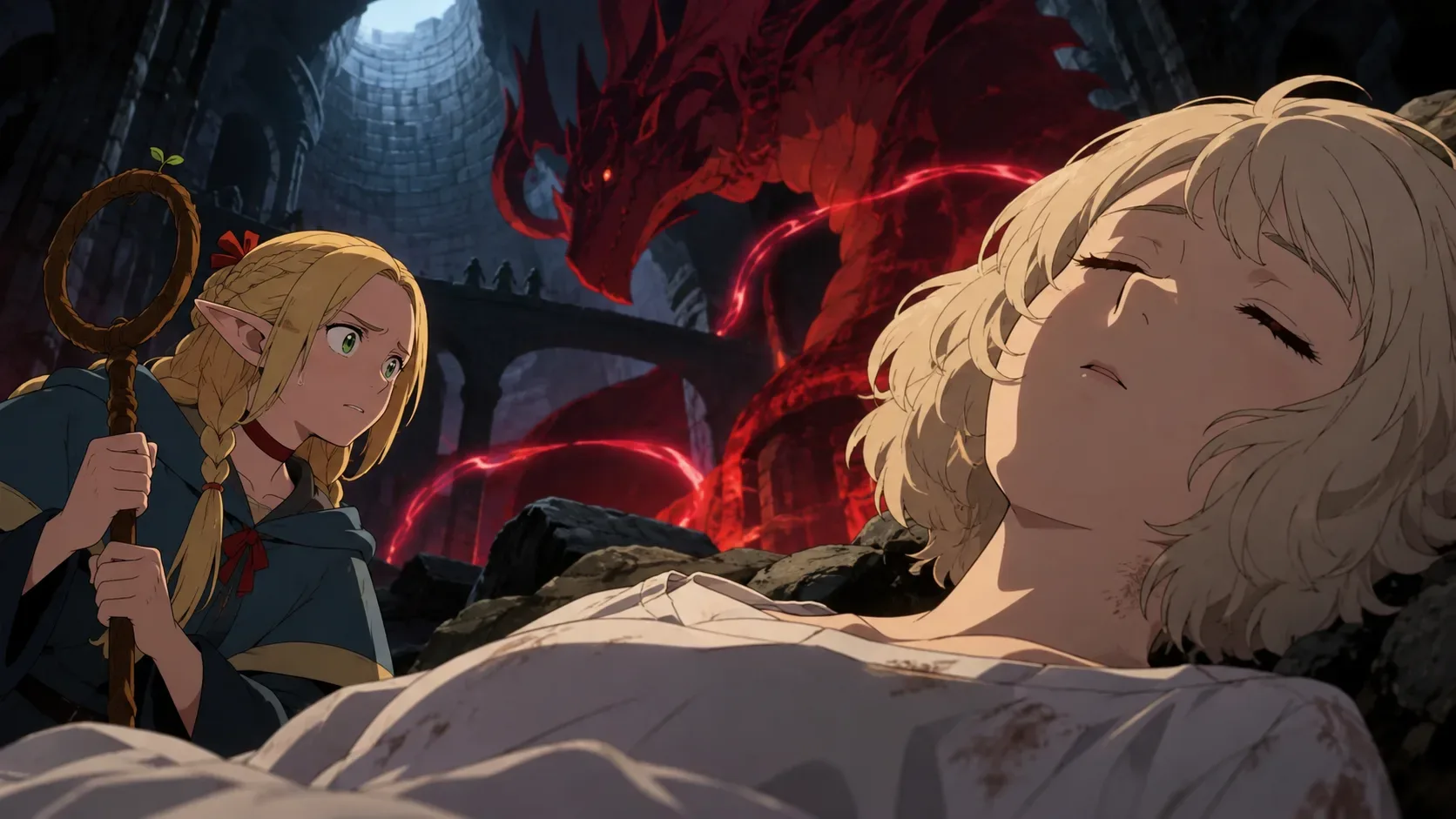
After defeating the Red Dragon, Laios and his companions find Falin’s bones mixed with the remains of other creatures the monster had swallowed. Their rescue plan changes immediately. It is no longer a matter of getting Laios’s sister out of the dragon and finding help aboveground.
The anime’s official Episode 12 synopsis makes the causal link explicit: because Falin’s body has been reduced to bones, its connection to her soul is tenuous, making it difficult to take her to the surface. The obstacle is not the weight of the bones or a physical barrier at the dungeon exit. It is the risk of losing the connection resurrection still depends upon while transporting her remains.
Why not bring in a resurrection specialist?
Laios initially considers taking the remains to the resurrection office. Marcille objects to moving them, leaving the option of bringing a specialist down instead. That would mean repeating a long journey while Falin remained in a precarious state. Nubia Brice’s account at Ready Steady Cut and JP Kristov’s analysis for Anime Corner both underline how impractical the distance made that alternative.
There is also the problem of rebuilding the missing tissue. Restoring so much of Falin’s body requires organic material, and keeping enough of it fresh during another journey down from the surface would complicate matters. The episode therefore presents two separate obstacles: the danger to the soul-body bond, and the logistics of securing help and replacement material in time. They should not be collapsed into one universal rule.
How did Marcille revive Falin on the spot?
Marcille reveals that she specializes in ancient magic, a practice the others regard as forbidden. With Laios’s approval, despite the group’s objections, they sort and reassemble Falin’s bones. To replace the missing body mass, they use meat from the Red Dragon itself. Marcille performs the ritual at the site, and Falin comes back to life.
The dragon meat is a solution to the circumstances, not evidence that every resurrection must use dragon flesh. Charles Hartford’s review at But Why Tho? likewise describes the ritual’s immediate success and the anxiety surrounding forbidden magic. The episode documents what the party did to save Falin, not an unrestricted formula applicable to any corpse or spell.
What does the episode establish, and what remains an assumption?
The supported conclusion is narrow: the extreme destruction of Falin’s body weakened its link to her soul; moving the remains was risky; reviving her where she was avoided that immediate danger. Marcille’s magic and the dragon’s flesh made that option possible in this particular situation.
This does not establish that no dead person can ever be carried out of a dungeon, that every resurrection follows identical conditions, or that ancient magic is without consequences. Those broader claims go beyond what Episode 12 establishes on its own.
Sources and references
- Official Dungeon Meshi anime website: Episode 12 synopsis, Red Dragon II
- Anime Corner, JP Kristov: Episode 12 analysis (March 27, 2024)
- But Why Tho?, Charles Hartford: Episode 12 review (March 21, 2024)
- Ready Steady Cut, Nubia Brice: Episode 12 recap (March 21, 2024)
- Netflix Spain: the localized title Tragones y mazmorras