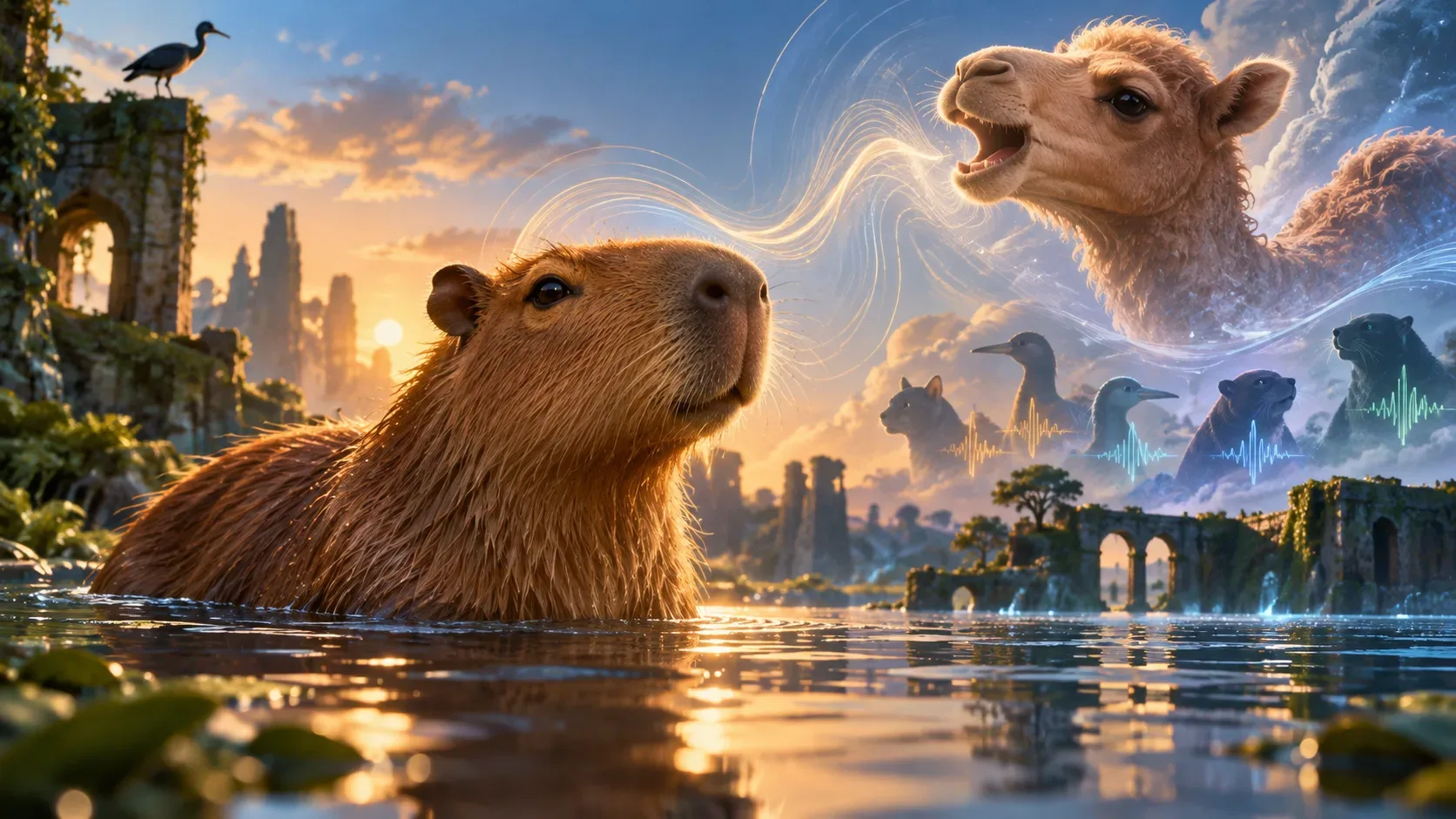
The capybara in Flow (2024) sounds like a baby camel because recordings of a real capybara did not suit the character's laid-back personality. According to Latvian director Gints Zilbalodis, the animal's actual call was too high-pitched and anxious for the peaceful impression he wanted. The filmmakers chose a different species' vocalization to make the character more believable, not because they were uninterested in authentic animal sounds.
That choice offers a way into the film's dialogue-free storytelling. In Flow, meows, barks, breathing, silence, and physical movement do the work usually assigned to spoken lines. Sound designer Gurwal Coïc-Gallas built this soundscape from real recordings, although the species heard does not always match the one seen on screen.
Why did the real capybara recording fail?
The difficulty began when Coïc-Gallas tried to record a capybara at a zoo. The animal was reluctant to vocalize. As the sound designer told Vulture, a keeper tickled a young capybara to coax an audible response. The noise turned out to be considerably shriller than the filmmakers expected.
Zilbalodis likened the result to a small dog's yapping in his interview with CEE Animation. Speaking to Slant Magazine, he explained that the character needed to feel calm and relaxed. The authentic capybara recording instead suggested nervousness. Changing the recording's pitch was considered, but the filmmakers eventually searched for another animal.
Zilbalodis and Coïc-Gallas told Vulture that they also considered a moose and a llama. Their solution was a recording of a baby camel found in a sound library. Coïc-Gallas stressed that he had not recorded that camel himself and did not know exactly where the library recording originated. It is therefore accurate to say the capybara uses a baby camel's sound, but not to claim that the crew necessarily brought a camel into a studio or zoo for the film.
Where did the other animals' voices come from?
The interviews reveal a mix of species-specific recordings, contributions from other animals, and constructed effects. The capybara is not simply the sole instance of a 'fake' voice in an otherwise literal soundtrack. The filmmakers relied on real animal material and physical sound effects rather than human actors impersonating the creatures.
| Animal or element | Documented sound source | Production decision |
|---|---|---|
| Capybara | A baby camel recording from a sound library | Replace the real capybara's shrill call with a sound that better conveys its peaceful nature. |
| Black cat | Recordings of sound designer Gurwal Coïc-Gallas's own cat | Use real feline meows; the cat stopped vocalizing around microphones, so he hid one by its food bowl. |
| Dogs | Recordings of actual dogs, often matching the breeds shown | Zilbalodis specifically names the shiba inu and retriever as examples of breed-matched sounds. |
| Lemur | Lemur recordings supplemented with calls from a small monkey | Broaden the vocal range of a character more talkative than the available lemur sounds allowed. |
| Secretary bird | Another bird recording; the replacement species was not named | Avoid making the already imposing character sound excessively frightening. |
| Whale-like large animal | Tiger breathing, lowered in pitch | Create convincing breathing without recording an actual whale. |
Coïc-Gallas also described making an underwater fish effect by moving compressed air through water near a microphone. That was an invented aquatic effect, not a claim that another species provided a fish's voice. Likewise, the monkey sounds used for the lemur and tiger breathing used for the whale do not mean that every animal in Flow was voiced by a different species.
Why did naturalism matter more than exact reproduction?
Zilbalodis wanted the animals to behave in recognizable ways. In the CEE Animation interview, he called the approach naturalism rather than photorealism. The animators studied real animals and built their performances by hand without motion capture. Sound followed the same principle: a recording had to suit a character's temperament and the scene, rather than meet a strict documentary standard.
The capybara makes the distinction especially clear. Zilbalodis described it to CEE Animation as something like a mentor, already at ease with the world. In his Sloan Science & Film interview, he explained that the animal represents peace amid the other characters' anxieties. A biologically accurate call that sounded distressed would work against that idea. A camel calf's sound, although belonging to another animal, communicated the intended feeling better.
It also shows why dialogue-free does not mean silent. Zilbalodis told Slant Magazine that he wrote character attitudes and intentions rather than literal conversations, relying on sound, framing, lighting, editing, and animation to carry meaning. In the CEE Animation interview, he and co-producer Gregory Zalcman explained the importance of reducing the mix: quiet passages help the more intense moments stand out.
What does this detail tell us about Flow?
The baby camel was not recruited to make the capybara speak like a human. It solved a specific sound-performance problem: expressing calm through an animal that seldom makes noise. The documented choices for the cat, dogs, lemur, bird, and whale show that the same goal shaped different solutions. In Flow, authenticity is less about matching every recording to the precise species on screen than about making the animals' emotions understandable without words.
Sources and references
- CEE Animation, Gert Hermans's interview with Gints Zilbalodis and Gregory Zalcman
- Slant Magazine, Marshall Shaffer's interview with Gints Zilbalodis
- Vulture, Alejandra Gularte's interview with Gints Zilbalodis and Gurwal Coïc-Gallas
- Sloan Science & Film, Nicolas Rapold's interview with Gints Zilbalodis