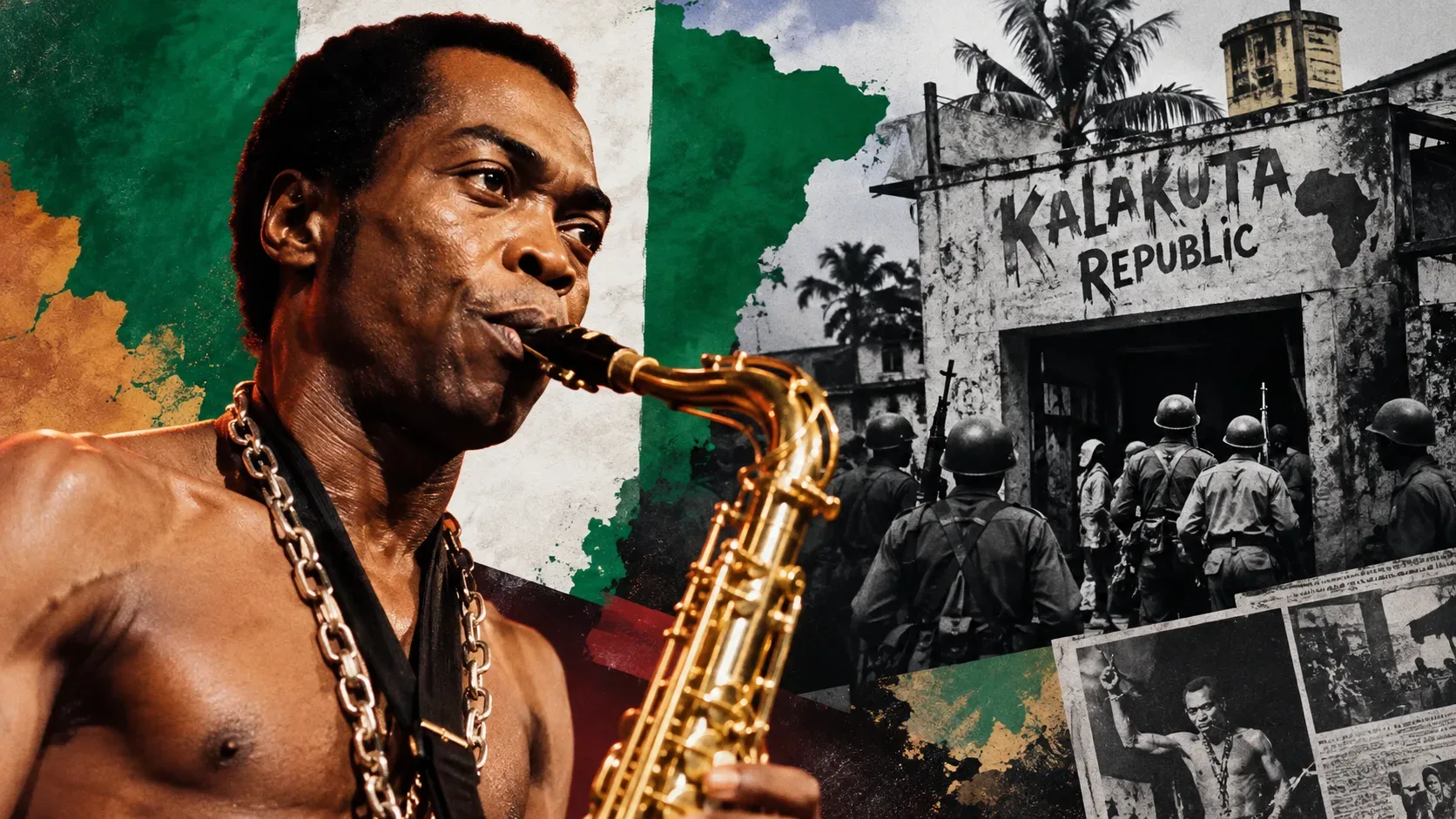
The song Zombie, by Fela Kuti and his band Afrika 70, confronted Nigeria’s military by comparing soldiers who obeyed orders automatically to people acting without independent thought. Its satire targeted abuses of power in a country under military rule. On February 18, 1977, troops destroyed Kalakuta Republic, a community in Lagos associated with the musician, in an assault that affected Fela, its residents, and his mother. The song intensified the confrontation, but hostility between the artist and the authorities had begun years earlier.
The estate’s documentation places Zombie in the story of 1976 while also dating the album 1976/1977. That dual designation does not establish an exact release date. Understanding the connection to Kalakuta requires separating the song’s meaning, the accumulated political tensions, and the events whose dates are documented.
What Zombie said about the military
Fela turned familiar military commands, including marching, saluting, and carrying out violent orders, into a succession of provocations answered by female voices with the word zombie. The satirical image suggests people obeying without considering the consequences. There is no need to reproduce the lyrics at length to identify the target: military discipline portrayed as mechanical submission.
The criticism was aimed at violence and blind obedience within the military establishment, rather than a literal description of every Nigerian soldier. As an interpretation, the metaphor also invites questions about individual responsibility when carrying out orders. The official catalogue describes the work as an attack on the army’s abuse of power.
Why the conflict predated the song
Kalakuta Republic was a place for living, community, and musical work. The Shrine, meanwhile, was Fela’s performance venue in Lagos. They were separate places, although part of the same cultural and political project. According to the official catalogue, the regime had already taken exception to his denunciations in records such as Alagbon Close (1974), Kalakuta Show (1975), and Ikoyi Blindness (1976).
In 1976, Fela became more involved with the Young African Pioneers. Late that year, he responded to a government traffic operation in which soldiers attacked motorists by calling it Operation Beat The Nation. In January 1977, he condemned FESTAC as government propaganda, withdrew from the event, and staged his own programme at the Shrine. His public opposition therefore extended far beyond a single record.
Timeline: from Zombie to the destruction of Kalakuta
- 1976: the official chronology places Zombie after Ikoyi Blindness; the album catalogue uses the broader designation 1976/1977.
- Late 1976: Fela criticizes a military-enforced traffic operation amid escalating friction with the authorities.
- January 15, 1977: FESTAC begins. Fela rejects its political use and organizes alternative events at the Shrine.
- February 16, 1977: filming ends on the docudrama The Black President. Its soundtrack, kept at Kalakuta, is destroyed in the raid two days later.
- February 18, 1977: according to the official chronology, approximately one thousand soldiers attack and devastate Kalakuta Republic.
- Second half of 1977: with the Shrine forcibly closed and other venues intimidated, Fela and Afrika 70 perform in Ghana.
- April 13, 1978: the musician’s mother, Funmilayo Ransome-Kuti, dies from injuries sustained in the attack.
What happened in the February 18, 1977 attack
According to the estate’s chronology, soldiers stormed Kalakuta, set it ablaze and destroyed it, beat and arrested Fela, and assaulted residents. The same source documents sexual violence against residents and says that Funmilayo, then 77, was thrown from a second-floor window. The government also shut down the Shrine. This was an assault on people and on spaces for creative work and communal life, not simply a ban on performing a song.
In an interview published by The Guardian in January 2026, graphic artist Lemi Ghariokwu recalls reaching the compound while the assault was under way and seeing injured victims. He also makes clear that he did not witness Funmilayo’s fall. His account helps convey the destruction, but it should not be treated as a court ruling or as eyewitness evidence of every event.
Consequences for Fela’s career and music
The destruction of Kalakuta wiped out property and recordings, including the stored soundtrack for The Black President. With the Shrine closed and other venue owners under pressure, Fela faced obstacles to performing in Nigeria and took his band to Ghana in the second half of 1977. The repression thus affected his ability to work and travel as a performer.
During the same period, the album Sorrow, Tears and Blood appeared on Kalakuta Records. An important distinction matters here: according to the official chronology, its title song responds to the repression of the 1976 Soweto uprising in South Africa, whereas the album sleeve is dedicated to the victims of the Kalakuta attack. In February 1978, a Lagos court dismissed Fela’s damages claim against senior army officers, the estate reports.
Did Zombie alone cause the military retaliation?
It is not possible to establish that a single song, by itself, explains the raid. The estate’s accounts explicitly connect Zombie with the regime’s violent response, but also document an earlier sequence of criticism, clashes, and political confrontations. The connection between music and retaliation is strong in historical accounts; attributing every motive behind the operation to one composition would flatten the chronology.
KCRW presenter Tom Schnabel described, in a 2011 article, an interview he conducted with Fela in 1986. He recalled the musician’s explanation of the satire against soldiers and the violence at Kalakuta. This is an identified retrospective account, not an independent judicial investigation into the chain of command behind the assault.
The sources themselves require care over dates: KCRW’s article says Funmilayo died eight days after being attacked, while the official chronology gives April 13, 1978, more than a year after the raid. This article follows the estate’s date while making the discrepancy explicit. The verifiable sequence remains clear: musical protest in 1976, escalating confrontation, the February 1977 attack, and consequences that continued into 1978.