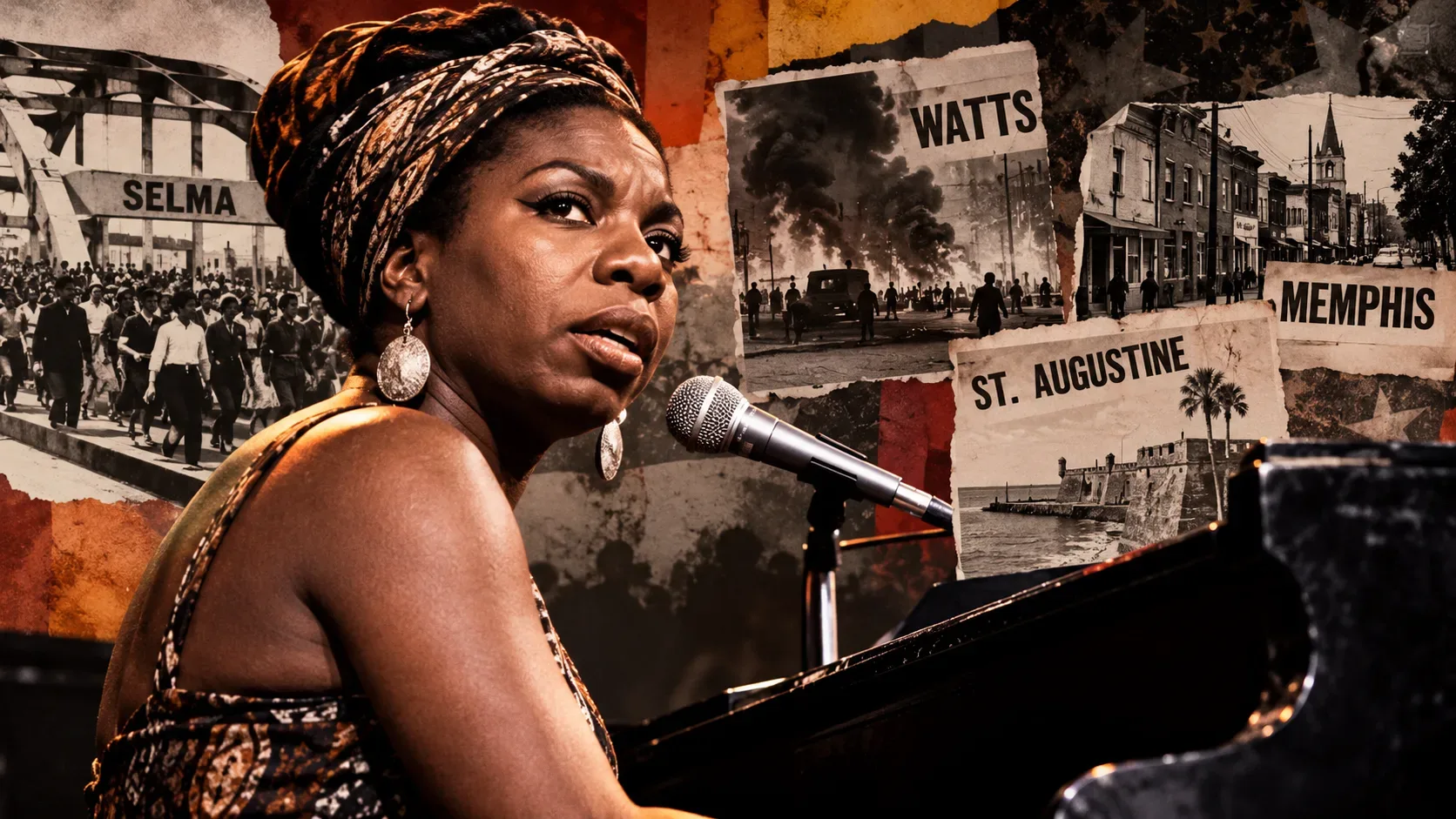
Nina Simone changed the place name in Mississippi Goddam to connect the song with the latest developments in the United States civil rights struggle. In documented performances, the original reference to Tennessee gave way to St. Augustine, Selma, Watts and Memphis. These were live adaptations of the same composition, not four newly issued official songs.
The dates matter: the Watts uprising took place in 1965, but the performance identified by the Library of Congress for that substitution was at the 1966 Newport Jazz Festival. Similarly, Memphis referred to Martin Luther King Jr.'s assassination on April 4, 1968, while the documented performance occurred three days later.
The original song and the 1964 recording
Simone wrote Mississippi Goddam in 1963 after the bombing of the 16th Street Baptist Church in Birmingham, Alabama, which killed four Black girls. The murder of civil rights activist Medgar Evers in Mississippi was also part of the racial injustice and outrage described by the Library of Congress. The song's original text named Alabama, Tennessee and Mississippi.
The Philips album Nina Simone in Concert, released in 1964, preserved a performance of the song recorded at Carnegie Hall in New York. Simone's official archive lists album sessions in March and April of that year. The LP provides a reference point for hearing the subsequent changes, although the composition itself dates back to 1963.
Timeline of the place names: event and performance
The timeline below separates the date of each historical event from the performance in which a change was documented. The new location replaced Tennessee in one specific passage; it did not necessarily remove the other locations from the song.
| Place and historical event | Documented performance or recording | Change to the place name |
|---|---|---|
| St. Augustine, Florida: protests against segregation in 1964 | September 10, 1964, on Steve Allen's television show | Replaced Tennessee with St. Augustine. |
| Selma, Alabama: attacks on marchers on March 7, 1965, and the voting-rights campaign | March 1965, performance for march participants in Montgomery | Replaced Tennessee with Selma. |
| Watts, Los Angeles: uprising of August 11-16, 1965 | July 2, 1966, Newport Jazz Festival, Rhode Island | Replaced Tennessee with Watts; the event was in 1965, but this documented performance was in 1966. |
| Memphis, Tennessee: assassination of Martin Luther King Jr. on April 4, 1968 | April 7, 1968, Westbury Music Fair, Long Island | Replaced Tennessee with Memphis and paused the song to address the audience. |
What was happening in each place?
In St. Augustine, activists challenged segregation in public facilities and services. The National Park Service documents demonstrations, arrests and violence in 1964. The Library of Congress places Simone's reference to the city in the September 10, 1964 edition of Steve Allen's television show, during which the word deemed offensive in the title was also censored on air.
Selma had become a symbol of the struggle for voting rights. On March 7, 1965, law enforcement officers attacked peaceful demonstrators on the Edmund Pettus Bridge, an event known as Bloody Sunday. The successful march reached Montgomery on March 25; Simone performed for activists in Alabama's capital that month and used Selma instead of Tennessee.
In Watts, tensions surrounding policing and racial inequality culminated in six days of unrest in August 1965. PBS discusses the substitution in connection with those events, whereas the Library of Congress essay identifies a performance using Watts at the Newport Jazz Festival the following year. Simone's official store confirms that she sang the song at Newport on July 2, 1966.
Memphis became an immediate reference to the death of Martin Luther King Jr., who was assassinated in the city on April 4, 1968. At Westbury Music Fair on Long Island on April 7, Simone replaced Tennessee with Memphis and added remarks to the audience over a continuing drumbeat. Her official archive dates the concert to that day.
Did these changes produce different recordings or compositions?
Each new city name should not be mistaken for the release of a separate song or a permanent revision of the studio lyrics. The historical documents describe performance choices that responded to unfolding news and to the audience present. Mississippi Goddam remained the same composition, but its geographical references could change.
There is also an important discographical distinction. The original 1968 LP 'Nuff Said! documented the Westbury concert, but Simone's official archive lists Mississippi Goddam among the tracks added to the expanded 2003 edition. A recording from that performance using Memphis therefore does not mean the track was included on the original LP.
Author Nadine Cohodas also describes a performance in Montreal toward the end of 1980 in which Simone improvised references to the world and to the US presidential election. This further documents her practice of updating the performance, without demonstrating that every substitution was used at every later show.
How to compare the versions without mixing up dates
Start with the 1964 recording on Nina Simone in Concert, then consider the September 1964 television performance, the March 1965 appearance in Montgomery, the July 1966 Newport recording and the April 1968 Westbury concert. Not all of these performances have equally accessible audio, and a historical account of a performance is not the same thing as confirmation of a commercial release.
The pattern makes the purpose of the changes clear: each new place name moved the song's protest toward another concrete episode in American history. What matters is keeping apart the event being invoked, the performance in which it was invoked and the record edition that later preserved, or did not preserve, that interpretation.
Sources and references
- Library of Congress: Nadine Cohodas's essay on Mississippi Goddam
- Nina Simone official archive: Nina Simone in Concert album
- PBS American Masters: history and changing lyrics of Mississippi Goddam
- National Park Service: civil rights struggle in St. Augustine
- National Park Service: Selma and the march to Montgomery
- Martin Luther King, Jr. Research and Education Institute: Watts Rebellion
- Nina Simone official store: recording of the 1966 Newport Jazz Festival
- Martin Luther King, Jr. Research and Education Institute: King's assassination in Memphis
- Nina Simone official archive: 'Nuff Said! album and expanded edition
- Nina Simone official archive: 1968 performances