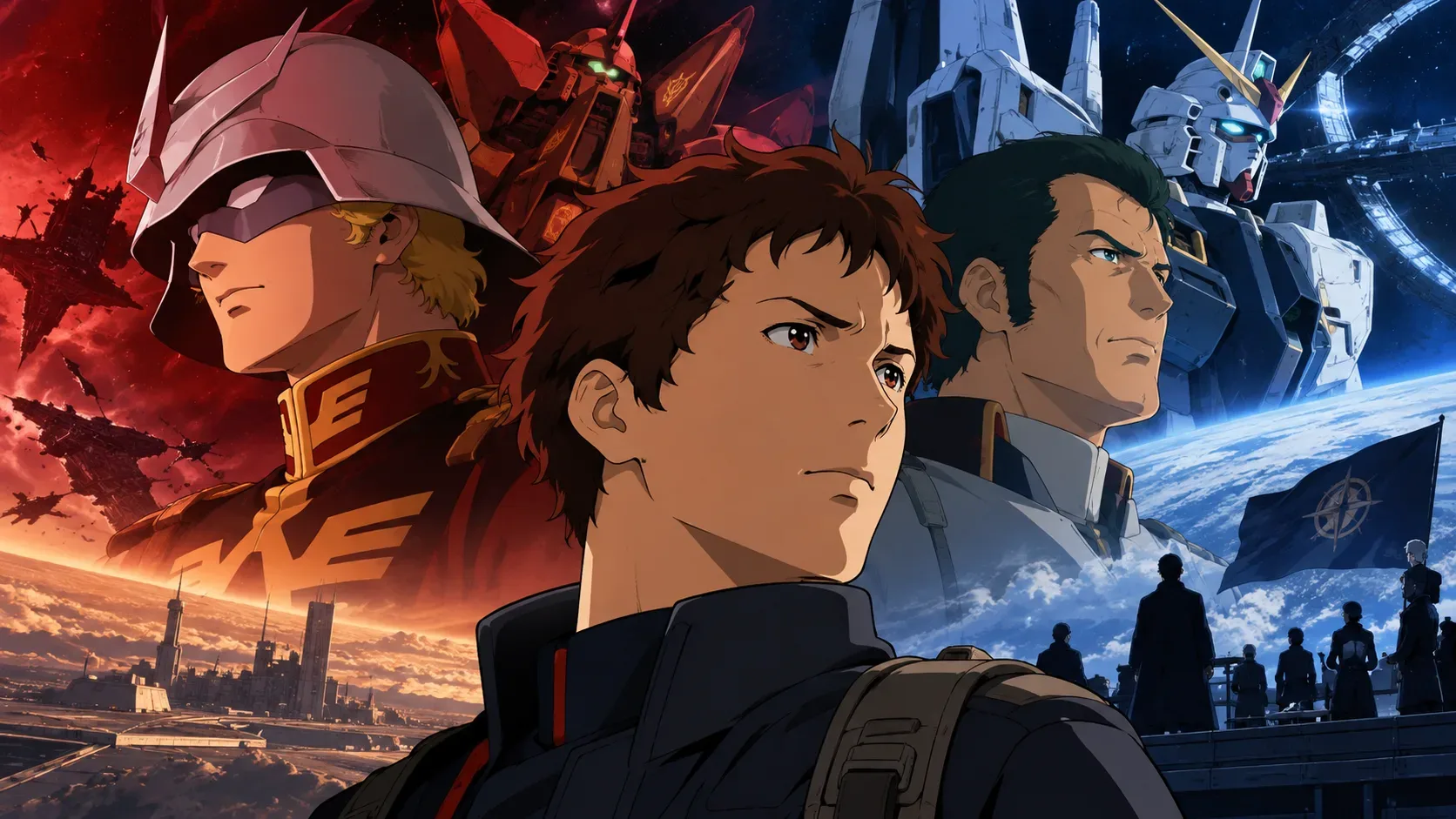
Char’s Rebellion explains why Hathaway Noa grew up scarred by war; Bright Noa explains the family contradiction he carries. In U.C. 0093, Hathaway witnessed the conflict between Char Aznable and Amuro Ray while his father commanded Federation forces. In U.C. 0105, twelve years later, the officer’s son secretly operates as Mafty Navue Erin, leader of an armed campaign against that same federal government. This gap, rather than a connection to an alternative Gundam timeline, underpins the Hathaway films.
Spoiler warning: the following sections reveal major events from Mobile Suit Gundam: Char’s Counterattack (1988) and the premise of the first Mobile Suit Gundam Hathaway (2021). They do not disclose the second film’s ending.
U.C. 0093 to U.C. 0105: the 12 years connecting the stories
U.C. stands for Universal Century, the calendar used by Gundam’s original continuity. The 1988 film takes place in U.C. 0093 during the Second Neo Zeon War, also called Char’s Rebellion. The first Hathaway and its follow-up place the next crisis in U.C. 0105. These are in-universe years, not release dates: the first film in the new series came out in 2021 and its second chapter, The Sorcery of Nymph Circe, in 2026.
| Year in the story | Why it matters to Hathaway |
|---|---|
| U.C. 0093 | Bright commands Londo Bell against Neo Zeon; Hathaway meets Quess Paraya and undergoes a traumatic experience amid the confrontation between Amuro and Char. |
| U.C. 0105 | The Federation faces Mafty’s campaign. An adult Hathaway hides his role as the movement’s leader while the government intensifies repression and the forced removal of civilians from Earth. |
Gundam’s official website explicitly places the stories twelve years apart, and the studio itself paired Char’s Counterattack with the second Hathaway film for a double feature branded U.C. 0093-0105. There is no need to invent an intervening war to fill that gap.
What happened to Quess, Chan, Amuro and Char?
In Char’s Counterattack, Char rebuilds Neo Zeon and tries to force humanity to leave Earth, even threatening to drop the asteroid Axis onto the planet. Londo Bell, commanded by Bright and including Amuro among its pilots, works to prevent the disaster. Hathaway, still a teenager, meets Quess Paraya and becomes emotionally attached to her. Quess eventually gravitates toward Char and joins the war as a pilot.
In the 1988 theatrical version, Chan Agi strikes Quess’s mobile suit, killing Quess as she protects Hathaway. Distraught, Hathaway fires on Chan and kills her. The effort around Axis prevents it from falling to Earth, while Amuro and Char disappear amid the phenomenon associated with the psycoframe. For Hathaway, Char’s Rebellion was more than a political event: it involved losing Quess and committing an act of violence himself. The newer film’s official synopsis explicitly describes him as haunted by an old trauma.
Bright Noa: why the commander’s son matters
Bright is more than a recognizable franchise name. A veteran of the One Year War and commander of Londo Bell in U.C. 0093, he represents the institutional continuity of Federation forces. Hathaway is his eldest son with Mirai Yashima, also known as Mirai Noa. Gundam’s official retrospective of Hathaway’s life confirms this family background and his appearance in Mobile Suit Z Gundam before the 1988 film.
That is precisely where the tension in U.C. 0105 comes from: the father built his career fighting threats to the Federation; the son, disillusioned with the government’s direction, secretly leads a movement that assassinates its ministers. This gives the Noa surname dramatic weight without prematurely claiming what Bright knows, or what he will do, about his son’s hidden identity.
Did Hathaway inherit Amuro’s ideals or Char’s?
According to the official synopsis, Hathaway seeks to carry forward the ideals and intentions of both Amuro and Char. That does not mean they advocated the same course of action. Amuro resisted the attempt to devastate Earth; Char condemned humanity’s dependence on the planet but drove his plan to destructive extremes. Hathaway adopts the urgency of changing society, yet chooses his own methods, which also cost lives.
By U.C. 0105, the Federation government restricts who may remain on Earth, and the so-called Man Hunters forcibly deport civilians. Mafty responds by attacking senior officials. The conflict in Hathaway is therefore not simply a replay of the war in 0093: criticism of corruption and privilege is central, but the film also asks what human price is paid for the violence used to challenge them.
Why the novels and the film should not be conflated
There is an important continuity distinction for anyone researching this story. Yoshiyuki Tomino’s original Hathaway’s Flash novels, written between 1989 and 1990, follow the literary version Char’s Counterattack: Beltorchika’s Children. That version does not reproduce every event in the 1988 theatrical film, particularly Hathaway’s responsibility in the tragedy involving Quess.
By contrast, the animated adaptation that began in 2021 was planned as a sequel to the film Char’s Counterattack. Crunchyroll reported this distinction based on producer Naohiro Ogata’s remarks, and director Shukou Murase reaffirmed it in a March 2026 interview with MANTANWEB. It would therefore be misleading to import a detail from Beltorchika’s Children directly into the film version of Hathaway’s story. This comparison establishes the starting point without using the novels to reveal future events from the adaptation.
What should you revisit before the second Hathaway, without new spoilers?
The most direct viewing order is Char’s Counterattack (1988), the first Mobile Suit Gundam Hathaway (2021), and then The Sorcery of Nymph Circe (2026). The original 1979 anime and Z Gundam add depth to the histories of Bright, Mirai, Amuro and Char, but they are not essential to grasp the two key points: Hathaway’s personal trauma in U.C. 0093 and the conflict between father and son in U.C. 0105. Availability varies by service and country; this is a narrative viewing order, not a claim about streaming catalogs in Brazil.
Sources and references
- Gundam official: Hathaway story and glossary
- Gundam official: Hathaway Noa character profile
- Gundam official: retrospective of Hathaway’s life
- Gundam official: U.C. 0093-0105 double feature
- Crunchyroll: Char's Counterattack background in U.C. 0093
- Crunchyroll: film adaptation and novel continuity
- MANTANWEB: interview with director Shukou Murase on continuity