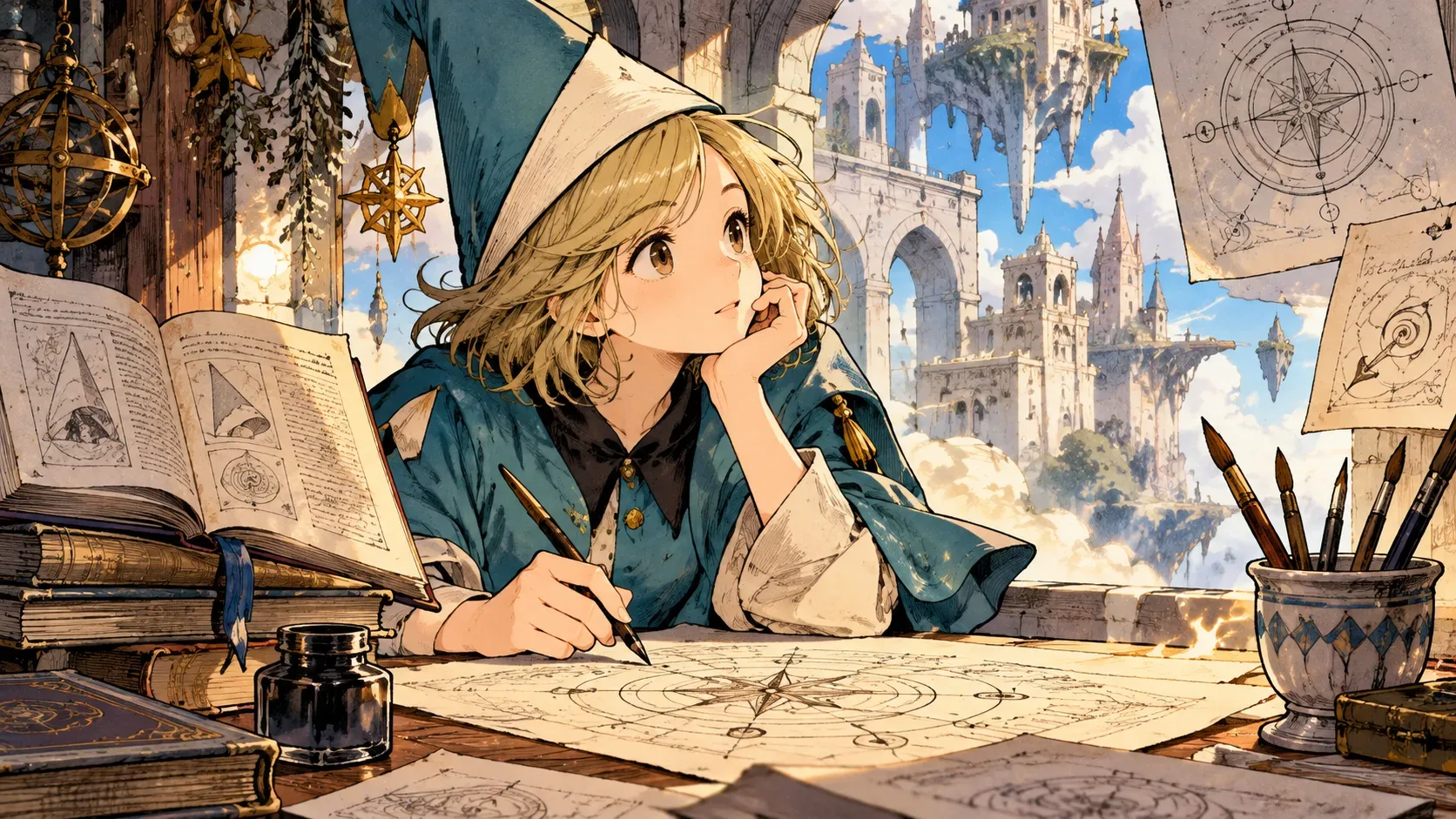
Witch Hat Atelier lets readers imagine spells of their own because Kamome Shirahama designed magic as a combinable visual language rather than a fixed list of powers. The creator confirmed that intention in an interview published in September 2026. That does not make fan-designed circles official: experimenting with a story's logic is different from adding something to its canon.
Shirahama had readers' original spells in mind from the beginning
In an interview with Jay Gibbs for Anime Corner, published on September 1, 2026, Shirahama said she designed the system from the outset so other people could create original spells. The question specifically mentioned fans sharing their own designs. Her answer did not suggest those designs would become part of the manga. It described a creative goal: rules that invite people to invent.
An editor's note added after a clarification from Shirahama explains the approach in more detail. She said she combined questions such as what, where and how, like pieces of a puzzle, then used symbols in place of verbal explanations. While building the story, she also considered who acts, when and why, how magic might be used and what kind of physical logic it would give her world. The interview does not supply a universal spell-making formula; it reveals the thinking behind the system.
Why draw magic instead of speaking it?
The choice grows out of Shirahama's own profession. Speaking with William Moo and Melvyn Tan for Anime Trending in an interview published in July 2024, she connected drawing symbols with her experience as a manga artist. Readers can try reproducing a glyph on paper and feel the effort involved. Reciting an imaginary incantation or copying a complicated gesture, she argued, does not necessarily offer the same sense of participation.
She likened the process to learning music: observe, imitate, practice and build skill. Coco's development in the manga makes that idea tangible. Her early marks are imperfect, and practice gradually improves them. The focus is not solely on spectacular results but on the work required to achieve them. Drawing becomes both a fictional technique and an invitation to the reader's imagination.
What does it mean to combine symbols in a magic circle?
The most useful way to understand the design is to distinguish meaning, combination and outcome. The marks on the page do more than decorate the artwork: together, they carry information on which a magical effect depends. Changing a combination means reconsidering the intended effect, its application and the limits of that fictional world. This is an explanation of the creative logic Shirahama described, not a newly invented spell recipe.
The important point in the 2026 interview is that symbols take the place of lengthy explanations. Rather than having a narrator justify every effect, the drawing offers clues to an internal grammar. Readers can build hypotheses from familiar patterns, but an internally plausible hypothesis must still be distinguished from a rule actually demonstrated in the story.
A craft to learn, not a gift reserved for a few
In an interview published by UNESCO in April 2026, Shirahama described Witch Hat Atelier as a story about possibility. In a world where people believe magic belongs only to those born with a special ability, an ordinary girl finds another path. Shirahama emphasized the idea that someone who appears excluded can learn and find a place for themselves.
That principle also explains why a combinable system serves the story. If learning involves observation, experimentation and correction, fantasy begins to resemble a craft. But the freedom to invent does not erase the world's internal restrictions: what a character can perform, what they still need to learn and what is permitted remain questions for the actual narrative.
The anime adaptation also had to interpret the visual language
In a July 2024 Anime Trending interview during preparation for the adaptation, Shirahama described how the staff asked what particular circles should look like when set in motion and which portions would activate. Manga presents still images, so animating a seal required decisions about timing and movement that were not always specified on the page. She helped work through those details. The interview documents production discussions at that time, not a new rule that readers can automatically apply.
Fan-created spells and official spells are not the same
The system creates room for experimentation: a reader can draw symbols, propose a hypothetical function and debate whether it follows established principles. That is fan creation. A spell should only be described as official when the published work or an authorized statement supports that status. The 2026 interview establishes Shirahama's desire to encourage invention, not her approval of every plausible design.
That distinction is the heart of the idea. The circles give readers enough material to imagine solutions without pretending the story has confirmed every possibility. Magic feels learnable because the drawings encourage questions about how it works, not just admiration for the outcome.