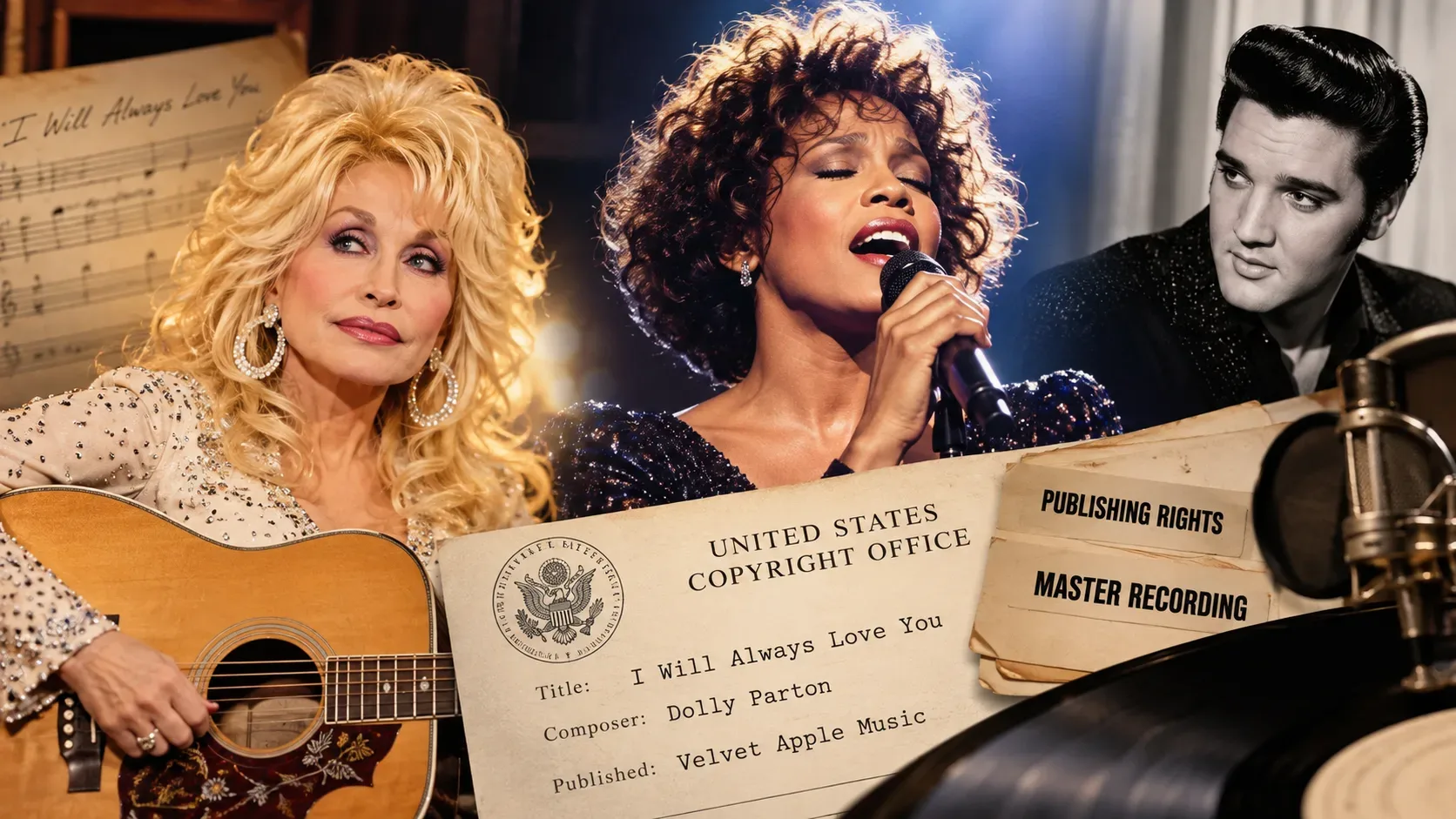
Dolly Parton did not reject Elvis Presley as a performer of I Will Always Love You. She rejected the business condition set by his manager, Colonel Tom Parker: handing over at least half of the song's publishing interests before Elvis could record it. The planned recording never happened. Years later, Whitney Houston released her rendition, but she did not buy Parton's songwriting credit, the underlying composition, or the publishing rights Parton had kept. Houston's recording carries its own copyright, separate from the songwriter's rights.
What did Elvis want, and why did Dolly refuse?
Parton wrote I Will Always Love You around the time she was leaving her professional partnership with Porter Wagoner. The U.S. Copyright Office identifies a 1973 registration for the musical composition and lyrics, not for Houston's recording or any later record release. Dolly's original recording reached listeners in 1974 and became a country hit.
According to Parton's account, revisited by the Los Angeles Times in September 2023, Elvis wanted to record his own version, and she was excited about the prospect. On the eve of the planned session, Parker said he required at least a 50% publishing interest. Dolly regarded the song as her most valuable composition and refused to give away that stake. She regretted the lost opportunity but stood by her decision.
The distinction matters: Parker's demand concerned the publishing interest in the song, not the purchase of an Elvis master that already existed. Nor is there a completed commercial recording by Elvis to attach to the disagreement. It was a failed negotiation, not a rule that every cover requires a songwriter to sell publishing rights.
Composition, publishing and master: which rights are different?
The U.S. Copyright Office explains in Circular 56A that a song and a particular sound recording of that song are distinct works under U.S. copyright law. The owner of the composition and the owner of the recording may be different people or companies. Contracts and licenses govern how each use generates payment.
| Rights layer | What it covers | How it applies |
|---|---|---|
| Composition and lyrics | The melody, harmony and words written by Dolly. | The Copyright Office identifies Parton as owner of the composition; performing it did not make Whitney its writer. |
| Publishing interests | Commercial exploitation and administration of the composition, subject to contracts. | Parker asked for at least half of this interest; Parton refused. Publishing administration does not necessarily mean an outright copyright sale. |
| Sound recording (master) | A specific recorded performance and its sound production. | Whitney's recording has separate copyright protection. Owning the composition does not give Dolly ownership of Whitney's master. |
Did Whitney Houston buy any of Dolly's rights?
The sources reviewed do not document Houston purchasing Parton's composition copyright or a share of the publishing of I Will Always Love You. Whitney's official single credits name Dolly Parton as songwriter and David Foster as the recording's producer. Released in the United States on November 3, 1992, Houston's version appeared on the soundtrack of The Bodyguard and spent 14 weeks at number one on the Billboard Hot 100.
That does not mean Houston necessarily owned the master merely because she sang the song. The official page for a film recording, reissued in 2017, carries a 1992 phonogram credit for Arista Records LLC. That credit documents the recording's label association, but on its own cannot establish every contractual transfer or the current complete ownership chain. Whitney's voice and artistic recognition did not transfer Dolly's composition to her.
The Copyright Office is equally clear in the opposite direction: Parton owns the composition rights but not the copyright in Houston's sound recording. The success of a rendition can generate income in different layers, including the underlying musical work and the phonogram, according to applicable licenses and contracts. Songwriting royalties and master revenue are not the same payment.
Why did keeping the rights pay off for Dolly?
By retaining her publishing interest, Parton preserved a significant economic stake in the song when Houston's version reached a massive audience in 1992. In later interviews, Dolly said the hit earned her substantial money. That does not mean she collected all revenue from the recording or that Whitney was unpaid for her performance.
It also matters to distinguish ownership from publishing administration. In 2019, Dolly's official website announced an agreement for Sony/ATV to represent and administer part of her catalog, including I Will Always Love You. The announcement alone does not establish a sale of the songwriting copyright or Houston's master. The documented outcome is narrower: Elvis did not record the song after Parker's demand, Houston did not acquire Parton's composition, and the separate recordings occupy a different rights category from the written song.
Sources and references
- U.S. Copyright Office: Dolly Parton, Whitney Houston and the song copyrights
- U.S. Copyright Office: Circular 56A, musical works and recordings
- Los Angeles Times: Dolly Parton and the Elvis Presley proposal
- Dolly Parton: Sony/ATV publishing administration agreement (2019)
- Whitney Houston: official 1992 single credits
- Whitney Houston: film recording credits and Arista label
- U.S. Copyright Office: copyright guidance for musicians