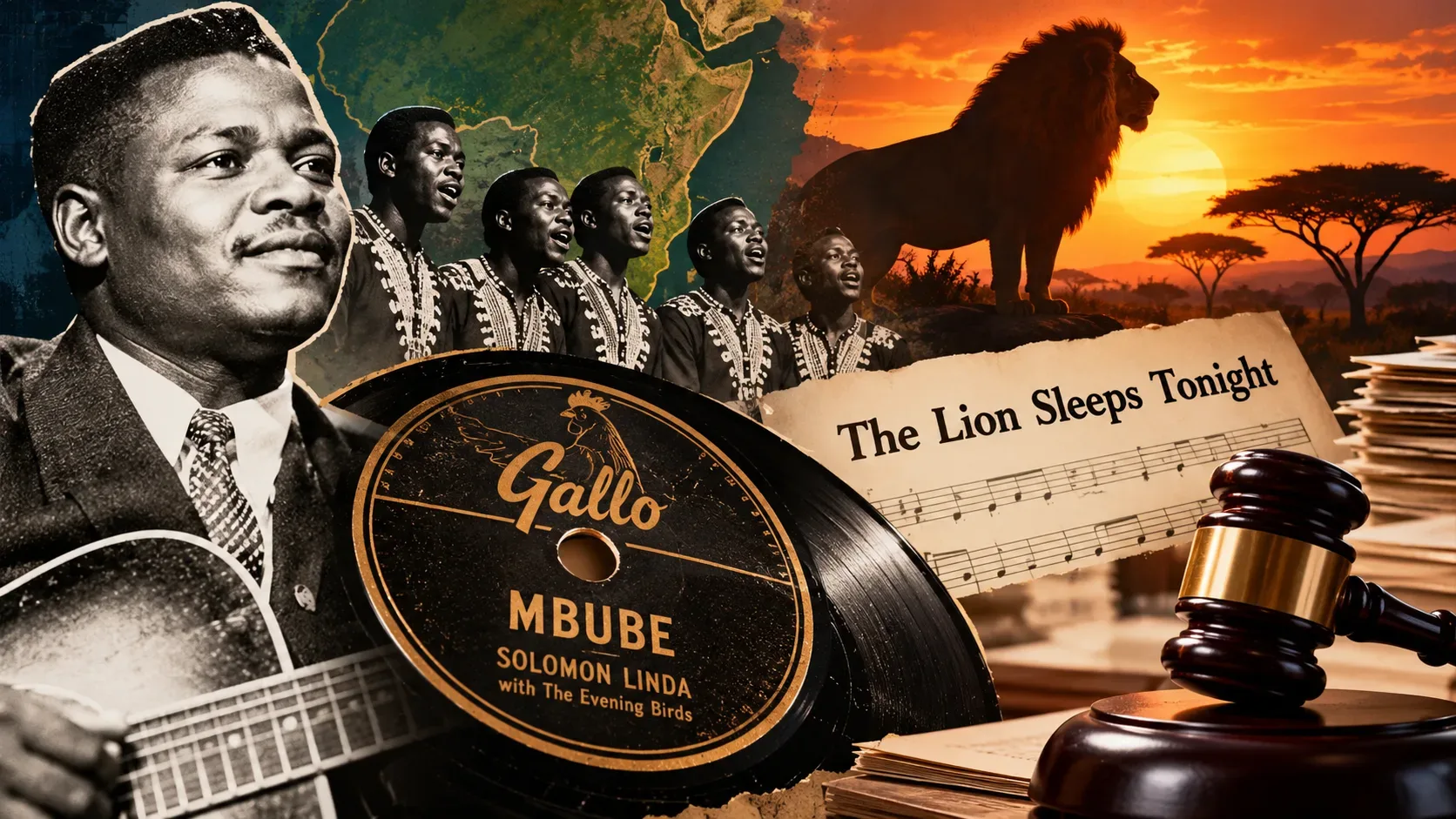
The Lion Sleeps Tonight grew out of Mbube, recorded in 1939 by South African musician Solomon Linda and the Evening Birds. It reached the United States as the Weavers' Wimoweh, then took on English lyrics and a new pop arrangement in the Tokens' 1961 recording. That worldwide success did not bring Linda's family comparable recognition or income. In 2006, a settlement involving music publisher Abilene Music acknowledged that the hit derived from Mbube, credited Linda as a co-composer, and provided for past payments and future royalties. The financial amount was not disclosed.
Mbube: Solomon Linda’s original 1939 recording
Solomon Linda was a Zulu migrant worker and singer in Johannesburg. In 1939, he recorded Mbube, meaning lion in Zulu, with his vocal group, the Evening Birds. The arrangement combined chanted ensemble voices with improvised high-register lines from Linda. In a 2006 account published by the World Intellectual Property Organization (WIPO), the family's lawyer Owen Dean identified the melody of that recording as the musical material carried into the later versions.
The record became successful in South Africa. But record sales and ownership of the composition were separate matters: according to Dean, Linda assigned worldwide copyright in Mbube to the Gallo record company for ten shillings. He died in 1962, before the international dispute over the song's earnings was resolved. Its history therefore did not begin with American performers or with music written for Disney.
How Mbube became Wimoweh in the United States
The South African recording reached folk singer Pete Seeger in the early 1950s. Seeger adapted it for the Weavers and rendered a sung Zulu expression as Wimoweh, an approximate phonetic version rather than a translation of the title Mbube. WIPO's history of the song identifies this stage as the composition's first major international transformation.
The Weavers recorded their version in 1952, according to the chronology set out in a 2000 decision of the U.S. Court of Appeals. It retained musical elements of the original but circulated in a different market under a different name. This stage should not be confused with the English-language hit of the next decade: Wimoweh did not originate with the lyrics now associated with The Lion Sleeps Tonight.
What the Tokens changed in 1961
In 1961, songwriters and producers George David Weiss, Hugo Peretti and Luigi Creatore worked on a new adaptation, recorded by the Tokens as The Lion Sleeps Tonight. Their work introduced English verses and a pop presentation distinct from both the South African recording and the Weavers' arrangement. The track became a major commercial hit in the United States.
The 2000 U.S. appellate decision documents the three writers' role in the English lyrics and describes a separate authorship dispute between former Tokens members and those songwriters. That case should not be confused with the later claim brought by Linda's heirs. Nor do the new words and 1961 production establish that the underlying Mbube melody had no identifiable creator.
Why The Lion King became part of the dispute
The song was covered many times and reached further audiences through uses associated with Disney's The Lion King, on screen and on stage during the 1990s. Disney's use of the song does not mean that the company composed it or originally owned Mbube. The legal issue concerned permission to exploit The Lion Sleeps Tonight, an adaptation that retained material created by Linda.
According to Owen Dean's account, U.S. publisher Abilene Music held rights to The Lion Sleeps Tonight and licensed its use to Disney. The family representatives sued Disney and other licensees in South Africa because they could not sue Abilene directly in that jurisdiction, where the publisher had no known assets. Distinguishing the original composer, the rights administrator and the company using a song is essential to understanding the proceedings.
From copyright transfers to the 2004 lawsuit
The family's legal strategy relied on a reversion provision of Britain's 1911 copyright legislation as it applied to the South African dispute. Under the interpretation advanced by Dean, rights assigned during a creator's lifetime could revert to the estate 25 years after the author's death. For Linda that meant 1987. Dean also examined later assignments signed by Linda's widow and daughters, arguing that these had not transferred the particular reversionary right vested in the estate.
The estate was reopened in 2004 and litigation proceeded with court measures involving Disney trademarks registered in South Africa. ABC News reported that year that the family sought 10 million rand in damages. The decision allowing interim measures to remain in place enabled the case to proceed, but it should not be described as a final judgment ordering Disney to pay the amount claimed.
What the 2006 settlement secured for Linda’s heirs
Before the trial scheduled for February 21, 2006, the parties reached a settlement involving Abilene Music. ABC News reported the agreement on February 17. Owen Dean's detailed WIPO account describes the following terms:
- compensation to Linda’s heirs for past uses of The Lion Sleeps Tonight and a share of future royalties from its worldwide exploitation;
- express acknowledgment that The Lion Sleeps Tonight was derived from Mbube;
- recognition of Solomon Linda as a co-composer of The Lion Sleeps Tonight, with that credit to be used thereafter;
- establishment of a trust to administer the heirs’ copyright interests and payments owed to them.
The payment amount remained confidential. The case was withdrawn as part of the settlement, so the outcome was not a final trial judgment deciding every allegation on its merits. It is also inaccurate to assume Disney itself made the undisclosed payment negotiated with the publisher: Abilene was central to the resolution, although Disney was involved in the litigation.
Did the settlement settle every question about the song?
The agreement brought recognition and financial entitlements that the family had lacked, but it does not show that the heirs received all income from every recording. A 2019 Los Angeles Times report about the documentary The Lion's Share showed that the adequacy of the compensation continued to be questioned. The exact terms of the 2006 financial payment were still undisclosed in the sources consulted.
The chronology establishes the main distinctions: Mbube is the South African composition recorded in 1939; Wimoweh is the adaptation spread by the Weavers; The Lion Sleeps Tonight is the version with new lyrics and production popularized by the Tokens. The 2006 agreement formally connected that hit to Linda's work and his heirs' rights without erasing the differences among the recordings and contracts.