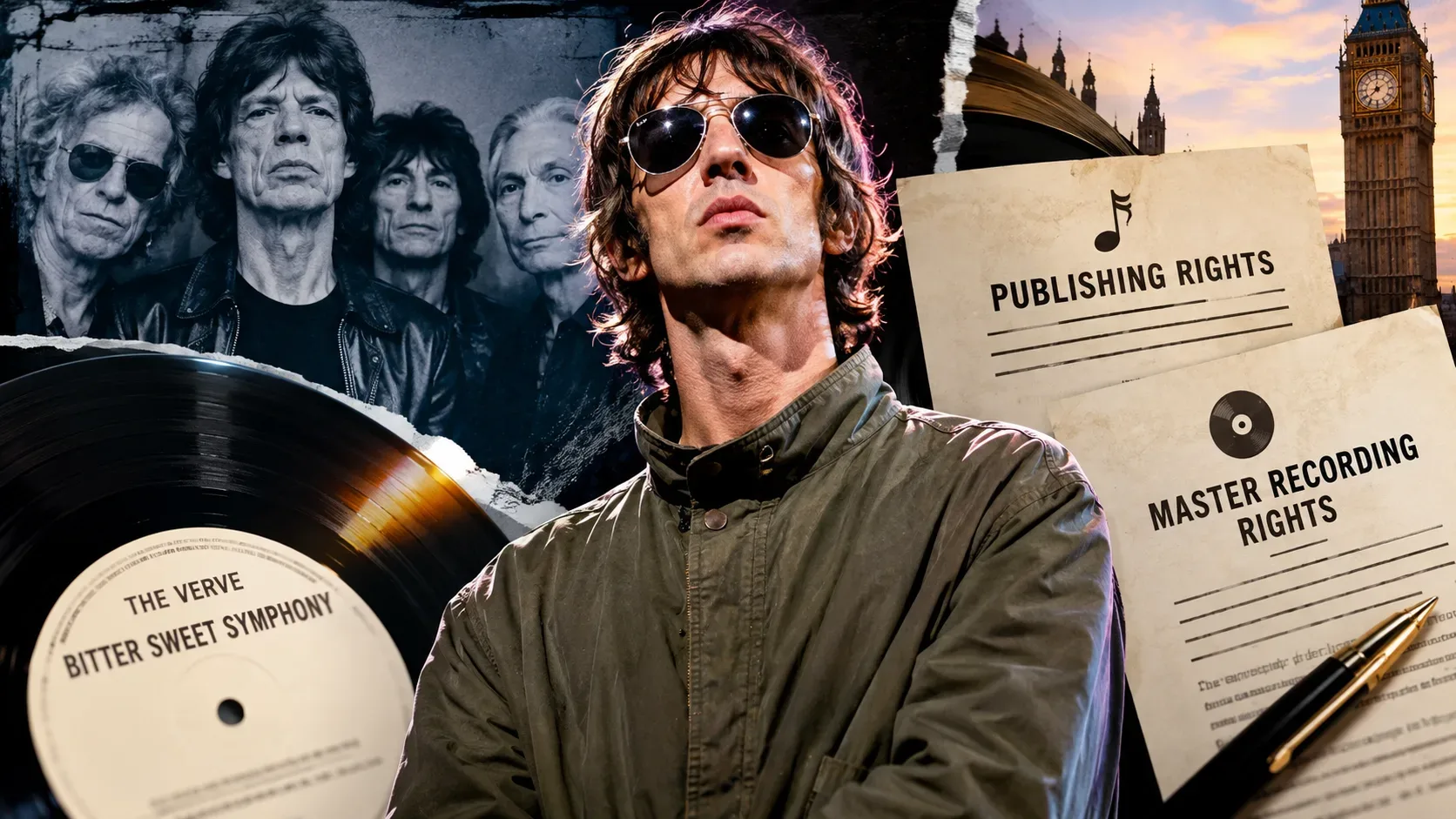
In 2019, Rolling Stones members Mick Jagger and Keith Richards agreed to relinquish their songwriting credits on Bitter Sweet Symphony and direct the future royalties attributable to their shares of the song to Richard Ashcroft. For the Verve songwriter, this brought a long-running dispute over the composition's publishing rights to a close. It did not mean the musicians transferred ownership of the original sound recordings or agreed to repay all income collected in previous decades.
The Bitter Sweet Symphony sample did not come directly from a Stones recording
Released by the Verve in 1997 on Urban Hymns, the track was built around a looping string passage. Its source was an orchestral version of The Last Time, a Mick Jagger and Keith Richards composition recorded by the Andrew Oldham Orchestra in 1965. In other words, the sound the Verve sampled came from a different recording, not directly from the Rolling Stones' own record.
That distinction matters. A song's writers, lyrics and music can be protected as a composition, while an individual recorded performance has separate protection. Sampling audio raises rights questions about both layers.
How incomplete clearance turned into a songwriting dispute
According to a Rolling Stones spokesperson quoted by Music Week on May 23, 2019, permission to use the sound recording had been obtained, but clearance for the underlying musical composition had not been settled. ABKCO, the company associated with Allen Klein that controlled rights to Stones compositions from that period, challenged the use. The dispute ended in an out-of-court settlement.
The outcome was severe for Ashcroft: Bitter Sweet Symphony came to credit Jagger and Richards alongside him, while the song's publishing rights and revenues came under ABKCO's control. This concerned the composition and its income. It does not establish that Ashcroft lost every possible source of revenue connected with the Verve's recording.
What Jagger and Richards actually gave up in 2019
Early in 2019, Ashcroft's managers Steve Kutner and John Kennedy sought a solution. As Kennedy explained in an interview with Billboard, also published by Stereogum, they contacted ABKCO's Jody Klein and then Rolling Stones manager Joyce Smyth. In April, Smyth informed them that Jagger and Richards had agreed to remove their names from the songwriting credits and assign their future songwriter royalty shares to Ashcroft.
The news became public on May 23, 2019, when Ashcroft received the PRS for Music Outstanding Contribution to British Music award at the Ivor Novello Awards. He thanked both musicians for the gesture. Music Week also published the Stones team's explanation: future payments that would otherwise go to Jagger and Richards would instead go to Ashcroft, and the pair would no longer require a songwriting credit on the track.
Publishing rights and master recording rights are not the same
Publishing rights relate to the underlying musical work: its composition and lyrics, songwriter credits, licensing and associated income. Master rights relate to a particular sound recording. Universal Music Publishing Group draws precisely this distinction in its guidance on music licensing.
That is why the 2019 decision should not be described as handing over the master of Bitter Sweet Symphony or transferring the orchestral recording of The Last Time. The reports reviewed establish a change in songwriting credits and in where Jagger and Richards' publishing-related shares would go. They do not demonstrate a transfer of ownership of either recording, nor do they erase the songwriting credit for The Last Time.
Did ABKCO stop being the publisher? What about past royalties?
It is also important to separate songwriting credit, a share of royalties and publishing administration. In Billboard's June 24, 2019 report, ABKCO was still identified as the sole publisher of Bitter Sweet Symphony, notwithstanding Jagger and Richards' decision. That report does not establish that the situation remained unchanged at every later date.
Nor did the verified statements about the 2019 agreement establish a requirement to repay Ashcroft all royalties collected since 1997. What is documented is the redirection of the duo's future royalties and the removal of their songwriting credits. The change mattered for recognition and income, but it was not a documented transfer of every right attached to every sound recording.
Sources and references
- Music Week: James Hanley's report on the 2019 rights decision
- Billboard, republished by Stereogum: John Kennedy interview and ABKCO's role
- Pitchfork: Ashcroft's statement and background to the dispute
- Universal Music Publishing Group: publishing versus master rights
- The Ivors Academy: 2019 Ivor Novello Award recipients