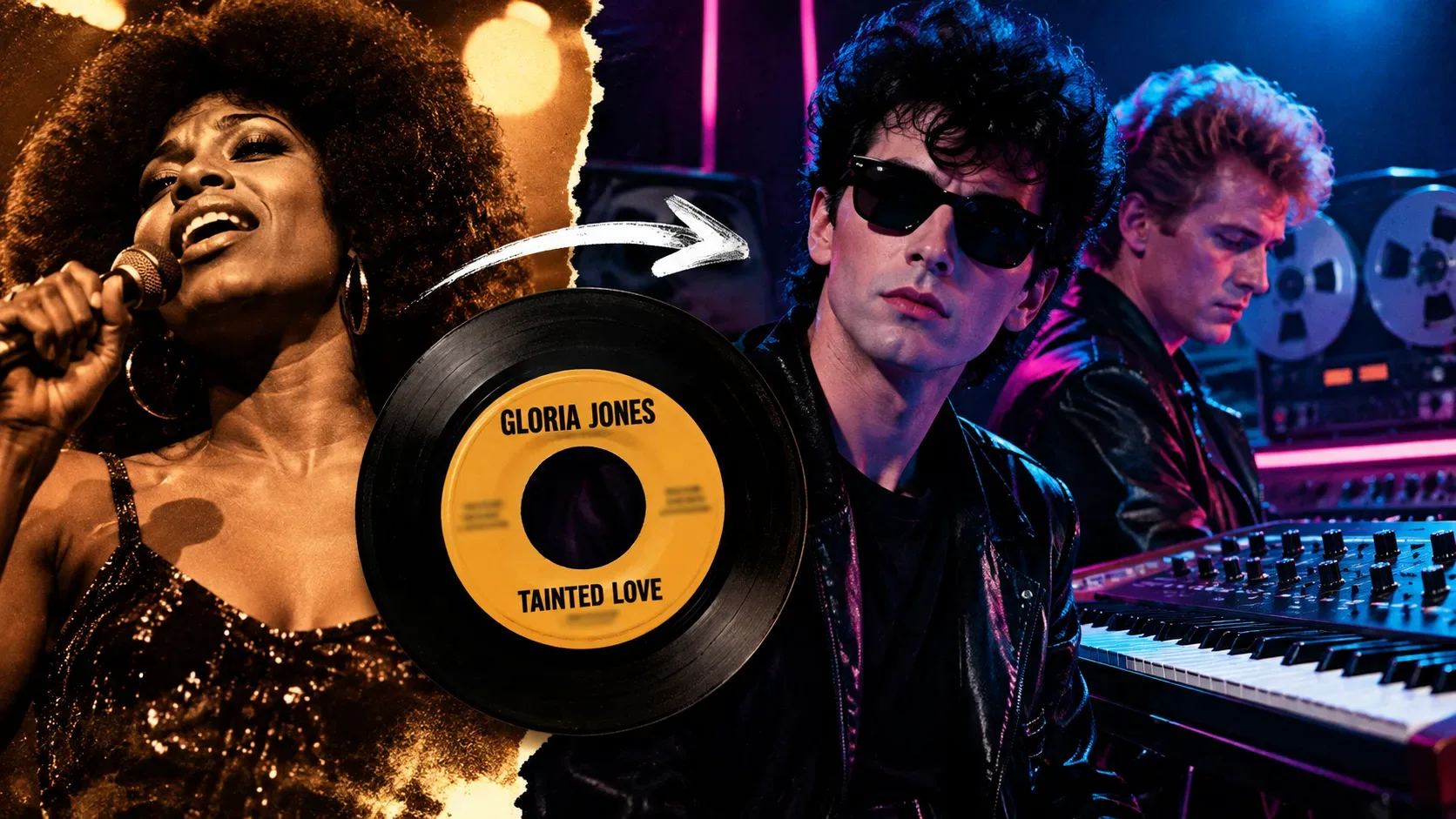
Soft Cell did more than replace the instruments on “Tainted Love” with synthesizers. By 1981, Dave Ball and Marc Almond had already reshaped the song Gloria Jones recorded in the 1960s into a slower, stripped-down electronic performance. Producer Mike Thorne brought that idea into the studio, combined Ball’s analog bass with Synclavier sounds, organized the percussion, and helped develop the metallic figure that became a signature of the record.
The difference between the versions lies in arrangement and production, but also in how they deliver a story about love turned sour. Interviews with Thorne, Ball, and Almond distinguish what the duo had already developed on stage from the elements created during the sessions.
Gloria Jones recorded the song long before Soft Cell had a hit
“Tainted Love” was written by Ed Cobb and recorded by Gloria Jones in 1964. That recording appeared as the B-side of “My Bad Boy’s Comin’ Home”, a single released in 1965 that did not chart at the time. The distinction matters: 1964 refers to the original recording, while 1965 is associated with the single’s release.
Jones’s performance was rooted in soul and R&B, with brass, backing vocals, and a faster pulse. In the 1970s, the track found a second life on Britain’s northern soul dance floors. Jones recorded it again for her 1976 album “Vixen”. Referring simply to the Gloria Jones version can therefore blur the difference between her 1960s recording and her later remake.
What Ball and Almond changed before meeting Mike Thorne
The transformation did not begin from scratch with the producer. Ball has said he knew “Tainted Love” from northern soul nights; Almond encountered it in clubs, and Soft Cell started performing it live. They wanted a reinterpretation suited to their unusual lineup: keyboards, electronic equipment, and a theatrical voice, rather than a recreation of a soul band.
The basic direction was already clear in the demo Thorne heard. In his Mix interview, the producer said the overall structure was there, but the recurring metallic hook and the move into the Supremes’ “Where Did Our Love Go?” on the extended version had yet to be added. The reinvention was therefore collaborative: the duo established the musical language, while Thorne helped give it its recorded identity.
Korg and Synclavier: why the combination mattered
The recording took place in Studio Two at Advision in London, with Mike Thorne producing and Paul Hardiman engineering. The bass came from one of Dave Ball’s Korg synthesizers, providing the insistent pattern around which the arrangement unfolds. Thorne brought his Synclavier, an exceptionally advanced and costly digital system at the time, which supplied piano-like tones, orchestral swells, and other details.
Ball described the result as a collision between relatively cheap gear and highly sophisticated technology. That explains the simultaneous roughness and precision of the sound: the low end is spare and repetitive, while the digital tones add space and contrast. This was not simply a technology showcase. The arrangement exposes the tension between a regular electronic pulse and Almond’s performance.
Where the song’s metallic hook came from
One of the most revealing additions emerged in the studio. Thorne told Mix that the repeated percussive sound between the vocal phrases began on a Synare drum synthesizer. Running its attack through a Delta Labs DL4 delay, using feedback and changes to the repeat time, produced a longer, stranger metallic tone than the original hit.
Almond and Ball also remember contributing electronic percussion, alongside real finger snaps. Their recollections emphasize different parts of the playing, so not every individual strike can be assigned with identical certainty; Thorne’s explanation of how he built the central sound is nevertheless specific. The record combined performance, synthesis, and effects processing rather than relying on one miraculous preset.
Was it a TR-808 drum machine? The interviews draw a distinction
It would be misleading to assume that the drum pattern on “Tainted Love” came from a Roland TR-808. In an interview with The Electricity Club, Ball named the Roland CR-78 as the machine used on the track and explained that its single output required engineer Paul Hardiman to separate elements of the beat. Mix likewise describes Thorne borrowing a Roland rhythm machine and the kick and snare being treated separately.
Ball places his important early use of the TR-808 later, during the sessions associated with “Non-Stop Erotic Cabaret”, and specifically connects it to “Bedsitter”. That distinction prevents the equipment used on Soft Cell’s subsequent work from being retrospectively assigned to the earlier single.
Marc Almond’s vocal and the mixing choices
Thorne told Mix that Almond’s lead vocal, recorded on a Neumann U87 microphone, retained the energy of one of his earliest performances. Almond has recalled doing very few takes. This is not an excessively polished vocal: the contrast between its exposed emotion and the repeating electronic backing helps explain the record’s dramatic effect.
The sessions also involved important editing decisions. “Tainted Love” was developed as an extended piece that flowed into the Supremes’ “Where Did Our Love Go?”. The songs were separated for the seven-inch single. Thorne also described a subsequent New York remix intended to give the shorter version a wider stereo image at the record label’s request. The seven-inch single and the twelve-inch version should not be treated as identical recordings.
What changed between the original and the 1981 hit
It remained Ed Cobb’s composition. What changed was the tempo, texture, instrumentation, treatment of the voice, and rhythmic impact. Jones’s interpretation delivered fast-moving, richly arranged soul; Soft Cell concentrated the tension in a synthesizer line, persistent beat, unusual metallic accent, and Almond’s delivery. This comparison is grounded in the arrangements described by those involved and does not suggest they regarded Jones’s original as an inferior recording.
The approach reached a wide audience: “Tainted Love” topped the UK singles chart in 1981 and stayed at number one for two weeks, according to Official Charts. That success neither erased Gloria Jones’s record nor made Thorne the song’s writer. His achievement was helping an existing song take on a sound that fitted Soft Cell’s artistic identity.
Sources and references
- Mix, Robyn Flans: Classic Tracks: Soft Cell’s “Tainted Love”
- The Electricity Club: Soft Cell Interview (Dave Ball)
- The Guardian, Dave Simpson: How we made Soft Cell’s Tainted Love
- The Quietus, Patrick Clarke: An Oral History of Non-Stop Erotic Cabaret
- Official Charts: Flashback 1981, Soft Cell - Tainted Love