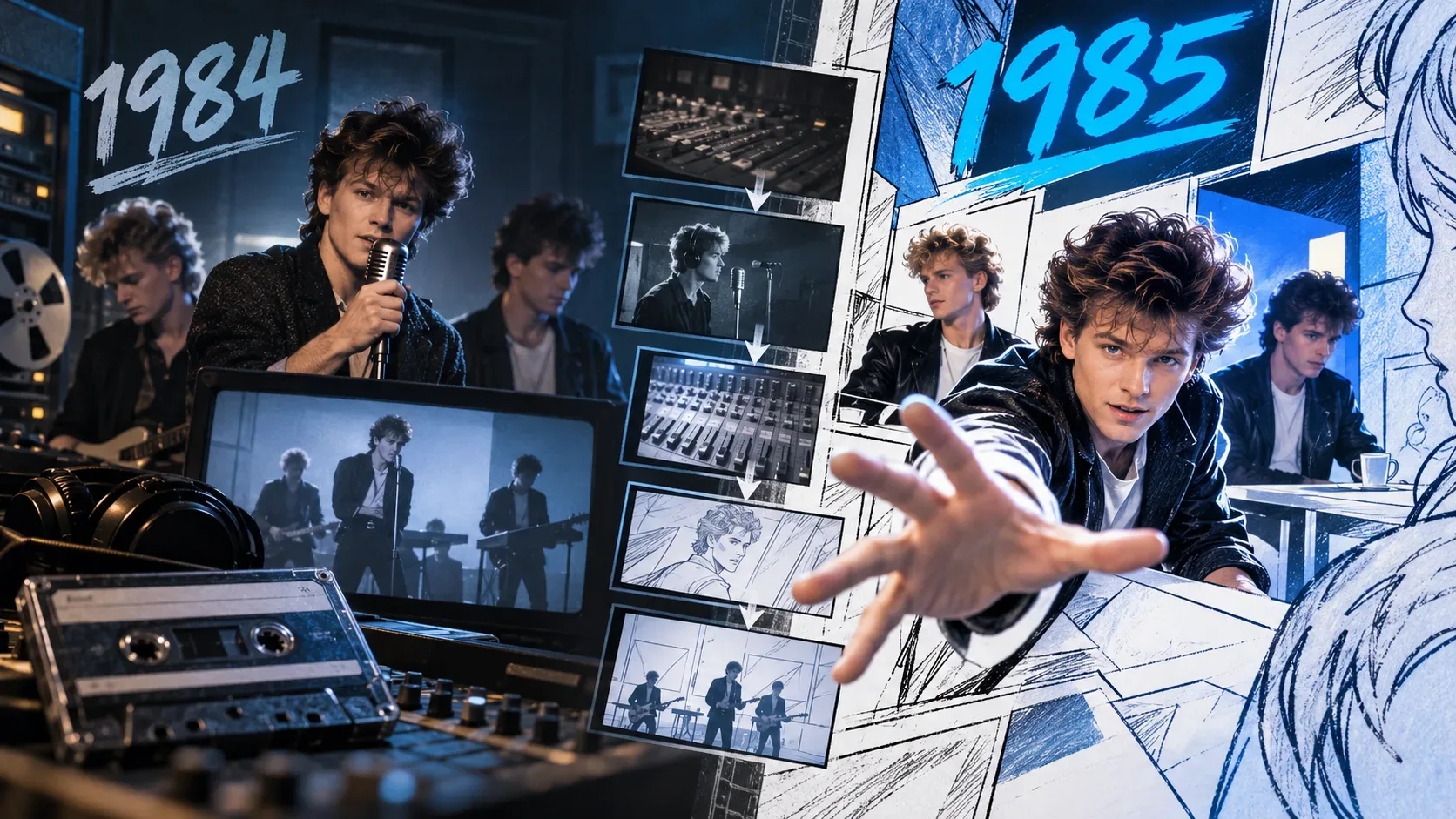
The song Take On Me had its first commercially released recording and a music video in 1984. In 1985, a-ha re-recorded the track with producer Alan Tarney and promoted it with a different music video, directed by Steve Barron, combining live-action filming and drawn animation. One detail often muddles the timeline: in the United Kingdom, the 1985 recording was issued in April and reissued in September. That does not mean there were three videos or three entirely different re-recordings.
To follow the sequence, four things must be kept separate: demos made before the breakthrough, the recording sold on disc, successive commercial release attempts, and the two audiovisual productions. The 4K remaster released in 2019 belongs to the history of the second video; it is not a third 1980s music video.
Before the 1984 single: the Take On Me demos
The song predates a-ha’s commercial debut. According to the band’s official history, an early version titled Lesson One was recorded in Norway in late 1982 and developed again as a demo at the Rendezvous studio in London in the summer of 1983. These were development stages, not the 1984 single that reached record shops.
The trio of Morten Harket, Magne Furuholmen and Pål Waaktaar-Savoy therefore already had the song’s foundation before settling on the commercially released recording. Treating a demo, the first single pressing and the album version as equivalent releases makes the timeline needlessly confusing.
1984: the first commercial recording and performance video
The first Take On Me single was released on 19 October 1984, a date given both by a-ha’s official history and a specialist catalogue of its physical editions. That recording was produced by Tony Mansfield. The discography also credits a remix by John Ratcliff with the band on the original release. It is a different recording from the re-recording that would become widely known the following year.
The first music video accompanied this period and largely featured the three band members performing against a blue background. With no comic-book storyline or characters crossing between worlds, it was built around performance. A retrospective in Creative Review and a-ha’s official 2019 announcement confirm that this video existed before Barron’s famous production.
The initial attempt did not achieve the intended international breakthrough. The band and its label consequently reconsidered both the production of the song and its presentation on television.
1985: Alan Tarney’s re-recording and the reissues
A-ha returned to the studio to make another recording of Take On Me, this time produced by Alan Tarney. The official retrospective explains that Tarney drew on the feel of an earlier demo to arrive at the desired sound. Calling the 1985 track merely an old recording with improved audio therefore overlooks a change in production and recording.
This new version was released in the UK in April 1985 but initially drew little attention. The single was reissued in the UK in September 1985, after the new video began building momentum in the United States. The discography lists three UK single-release stages: October 1984, April 1985 and September 1985. They do not represent three principal recordings or three music videos.
Tarney’s recording is the one associated with the debut album Hunting High and Low (1985). In October 1985, Take On Me reached number one on the US Billboard Hot 100 and peaked at number two on the UK Official Singles Chart. These are rankings from different markets, not Brazilian chart positions.
The two videos: blue-backdrop performance or comic-book romance?
The visual contrast is easier to spot than the successive record pressings. In the 1984 video, the band performing against a blue set is the central image. In the 1985 video, director Steve Barron tells a story that moves between real life and pencil-drawn images. Animation is combined with filmed action using rotoscoping, a technique in which live-action images are traced frame by frame.
The later video turns a synth-pop song into a miniature romantic adventure, involving a character who appears to step out of a comic book and connect with a woman in the real world. Artists Michael Patterson and Candace Reckinger worked on the animation. According to official a-ha material published in 2020, rotoscoping thousands of frames took 16 weeks.
The band’s timeline says the revamped video was already airing on American television in May 1985. This is separate from the September UK single reissue. The recording, video and release campaign did not all happen on the same day.
Timeline: recording, release and music video
| When | Audio and commercial release | Music video or context |
|---|---|---|
| Late 1982 and 1983 | Early demos, including Lesson One | These are not yet either of the two commercial videos. |
| 19 October 1984 | First single, produced by Tony Mansfield | First video: band performing against a blue backdrop. |
| April 1985 | New Alan Tarney recording released in the UK | This release precedes the commercial boost from the second video. |
| May 1985 | Same phase as the 1985 re-recording | Steve Barron’s video appears on US television. |
| September and October 1985 | UK reissue; UK no. 2 and US no. 1 in October | The live-action and pencil-drawing video becomes famous. |
| December 2019 | Restoration of material associated with the 1985 video | Barron’s video appears in 4K; it is not a new 1980s video. |
Why are there two recordings but three single releases?
The answer depends on what is being counted. For the period’s main audio recordings, the relevant comparison is Mansfield’s 1984 release and Tarney’s 1985 re-recording. For the UK single campaigns, three dates matter: October 1984, April 1985 and September 1985. For the music videos, there are two: the performance video and the animated one. Seven-inch and twelve-inch editions, plus extended versions, may involve different durations and mixes, but they do not automatically turn each record into another music video.
The dates above describe the documented UK sequence and the push in the United States. Other countries had their own pressings and campaigns; the British schedule should not be treated as a universal release calendar.
Is the 4K video a third original version?
No. On 30 December 2019, a-ha announced a 4K restoration of the 1985 video. This was possible because it had been filmed and edited on 35 mm film. The official statement notes minor differences in a few recovered frames and the restoration of end credits omitted from earlier versions.
Those details make the restoration useful when comparing different presentations of Barron’s own video, but they do not turn it into the first video, a third original 1985 shoot or another recording of the song. To identify what you are watching, the practical question is whether it simply shows the band against a blue backdrop or the filmed and illustrated story. That is the key distinction between the two original videos.
Sources and references
- a-ha: official band and Hunting High and Low history
- a-ha: 2019 statement on the two videos and the 4K restoration
- a-ha: animation credits and restoration details (2020)
- Creative Review: an oral history of the Take On Me video (2022)
- a-ha Discography: first, second and third single releases
- Official Charts: UK chart history for Take On Me