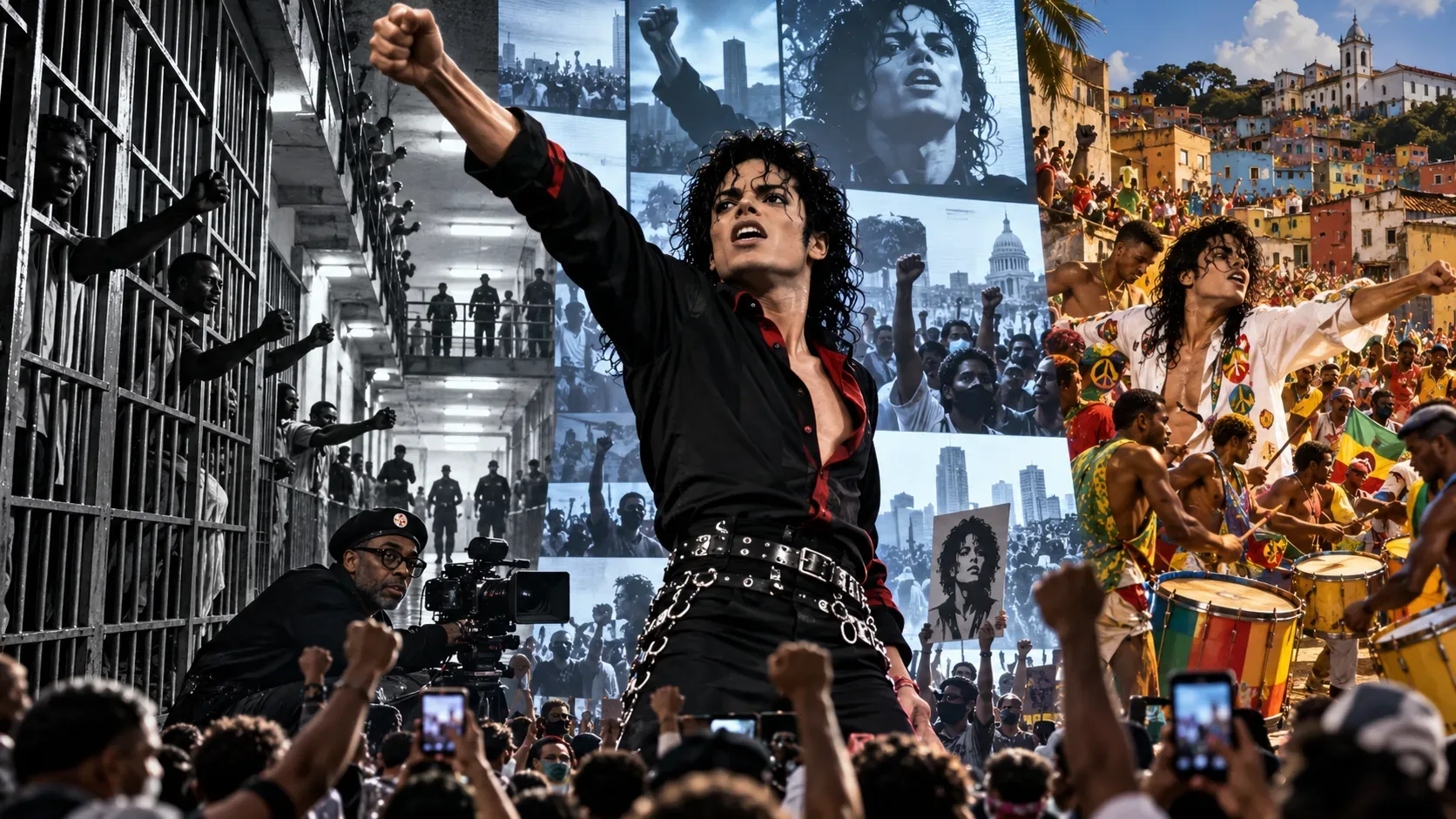
Michael Jackson and Spike Lee made two music videos for "They Don't Care About Us" in 1996 to present the same song through different visual approaches: one follows Jackson in Brazil, alongside Olodum and residents of Salvador and Rio de Janeiro; the other places imprisonment and images of violence and human rights abuses at the center of its protest. On August 29, 2020, Lee unveiled a new edit combining material from both productions with footage of contemporary anti-racism demonstrations. The 2020 film is a Lee-directed re-edit, not a new shoot featuring Jackson, who died in 2009.
Explaining the effect of the two original versions is different from claiming to know precisely why the filmmakers separated them. The films and official documentation establish their contrasting approaches, but the full chain of editorial decisions in 1996 is not established by the available primary sources.
Before the videos: a protest song released in 1995
The track appeared on the 1995 album HIStory: Past, Present and Future, Book I. According to a statement issued by the Michael Jackson Estate in 2020, Jackson described the song as addressing prejudice, hatred, and social and political problems. That context helps explain why both videos deal with inequality, racism, and institutional violence without using the same imagery.
The lyrics also drew criticism in 1995 over language considered antisemitic. Jackson apologized and announced plans to rerecord parts of the song, as the Los Angeles Times reported at the time. This documented dispute is separate from broadcast restrictions later associated with the prison video. The controversy surrounding the words alone does not explain why two edits were produced.
The Brazil version: Pelourinho, Santa Marta and Olodum
In February 1996, filming took place in Pelourinho, Salvador, with Olodum, and in Santa Marta, Rio de Janeiro. Memória Globo documents reporter Glória Maria's coverage for Fantástico, broadcast on February 11, 1996, including her encounter with Jackson in Rio. Contemporary reporting in Folha de S.Paulo recorded the Pelourinho performance and scenes involving the percussionists.
The locations were not simply a tourist backdrop. Authorities concerned about Rio's image opposed the shoot, and permission to film became a legal dispute, according to Folha. The finished work joins the collective energy of drumming and street performance to the song's political message. Brazil describes a filming location, not a version made exclusively for the Brazilian market.
The prison version: incarceration and violence in focus
The other 1996 film, also directed by Lee, places Jackson in a prison setting and uses archival images related to abuses and conflict. Jackson's official website identifies it as the Prison version. Unlike the energy of the Brazilian streets, this edit foregrounds confinement and a more direct condemnation of institutional violence.
The description on Jackson's official video channel says the prison film was restricted to certain broadcast hours because of its controversial content. This provides context for its television circulation, but does not establish that censorship caused the creation of two versions. Programming restrictions, the 1995 dispute about lyrics, and political objections to filming in Rio were distinct events.
So why were there two versions in 1996?
What can be stated without speculation is that Lee completed two standalone short films using the same song and complementary visual ideas. In a 2012 interview with The Playlist, he confirmed that he made both versions, one in Brazil and one in the United States. The Brazilian edit channels the protest through a community and its cultural expression; the prison edit emphasizes repressive institutions and documentary footage.
There is another historical lead, with an important verification limit. A 2001 article republished by the fan site True Michael Jackson attributes to Lee the claim that the initial plan was to combine the prison footage with scenes shot in Brazil. Since the consulted publication does not supply the complete original interview record, this should be treated as an attributed secondary account, not definitive proof of why the film was split. The verified sources do not support reducing the choice to an MTV order or any single cause.
What did Spike Lee add in 2020?
The new short film premiered on August 29, 2020, when Jackson would have turned 62, during a virtual edition of the Brooklyn Loves Michael Jackson celebration. The Estate issued a statement the next day confirming that Lee had combined excerpts from both original films with footage of demonstrations in cities around the world. Rolling Stone also reported the inclusion of outtakes from the earlier productions.
The new images connect with protests against racism and police violence, particularly the movement that intensified after George Floyd's death in the United States. The Estate's statement lists Rio de Janeiro, Atlanta, Paris, Helsinki, and Cape Town among the locations represented. In a statement reproduced in that release, Lee argued that a protest song remains relevant while the struggle for equality continues. This is his documented explanation for revisiting the work in 2020.
The 2020 edit therefore places existing footage in a new context through later events. It neither replaces the two 1996 videos nor erases their differences. Instead, it connects a historical protest statement with images of a new period of public mobilization.
Comparing the three edits
| Edit | Main material | Emphasis |
|---|---|---|
| Brazil, 1996 | Pelourinho, Santa Marta, Michael Jackson, Olodum and residents | Collective presence, Afro-Brazilian culture and social inequality |
| Prison, 1996 | Prison staging and documentary imagery | Incarceration, police violence and human rights abuses |
| Re-edit, 2020 | Scenes from both videos, archival material and 2020 protests | Connecting the protest to global anti-racist mobilization |
How the videos change the reading of the song
In an academic article published in Conversas & Controvérsias, Gabriella Maria von Flebbe do Amaral examines the two 1996 videos as denunciations of structural racism and police violence. That is the researcher's interpretation, not an additional creative intention automatically proven for the filmmakers.
Viewed in sequence, the three edits reveal three ways of using the same composition: music and community in Brazil, a confrontation with institutions in the prison film, and a connection to demonstrations from another historical moment in 2020. The differences concern audiovisual storytelling and editorial context. These are not three different songs or three previously unreleased Michael Jackson performances.
Sources and references
- Michael Jackson Estate: 2020 short-film announcement
- Official artist site: Brazil version
- Official artist site: prison version
- Official 2020 video on YouTube
- Memória Globo: Glória Maria reports from the 1996 shoot
- Folha de S.Paulo: 1996 Pelourinho shoot
- Folha de S.Paulo: dispute over the Rio shoot
- The Playlist: 2012 interview with Spike Lee
- Rolling Stone: 2020 re-edit and archival material
- Conversas & Controvérsias: academic analysis of both videos
- Los Angeles Times: the 1995 lyric controversy and revision
- True Michael Jackson: secondary account of the proposed original edit