Spoiler warning: this recap reveals Jigsaw's identity and the entire ending of Saw (2004).
In Saw (2004), Adam must find a way out of an abandoned bathroom while doctor Lawrence Gordon is ordered to kill him before six o'clock or his wife and daughter will die. The twist is that Jigsaw is not Zep, the man threatening Gordon's family: the killer is John Kramer, who has been pretending to be the corpse lying between the two prisoners from the beginning. The film ends with Gordon crawling out of the bathroom badly injured and Adam locked inside.
How Adam and Gordon end up in the bathroom game
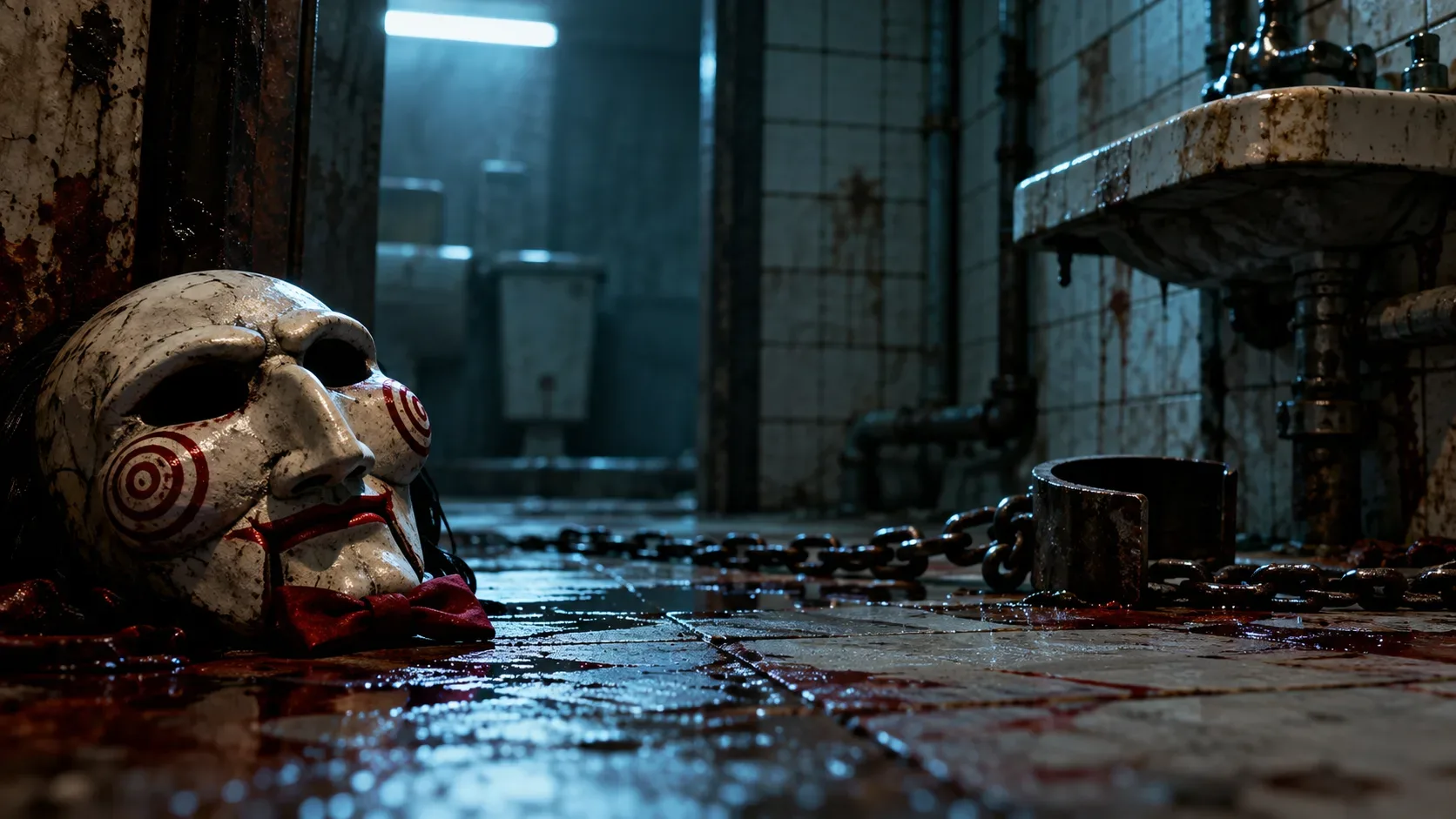
Adam (Leigh Whannell) wakes in a bathtub and, as he moves, lets the water drain away. Across the room, doctor Lawrence Gordon (Cary Elwes) regains consciousness with no idea how he got there. Both men have chains fastened around their ankles. Between them lies an apparently dead man with a revolver and a microcassette player, neither of which they can easily reach.
Each prisoner finds a tape with different instructions. Adam is challenged to stop merely watching other people and take action to survive. Gordon must kill Adam by six o'clock; otherwise Alison and Diana, his wife and daughter, will be murdered. This rule turns potential cooperation into a conflict: fulfilling Gordon's test would mean killing the only other person who can help him.
The clues and escape attempts in sequence
- The hacksaws: a clue leads to two saws hidden in the toilet cistern. They cannot cut the chains. After Adam breaks his trying to force the metal, Gordon realizes they are probably meant for cutting off their own feet to free themselves from the shackles.
- The mark on the wall: a fluorescent clue leads to a hidden box with a mobile phone, cigarettes and a lighter. The phone can receive calls but cannot be used by Gordon to summon help.
- The staged death: instructions suggest killing Adam using a cigarette dipped in poisoned blood. The men try to fake his death, but an electric shock establishes that someone is watching and sees through the deception.
- The photographs: Gordon learns Adam had been paid to follow him by former detective David Tapp. One photograph shows Zep Hindle, an orderly at Gordon's hospital. This discovery connects the bathroom to the threat against Gordon's family.
What the flashbacks reveal about Jigsaw and the investigation
The story intercuts the bathroom ordeal with earlier Jigsaw cases. Paul died while attempting to crawl through a maze of razor wire. Mark failed a test involving poison, a safe combination and a flammable substance. Amanda Young survived a trap attached to her head after recovering the key from inside another person's body. These events establish the killer's stated logic: forcing people into extreme situations to prove they value their lives. That does not make the games fair or safe.
Detectives David Tapp (Danny Glover) and Steven Sing (Ken Leung) investigated the traps. A penlight belonging to Gordon was found among the evidence, making him a suspect. During a raid on the killer's hideout, Tapp suffered a wound to his throat and Sing was killed by a gun trap. Tapp became consumed by the case, continued watching Gordon and hired Adam to photograph him.
Another flashback supplies the most important clue, although quietly: Gordon treats John Kramer, a terminal cancer patient, at the hospital, and Zep is associated with the same setting. Before the final revelation, the scene presents John as a patient, not as the man controlling the games.
What happens to Alison, Diana, Zep and Tapp
While Gordon and Adam hunt for a way out, Zep holds Alison and Diana hostage. Alison manages to call her husband and warns him that Adam is withholding information. As the deadline arrives, she fights back against Zep, and shots are fired. Tapp intervenes, allowing mother and daughter to escape the immediate danger, and pursues Zep toward the bathroom. During the chase, Zep shoots and kills the detective.
Not knowing whether his family is safe, Gordon panics. He saws off his own foot to escape the chain and uses the gun held by the apparently dead man to shoot Adam. The shot does not kill the photographer. Zep enters the bathroom to enforce the rules, but Adam fights back and kills him with the toilet cistern lid. Bleeding heavily, Gordon crawls away to get help and promises to return. The first film does not show whether he keeps that promise or establish Gordon's eventual fate.
Ending explained: why wasn't Zep Jigsaw?
Adam searches Zep's body for the key to his chain and finds another tape. The recording reveals that the hospital orderly was also being tested: he had been poisoned and was following instructions in hopes of obtaining an antidote. He was a participant in the scheme, not its architect.
Moments later, the supposed corpse in the middle of the bathroom gets up. He is John Kramer (Tobin Bell), the real Jigsaw, who has been in the room as Adam and Gordon argued, searched for clues and made their choices. The apparently dead body allowed both men, and the audience, to rule out the person closest to them.
John explains that the key to Adam's chain was in the bathtub. In the opening scene, when Adam wakes, it goes down the drain with the water before he notices it. Adam tries to attack John with Zep's gun, but receives an electric shock and cannot escape. John turns off the light, leaves and shuts the door, ending the game with Adam still trapped.
Which details are withheld until the final scene?
- The key: the object disappearing into the water at the beginning only gains meaning once John explains what it was for.
- The body on the floor: the apparent suicide is staged. The culprit is visible throughout the film without being identified.
- Zep as the suspect: the hostage situation, surveillance and his arrival at the bathroom suggest he is in charge; his own tape overturns that assumption.
- John at the hospital: the patient appeared in an earlier scene, but the story withholds the link between him and Jigsaw until the end.
What the original leaves unresolved and what belongs to the sequels
At the end of Saw (2004), Adam is alive, chained and abandoned in the bathroom. His death is not shown in that last scene. Gordon manages to leave the room, but his medical treatment and ultimate fate are not depicted either. Later films revisit these characters and add details about how the game was prepared. Those retroactive revelations should not be presented as scenes shown in the original film.