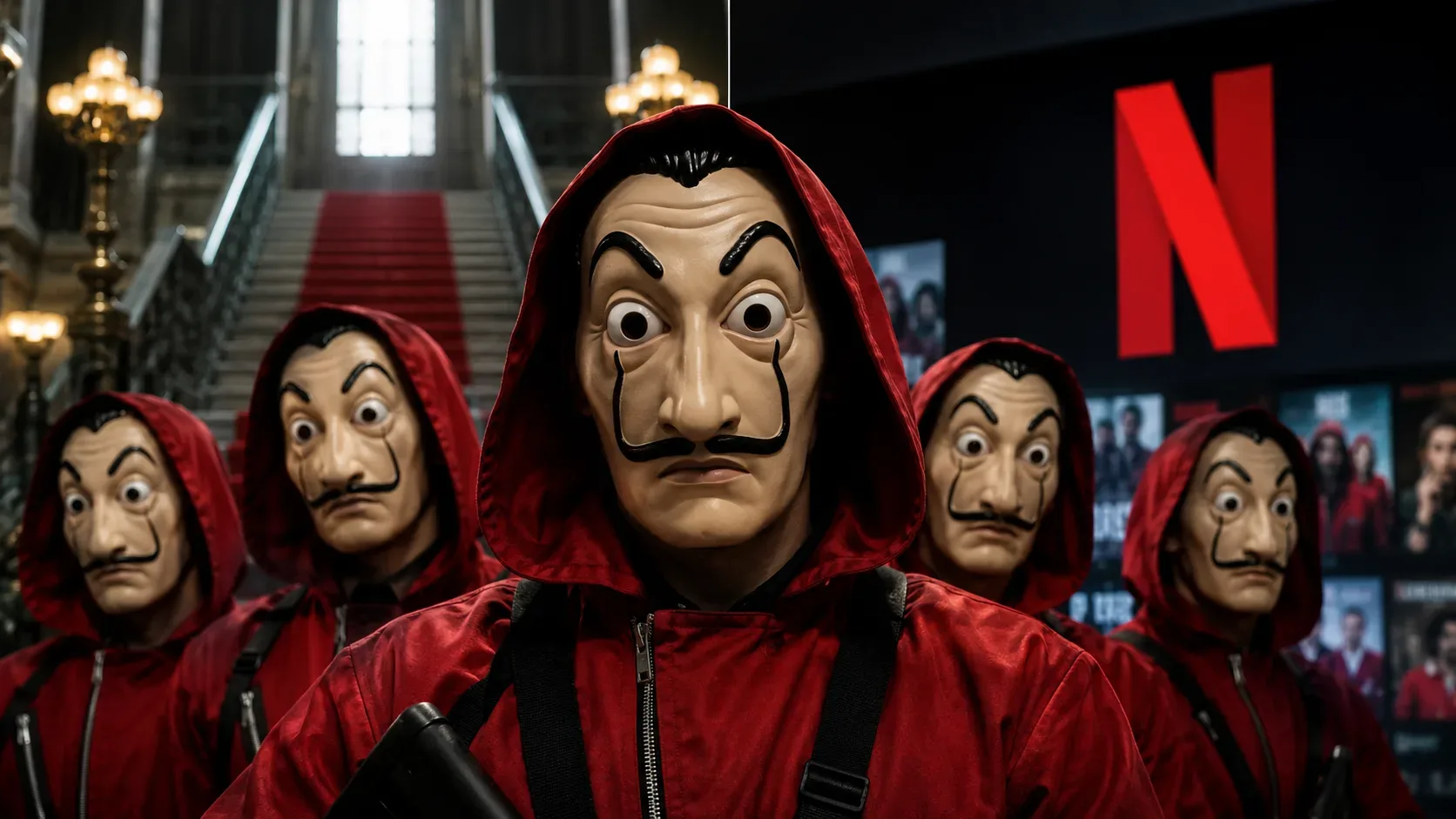
No. Money Heist: Korea - Joint Economic Area is a South Korean remake of the Spanish series La Casa de Papel, not a sequel. Released in 2022, it revisits the idea of a crew assembled by the Professor to take over a mint, but introduces its own versions of the characters. The backdrop is a fictional rapprochement between North and South Korea. Hahoe-inspired masks replace the Salvador Dalí masks as the new robbery's visual signature.
Why is it a remake rather than a continuation?
Netflix announced the project on January 18, 2022, as a Korean adaptation of the Spanish hit, and subsequently described it as a remake. Familiar names and dramatic roles are reworked within a new story. The series is not presented as what happened after the Spanish gang's heists.
For example, Yoo Ji-tae's Professor fills the role played by Álvaro Morte in the original, but he is not presented as the same man later in life. The resemblance helps audiences recognize the storytelling framework; it does not establish a shared timeline.
What is the Joint Economic Area in the story?
The drama takes place in an alternative near future in which the two Koreas move toward reunification and establish a zone of economic cooperation where the peninsula is divided. In this fictional setting, the former Demilitarized Zone becomes home to the United Korea Mint, where a new shared currency is to be printed.
Reunification here is a fictional premise, not a real-world event. The show explores the gap between promises of prosperity and the benefits actually felt by ordinary people. In material published by Netflix in May 2022, writer Ryu Yong-jae explained that the adaptation brings tensions, mistrust and possibilities for cooperation between people from the North and South into the story. Those pressures affect both the thieves and the authorities trying to stop them.
The robbery keeps a key piece of the original plan: occupy a mint and produce money on-site, rather than simply emptying a vault of existing banknotes. What changes is the significance of the currency. In the Korean version, the gang targets the new money tied to an economic integration project whose inequalities the story questions.
Why do the thieves wear Hahoe masks instead of Dalí masks?
In the Spanish series, red jumpsuits are paired with masks modeled on the face of Salvador Dalí. The Korean crew keeps the jumpsuits but adopts masks inspired by the traditional Hahoe masks associated with Andong, South Korea. Netflix Tudum notes that this mask tradition has also been used to mock and criticize those in power.
The visual change fits the relocation of the story. A symbol closely associated with the Spanish show's imagery is replaced by a Korean cultural reference that can carry its own social commentary. It is not evidence that the two crews inhabit the same fictional universe or have exchanged disguises.
Money Heist versus Money Heist: Korea: the key differences
| Aspect | Spanish original | South Korean remake |
|---|---|---|
| Continuity | The original story of the Spanish robbers. | A new retelling, not a continuation of the Spanish plot. |
| First heist setting | The Spanish Mint. | The United Korea Mint in a fictional joint economic zone. |
| Money-making plan | Print money inside the mint. | Print the new shared currency of the Koreas' economic integration. |
| Broader conflict | Robbers, hostages and authorities in a Spanish setting. | Thieves and authorities from both sides of the peninsula amid political tensions. |
| Masks | Stylized Salvador Dalí faces. | Masks inspired by the Hahoe tradition. |
| Code names | Professor, Tokyo, Berlin, Denver, Nairobi and others. | Many of the same aliases, assigned to newly interpreted characters. |
Do the matching character names mean they are the same people?
No. Netflix's character guide identifies deliberate counterparts. Yoo Ji-tae plays the Professor who plans the heist; Park Hae-soo portrays Berlin, who leads the robbers inside the mint; and Jun Jong-seo takes on Tokyo. In the Korean retelling, Tokyo has a distinct background as a North Korean migrant worker, linking her story to the new setting.
The police have a counterpart too. Kim Yunjin plays Seon Woo-jin, the South Korean negotiator whose dramatic role resembles that of Raquel Murillo, played by Itziar Ituño in Spain. Denver, played by Kim Ji-hun, retains the father-son connection with Moscow, played in the remake by Lee Won-jong. These are parallels in roles and relationships, not appearances by the original actors or returns of the original characters.
Do you need to watch the Spanish show first?
No. The remake introduces its own Professor, gang, hostages and fictional political backdrop. Viewers familiar with the Spanish series will recognize the aliases, outfits and mint strategy, but the meaningful difference lies in how the adaptation reshapes those elements through the relationship between the two Koreas.
Sources and references
- Netflix, official adaptation announcement (January 18, 2022)
- Netflix, Hahoe mask and setting reveal (April 29, 2022)
- Netflix, story and shared currency background (May 20, 2022)
- Netflix Tudum, setting and mask background (July 1, 2022)
- Netflix Tudum, comparison with the Spanish heist (June 10, 2022)
- Netflix Tudum, cast and character guide (March 5, 2024)