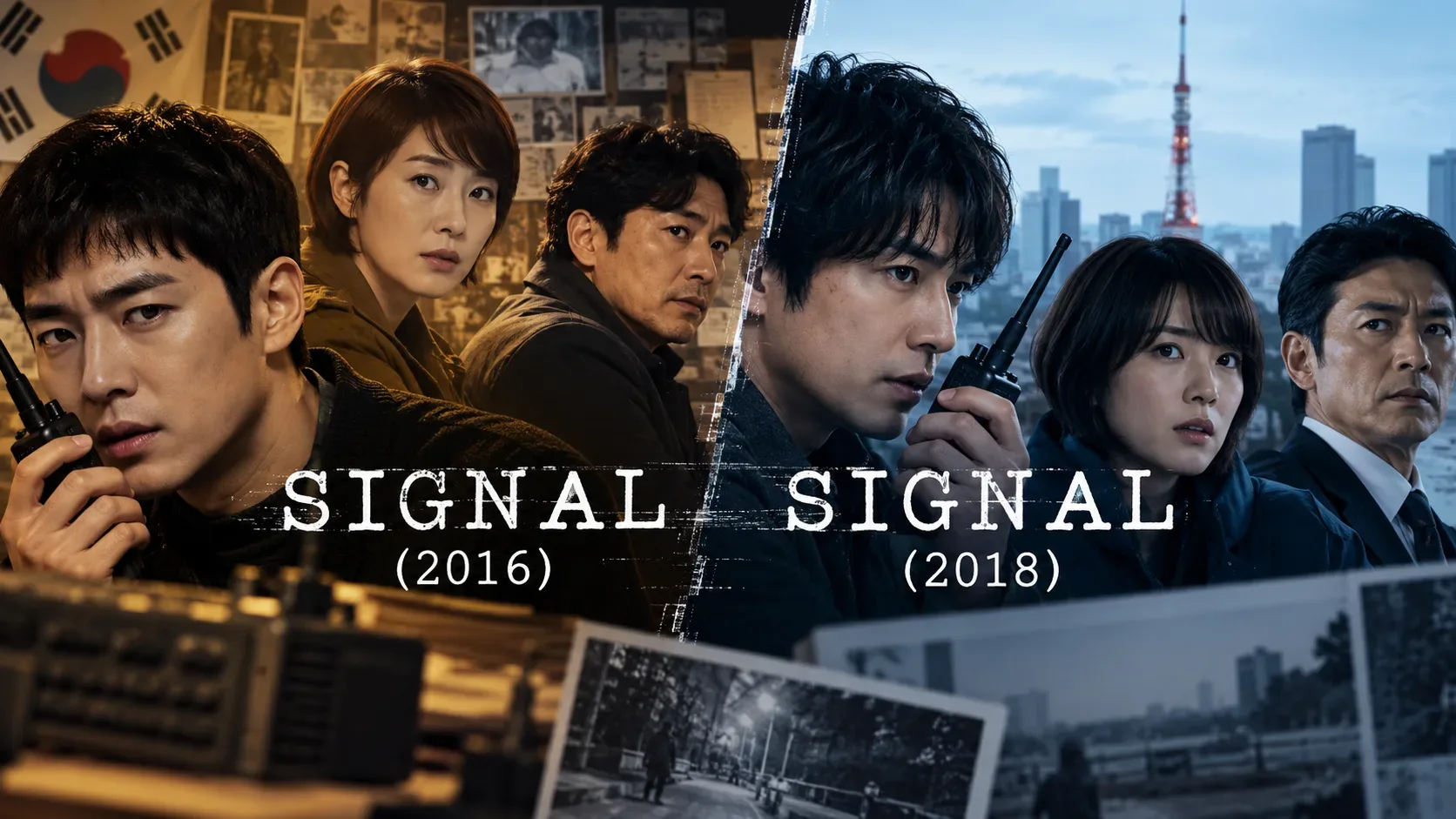
The 2018 Japanese Signal is an authorized remake of the 2016 South Korean drama, not its sequel. Both stories use radio contact between investigators living in different periods, but the Japanese production retells that premise with its own cast, characters and setting. Kansai TV identifies the Korean show as the original, while contemporary reporting documents the sale of remake rights.
What confirms that Signal (2018) is a remake?
On February 1, 2018, Soompi reported, citing a Studio Dragon source, that the adaptation rights had been sold to Kansai TV following an agreement with production company A Story. That is journalistic reporting about the deal, not the underlying contract. More direct editorial confirmation comes from Kansai TV itself: its programme materials name Signal, written by Kim Eun-hee and associated with Studio Dragon and ASTORY, as the original drama.
The Japanese production is titled シグナル 長期未解決事件捜査班 and is marketed internationally as Signal. Masaya Ozaki is credited with writing the adapted screenplay. The shared name and mysterious radio therefore reflect an official adaptation relationship, rather than a story taking place after the Korean series.
Korean vs Japanese Signal: the documented differences
| Feature | Signal (2016), South Korea | Signal (2018), Japan |
|---|---|---|
| Original broadcast | tvN, January 22 to March 12, 2016 | Kansai TV/Fuji TV, April 10 to June 12, 2018 |
| Episode count | 16 | 10 |
| Principal announced cast | Lee Je-hoon, Kim Hye-soo and Cho Jin-woong | Kentaro Sakaguchi, Kazuki Kitamura and Michiko Kichise |
| Writing credits | Kim Eun-hee, writer of the original drama | Masaya Ozaki, adaptation screenplay |
| Story context | Investigators and cases set in a South Korean environment | Characters and investigations framed within Japanese policing |
The Korean dates and cast are listed by tvN, whose episode guide reaches episode 16. Kansai TV’s international catalogue confirms ten Japanese episodes, with a longer opening instalment. This is a genuine structural difference, but 16 versus 10 does not establish that six episodes were simply removed.
What stays the same, and what is reinterpreted?
The central device survives: an impossible radio transmission links police officers across time and allows them to revisit unsolved crimes. In the Japanese synopsis, Kento witnessed a girl’s abduction as a child, was dismissed by the police and, fifteen years later, hears a detective from the past through a radio due to be discarded. tvN describes the Korean original as present-day and past investigators reconnecting to reopen cold cases.
Changes to the names, performers and institutional setting show how the concept was localized. However, establishing exactly which crimes, character arcs and scenes correspond would require an episode-by-episode comparison. The official descriptions and announcements consulted do not justify claiming that Japanese episode one exactly reproduces Korean episode one, or that every case was either retained or replaced.
Is the 2021 Japanese film a sequel?
There is a later production within the Japanese adaptation’s own branch. Kansai TV describes the Signal feature film, released in Japanese cinemas on April 2, 2021, as an original story spun out of its 2018 series. This extends the Japanese version; it does not turn the 2018 television remake into season two of the South Korean drama.
Which version should you watch first?
Start with the 2016 Korean series if you want to see the source drama. The 2018 Japanese series then offers a way to compare its reinterpretation with a different cast and cultural setting. The remake’s premise can also be followed independently: official materials do not present it as a later chapter in the Korean storyline. This comparison addresses the productions and their original formats, not their current availability on streaming services in any particular country.