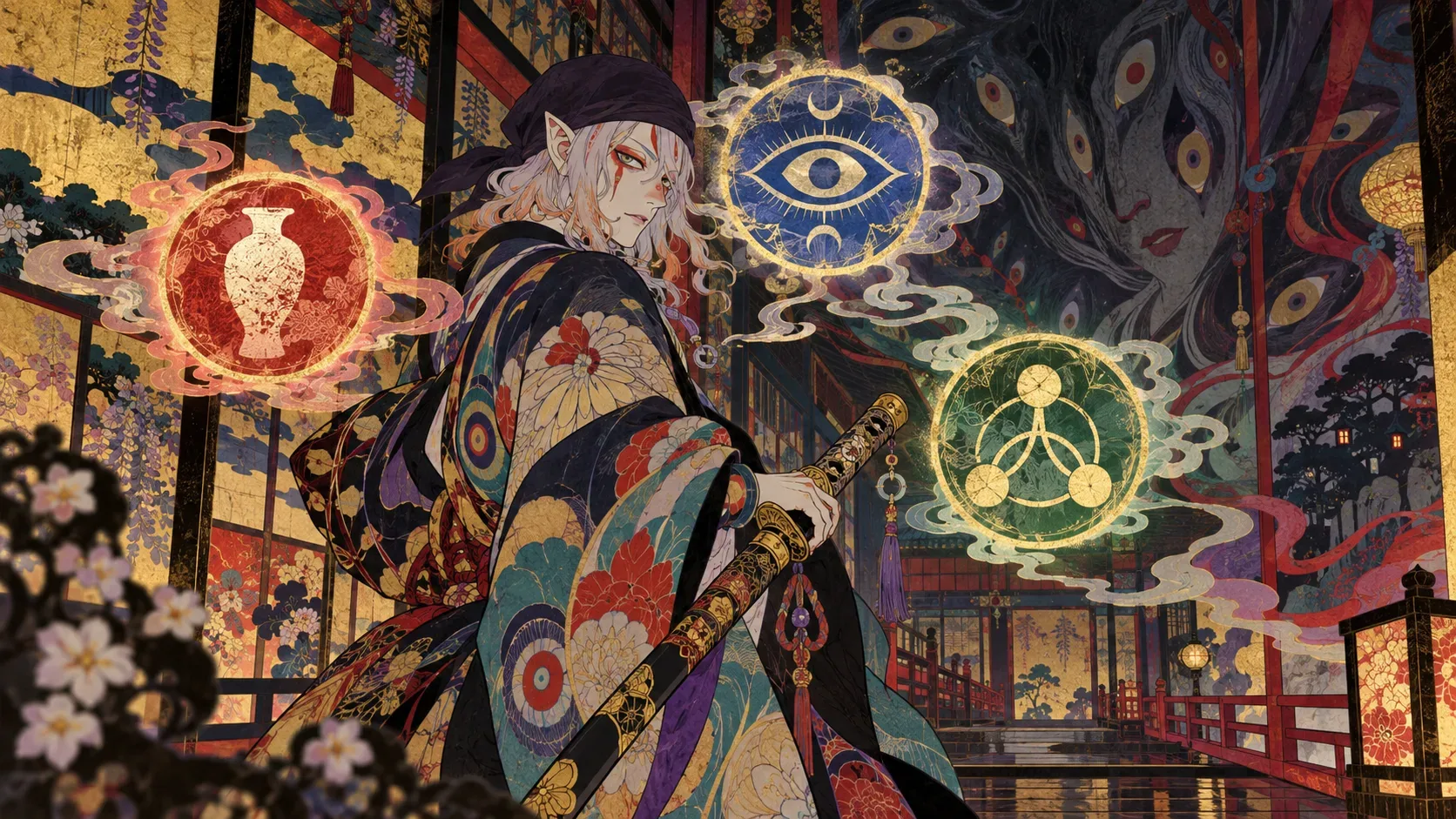
In Mononoke, the Medicine Seller can draw his exorcism sword only after uncovering three aspects of the entity he faces: Form (katachi), Truth (makoto) and Reason (kotowari). In practical terms, he must discover what the apparition is, what happened and why that emotion became a threat. Seeing the monster, finding a clue or being powerful enough to fight it is not sufficient.
This is an explicit restriction of the fictional world, present in the 2007 TV series and reaffirmed in official materials for the feature films. Each element can be explained, but it is important not to turn a narrative interpretation into a technical system that the work never fully codified.
Mild spoiler warning: this article mentions the premise of a TV story arc and the central investigation in the films, without revealing their endings.
Form, Truth and Reason answer three different questions
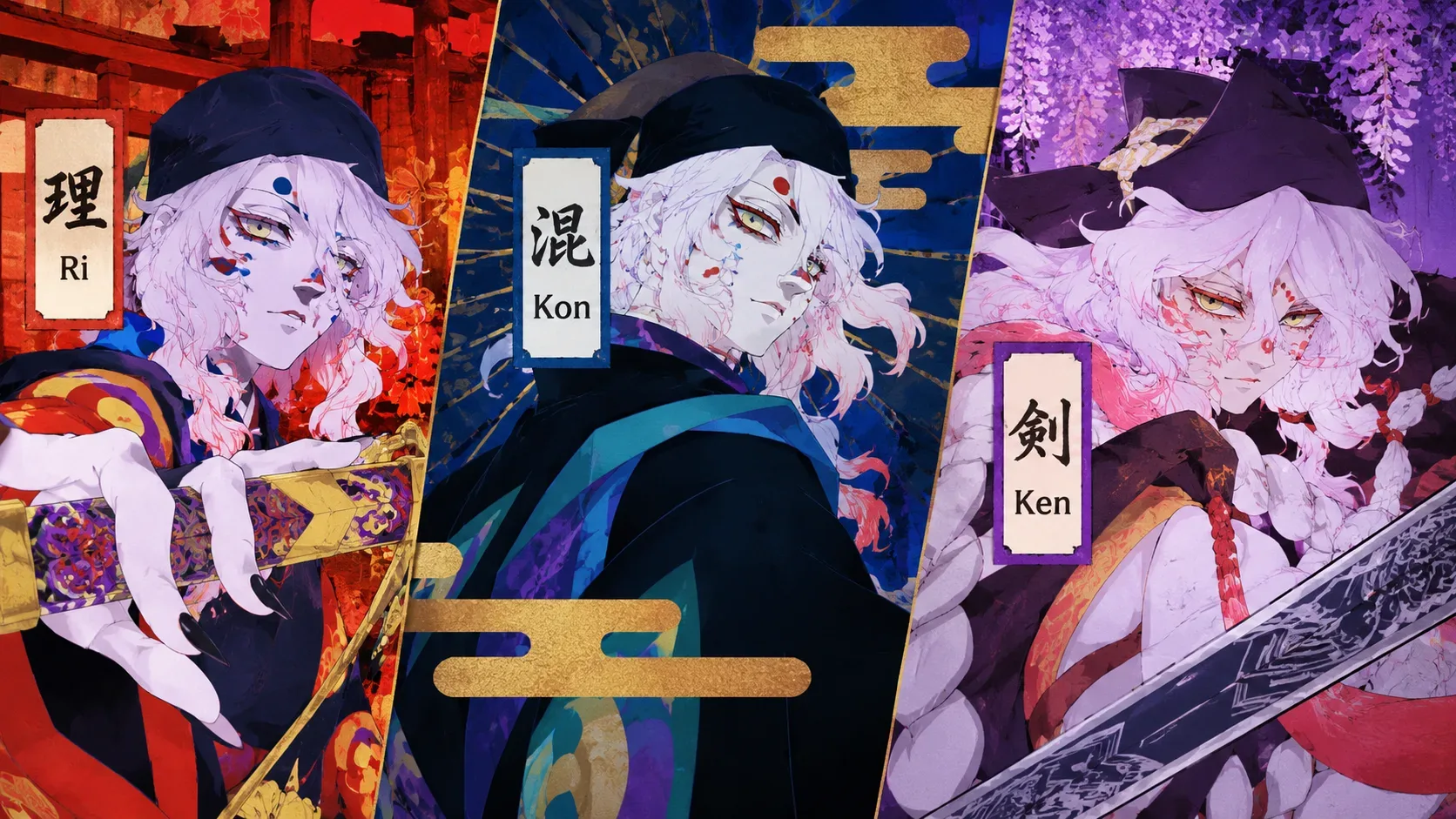
Official materials use the Japanese characters 形, 真 and 理 and state that all three must be established. In unpacking their roles, FILMAGA’s analysis distinguishes identifying the entity, uncovering a hidden past and understanding the emotion behind the curse. That reading fits the official synopses, but it is not a rulebook prescribing a fixed checklist of clues.
- Form (katachi): the identity or nature of the supernatural manifestation, often the kind or name of the ayakashi. Merely seeing its outline does not settle the question.
- Truth (makoto): the events that actually lie behind the case, including facts omitted, distorted or concealed by the people involved.
- Reason (kotowari): the state of mind, attachment, desire or resentment explaining why the entity became a mononoke. Here “reason” means cause and motivation, not being morally right.
The three dimensions are connected: recognizing the creature does not explain the human history sustaining it, and knowing the facts does not automatically reveal the feeling that turned them into a haunting.
Why does the sword remain sheathed even when danger is visible?
The official movie website’s equipment section is unambiguous: the sword cannot be drawn until Form, Truth and Reason have been shown. The delay therefore does not mean the Medicine Seller lacks skill or chooses to prolong the fight. The weapon itself is bound to the discovery of all three aspects.
The original series provides a particularly clear example. The official summary of the Zashiki Warashi arc identifies the supernatural entity, yet says the protagonist still needs to obtain its Truth and Reason by questioning people at an inn. Knowing which mononoke is present does not mean he can already exorcise it.
The official premise for the 2024 film Mononoke The Movie: The Phantom in the Rain follows the same logic: investigating the Ōoku’s concealed past is necessary to make the exorcism possible. This confirms that the condition remains in place without requiring the mystery’s answers to be spoiled here.
How are human emotions connected to a mononoke?
The official film introduction describes a mononoke as an apparition created when intense human emotions combine with an ayakashi, a supernatural presence. So the challenge is not simply to locate an external threat: the case involves relationships, suffering and desires that must be understood.
That origin clarifies the difference between Truth and Reason. Truth reconstructs the events; Reason seeks the emotional impulse connecting those events to the manifestation. Narratively, this makes the horror story an investigation in which listening to those involved is part of confronting the threat. It does not mean that every angry person automatically creates a mononoke, or that the sword passes moral judgment on who deserves forgiveness.
What can the Medicine Seller do before the exorcism?
The sword is not his only tool. According to the official equipment descriptions, scales point toward a mononoke, while talismans can keep it at bay or be used for protection and attacks. The same source notes that talismans become less effective against more powerful forces.
These tools help him investigate, locate the threat or buy time. They do not replace the three revelations required to draw the sword. The film materials also mention up to 64 exorcism swords, including eight special ones; that expansion of the mythology does not remove the core rule.
Did the rule change between the 2007 anime and the movies?
The official sources consulted provide no evidence that the movies discarded Form, Truth or Reason. Distributor Asmik Ace described the three conditions for the 2007 series, and the official movie pages and Netflix repeat the restriction on drawing the sword.
In an interview published by MANTANWEB in March 2025, director Kenji Nakamura described a change in dramatic scale: the television series focused more on individual emotions, while the films allowed him to explore friction between personal experience and social structures. That helps explain why the movie mysteries can be broader, without confusing the thematic development with a change to the rules of exorcism.
The sources establish that all three conditions are necessary, but they do not lay out a universal procedure with a mandatory order of clues, a fixed number of questions or an identical answer for every case. That is the boundary of the canonical explanation: the sword requires an understanding of the apparition, its history and its motivation, not merely victory in a fight.
Sources and references
- Official movie website: exorcism tools and sword
- Official movie website: setting and synopses
- Asmik Ace: overview of the original TV series
- 2007 anime website: Zashiki Warashi episode overview
- Netflix: official introduction to The Phantom in the Rain
- MANTANWEB: 2025 interview with Kenji Nakamura
- FILMAGA: attributed analysis of the three conditions