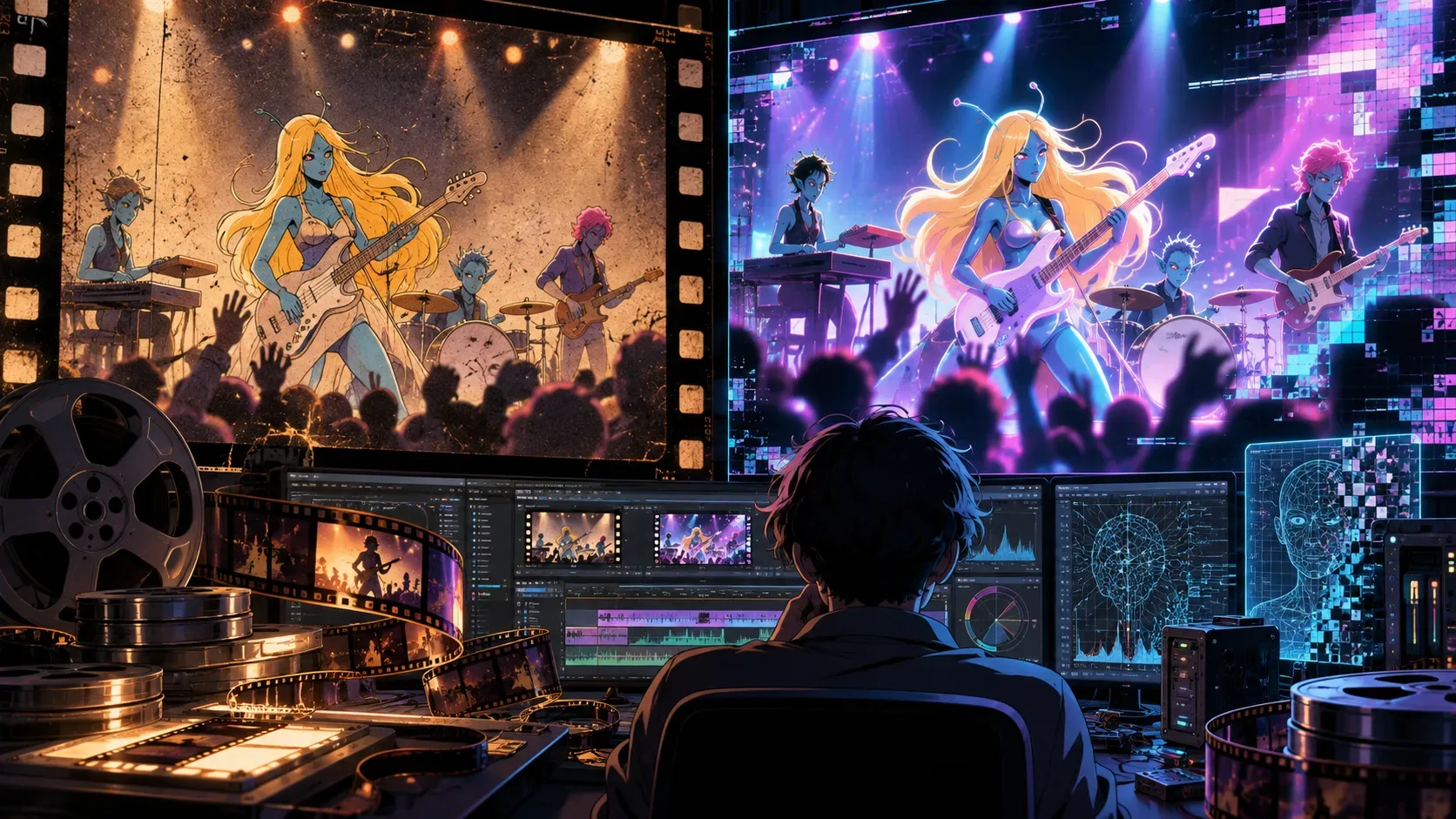
The 4K remaster of Interstella 5555 used an artificial-intelligence tool, according to statements by Cédric Hervet reported by ABC News. The controversy grew when viewers spotted outlines and details in the promotional footage that they considered artificial or excessively smoothed. Three points need to remain distinct: the reported use of AI in production, the visual objections raised by some viewers, and the technical specifications that have not been made public.
Released in 2003, the musical feature turns Daft Punk's 2001 album Discovery into a dialogue-free animated story. Directed by Kazuhisa Takenouchi, supervised by Leiji Matsumoto and produced by Toei Animation, it returned to screens in 2024 in a presentation advertised as a 4K remaster. That label describes the new presentation format, but does not, by itself, establish that a native 4K source existed.
Why did the team turn to AI?
ABC News's December 12, 2024 report explains the process through a preservation obstacle. According to its reporting, the animation was created digitally in NTSC, the video standard used in Japan, and subsequently converted to PAL, the format used in France. That conversion introduced limitations to the resolution and frame cadence of the material available for the rerelease.
Hervet, a co-writer of the film and a longtime Daft Punk collaborator, said at a Los Angeles Q&A that the team had been unable to obtain the source file from Japan. ABC reported that the work instead started with a master that had already been converted to PAL. This does not establish that all original files have been lost or that anyone comprehensively inspected the Japanese archive.
ABC places the start of Hervet's work with a Paris studio in January 2024. At another public discussion, he described an algorithm designed for anime that aimed to preserve the animation's drawn strokes. The report also relays the claim that the film was watched repeatedly to check its frames. These are accounts attributed to participants and journalistic reporting, not an independent technical audit.
Does a 4K remaster recover the original artwork?
No. Restoration may involve scanning, color correction and defect removal based on available source material. Resolution enlargement, often called upscaling, must estimate new pixels when the source contains less information than the output image. AI tools can help make those estimates, but they do not automatically recover lines and details that were never recorded in the material being processed.
This distinction explains the disagreement. One viewer may find that reduced noise and clearer edges make a film easier to watch on a large screen; another may feel the same processing alters line weight, texture, or the appearance of faces and backgrounds. Distinguishing faithful cleanup from interpretive reconstruction requires knowledge of the source and method and a controlled comparison, not just a 4K label.
How did the controversy unfold in 2024?
- 2003: the original film reached audiences as a visual companion to Discovery.
- June 2024: Tribeca Festival presented a version identified as remastered in 4K and highlighted its North American premiere.
- October 30, 2024: Crunchyroll reported the announcement of international screenings scheduled for December 12 through distributor Trafalgar Releasing.
- November 13 and 14, 2024: the trailer released as ticket sales began prompted criticism, covered by DJ Mag on November 14.
- December 12, 2024: the announced international screening date arrived, as documented by Trafalgar and ABC.
The sequence matters because the public debate intensified around the November trailer, even though the remaster had already screened at festivals and special events months earlier. This is not a new announcement from 2026.
What did critics object to, and where did opinions differ?
In its November coverage, DJ Mag collected fan comments linking the new look to AI processing and complaining about lost details and overly smoothed lines. ABC also documented unfavorable comparisons between editions and criticism across social platforms. These are recorded viewer reactions, but they do not, on their own, prove which technique caused each perceived flaw.
The response was not unanimous. ABC also reported on viewers who valued the chance to see the film in a theater despite reservations about the image. The debate therefore raises two separate questions: whether the processing preserved the look of the 2003 animation, and whether the rerelease improved access to the film. Accepting one claim does not require accepting the other.
What remains publicly undocumented?
The sources consulted do not identify the AI software or model, its parameters, the exact processing stages, or a complete inventory of surviving original assets. Nor do they offer an independently audited frame-by-frame technical comparison capable of isolating which changes arose from the earlier video conversion, the PAL source, or the processing carried out in 2024.
Hervet's statement supports the narrower conclusion that the team could not obtain the Japanese source file for this project. It does not justify claiming that the file no longer exists, that the team accessed the original negatives or digital production assets, or that it intended to distort the artwork. The case remains useful for discussing the preservation of older digital animation: increasing resolution and faithfully preserving an image are related aims, not identical ones.
Sources and references
- ABC News / Double J: Al Newstead on the remaster and Hervet’s statements
- Crunchyroll News: announcement of the remastered international screenings
- Tribeca Festival: 2024 4K screening program
- Trafalgar Releasing: official December 2024 screening page
- DJ Mag: coverage of the November 2024 trailer backlash