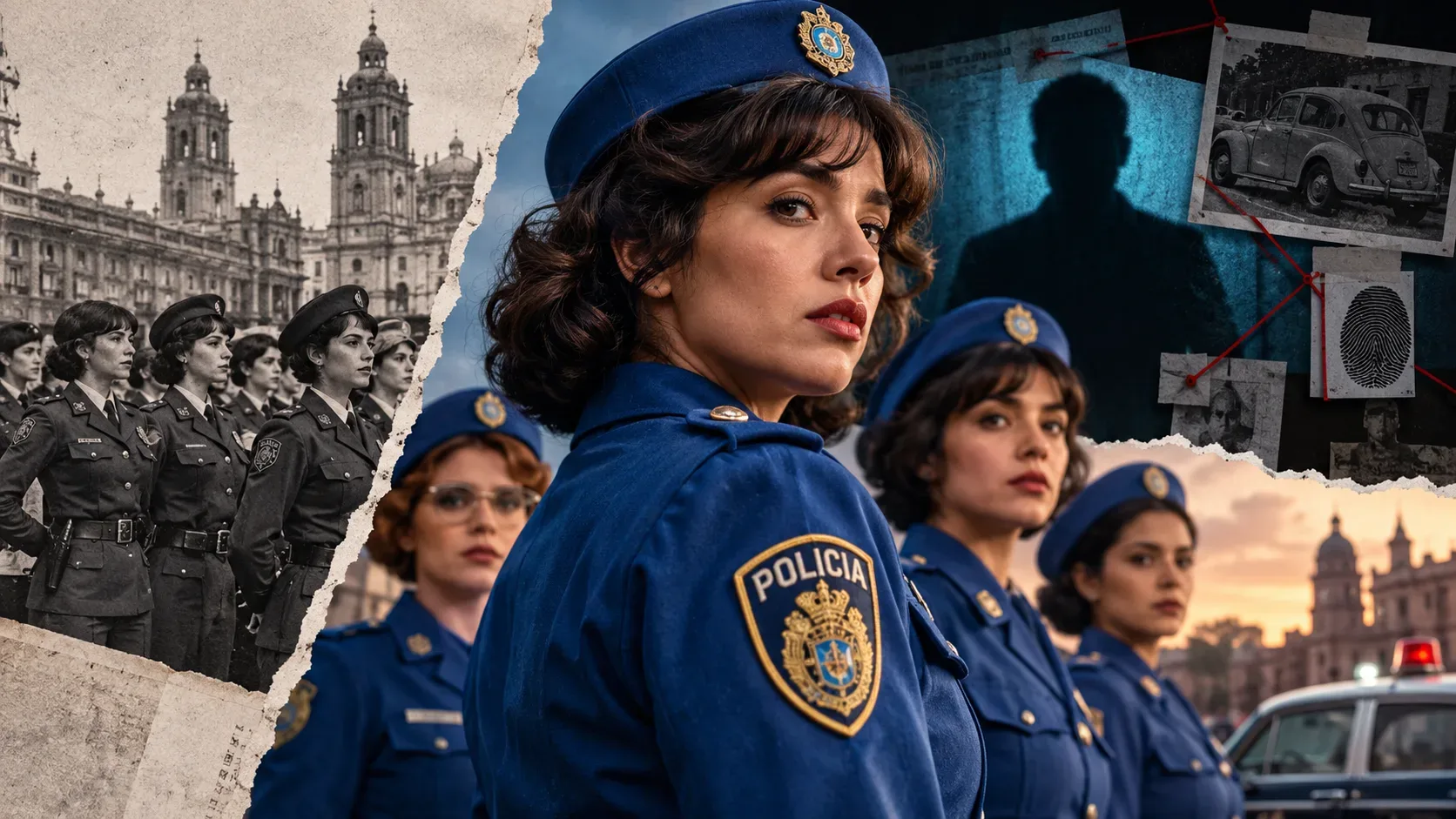
Women in Blue draws on women's entry into the Mexico City police and the obstacles they faced, but it does not recreate a real murder investigation. The series sets its story in 1971; according to Fernando Rovzar, the serial killer pursued by the main characters was invented for the drama. There is also a crucial historical distinction: women were already serving in a police corps in Mexico City in 1930. So 1971 cannot accurately be described as the year Mexico first had women police officers.
Did Mexico's first women police officers really appear in 1971?
No. Historian Fabiola Bailón Vásquez documents that Mexico City newspapers announced the formation of a women's police company on December 28, 1929. It began operating in 1930. Its members received training, uniforms and police identification, although they were heavily outnumbered by men and faced different duties and expectations.
Drawing on contemporary newspaper coverage, the study describes work involving women in custody, the protection of children and assignments in public spaces, alongside hostility and mockery aimed at the officers. This changes how the show should be read: the struggle for recognition did not begin from scratch in the 1970s. Earlier institutional efforts existed, even if promotional summaries tend to leave them out.
What happened in the 1970s, and what came from firsthand accounts?
The producers chose a later chapter in women's recruitment to the police, setting the drama in 1971. In interviews with La Jornada and El Universal, co-creator Pablo Aramendi explained that the team reached women connected with the period portrayed and drew on their accounts of training, working relationships and the difficulty of exercising authority in a male-dominated institution.
Aramendi said their duties included watching over schools and parks and helping tourists. He also linked the renewed recruitment effort to an attempt to repair the police's public image after the repression of students in 1968. That connection should be attributed to the co-creator and the interviews gathered by the production: the sources reviewed do not establish that every administrative decision depicted on screen unfolded exactly as shown.
What the show invented: the killer, the case and the main characters
Its central dramatic invention is the serial-killer case that drives four women officers to investigate on their own. Speaking to Reuters on July 25, 2024, Rovzar said that element was created to connect the historical setting with violence against women in contemporary Mexico. The sources examined do not support treating the killer, his victims or the covert investigation as a reconstruction of one documented case from 1971.
María, Valentina, Gabina and Ángeles are the main characters in Apple TV's story. Their personalities, family relationships and police decisions belong to the screenplay, rather than verified biographies of four named pioneers. Aramendi told La Jornada that the team was not telling the private lives of the women they interviewed. Instead, it turned their experiences and emotions into dramatic material.
Two ideas should also be kept separate: the creators' interpretation that recruiting women served the police's public image, and the specific fictional plot in which the squad is used to divert attention from a serial killer. The former appears as an attributed explanation in interviews; the latter is part of the show's premise and must not be presented as a documented historical operation.
Is any real officer identified in connection with Women in Blue?
Yes. There is a documented connection with real women officers, but that does not make the protagonists literal portraits. Apple identified Atala Pérez Rodríguez as a real-life member of the 'Azules' when reporting her attendance at the season-two premiere event in August 2026. That establishes a link between the production and a real officer. It does not establish that Atala is María, Valentina, Gabina or Ángeles, or that their individual stories match hers.
Does season two tell another true story?
Season two premiered on August 12, 2026, with eight episodes released weekly through September 30, according to Apple. María is now a lieutenant, and an investigation into the death of a student activist reaches back to the 1968 student massacre. The reference to 1968 draws on a historical event, but the investigation, suspects and resolutions remain fiction unless independently supported by specific historical evidence.
The most accurate answer is therefore to distinguish three layers: documented history, including women police officers serving as early as 1930; real experiences recounted by the creators, such as discrimination and restrictions on officers' duties; and dramatization, especially the four personal journeys and the criminal cases that propel the series.
Sources and references
- Apple TV Press, season-one announcement and synopsis (June 17, 2024)
- Reuters, Hanna Rantala, interview with Fernando Rovzar (July 25, 2024)
- Fabiola Bailón Vásquez, historical study of the 1930 women's police corps (2020)
- La Jornada, interview with Pablo Aramendi (July 31, 2024)
- El Universal, César Huerta Ortiz's interview with Pablo Aramendi (July 31, 2024)
- Apple TV Press, season-two release and storyline (March 26, 2026)
- Apple TV Press, premiere event featuring Atala Pérez Rodríguez (August 12, 2026)