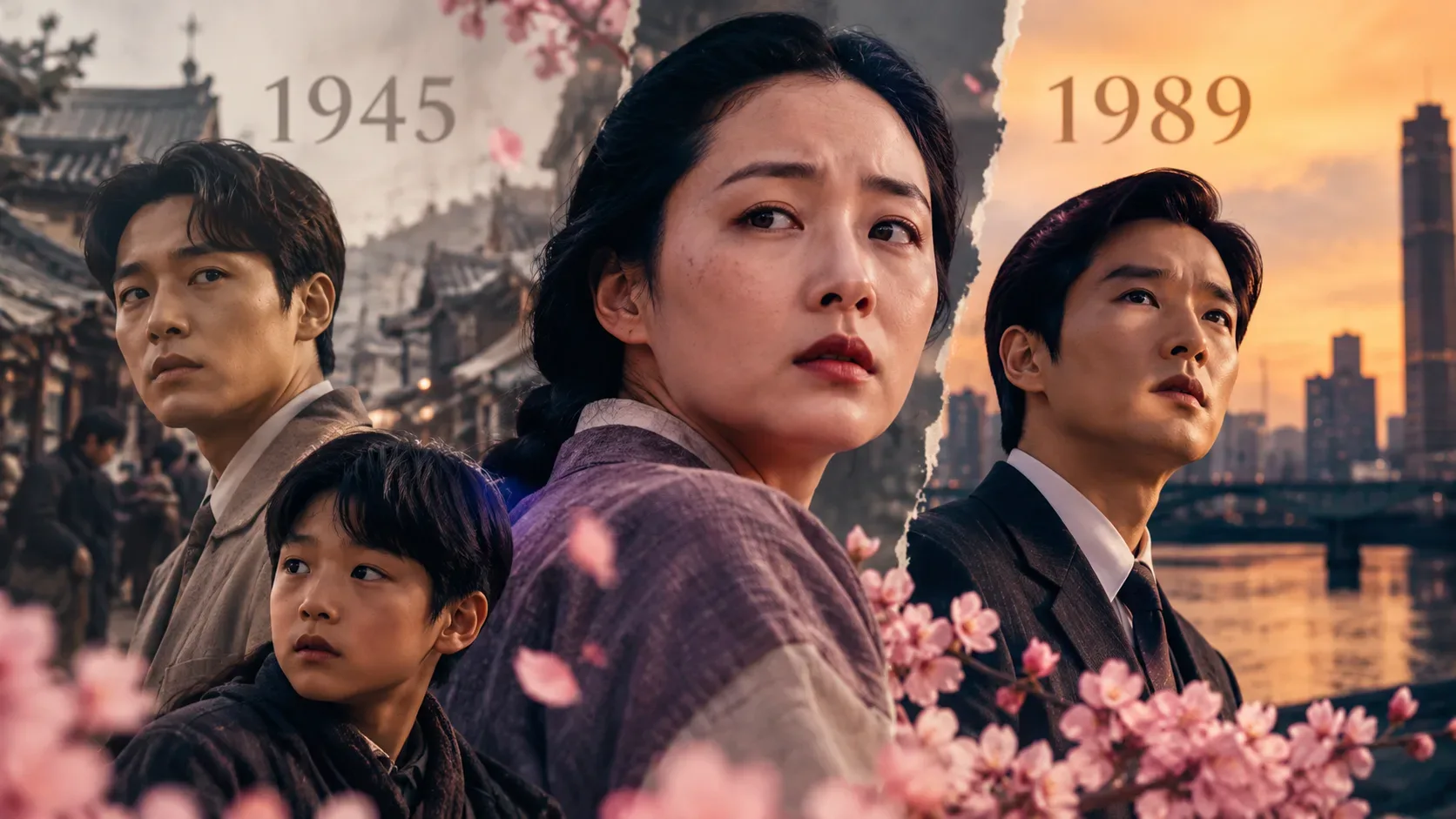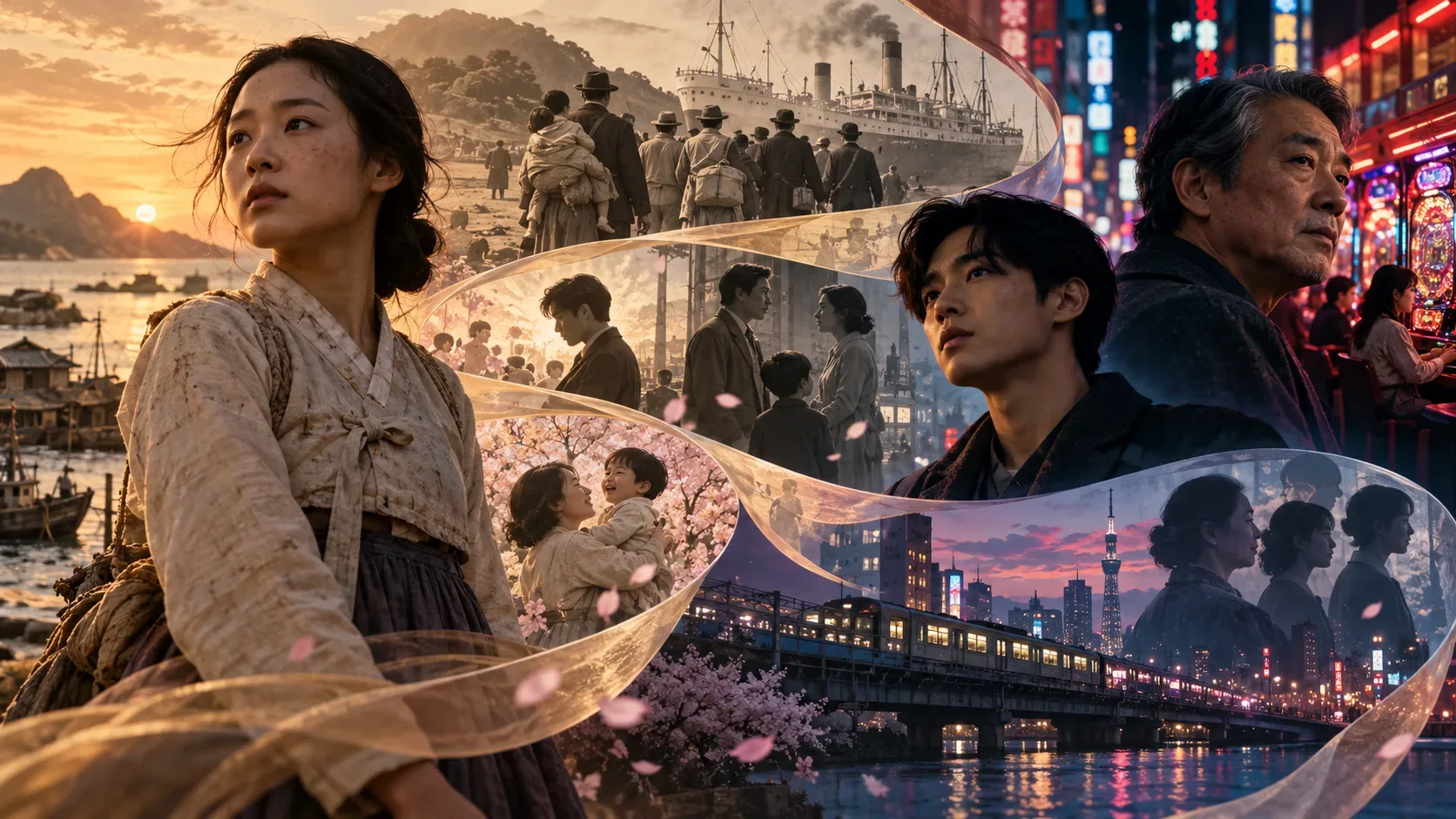
The TV adaptation of Pachinko jumps between decades because creator Soo Hugh wanted young Sunja's experiences and her grandson Solomon's adult life to speak to each other. Min Jin Lee's 2017 novel moves largely forward in chronological order, following the family's successive generations. The Apple TV series, which debuted in 2022, places the past alongside 1989 from the outset, allowing viewers to see one generation's choices and another generation's consequences at the same time.
This is a deliberate adaptation choice, not a timeline mistake. In interviews with ELLE and TheWrap, Hugh explained that she wanted Solomon to have meaningful narrative space from the first episodes, rather than waiting until the family story reached its later years. The show retains the book's family-centered core while changing how the audience discovers the links between generations.
How the novel orders events and the show rearranges them
In the novel, readers encounter Sunja's origins, follow her coming of age, and move through the family's history as the years pass. Her descendants become increasingly important as that story unfolds. The sense of continuity comes from succession: readers learn about older family members' lives before reaching the experiences of younger ones.
On television, the editing establishes two major narrative tracks. One follows Sunja in Korea under Japanese colonial rule and later in Japan. The other follows Solomon in 1989 as he navigates work, belonging, and family relationships. The official synopsis for the very first episode already places Sunja's childhood in 1920s Korea beside Solomon's professional life many decades later.
That does not mean these characters are literally experiencing their events simultaneously. Rather, the show creates simultaneity for the viewer: distinct historical periods are intercut so that one situation can cast new light on another.
Pachinko's parallel chronology in three stages
The chart below is a reading guide, not an exhaustive timeline of every scene or year. It shows how the series brings its major narrative strands together.
| Period and storyline | In the novel | In the series |
|---|---|---|
| Early twentieth century: Sunja's origins in Korea | Forms the opening stretch of the family story. | Appears from the opening episodes, intercut with 1989. |
| 1930s and 1945: Sunja's life in Japan | Belongs to the family's forward-moving history. | The past continues to unfold while the edit returns to Solomon. Season two resumes Sunja's story in Osaka in 1945. |
| 1989: Solomon and the younger generation | Belongs to a later phase of the saga. | Has its own narrative track from season one and continues alongside the earlier story. |
Apple's official season-two announcement confirms that the same structure continues, with storylines unfolding in Osaka in 1945 and Tokyo in 1989. The season premiered on August 23, 2024. The time shifts, then, are not merely a device used in the premiere.
Why does Solomon need to appear so early?
Hugh told ELLE that a strictly linear version could have centered on Sunja's coming of age. She also wanted to explore Solomon's development, shaped by experiences he did not live through himself. Placing the two characters alongside one another allows the series to compare generations without treating either as merely an explanation for the other.
The contrast matters. Sunja faces hardship and displacement against a historical backdrop of colonial rule and migration. Solomon operates in corporate settings in 1989, yet his opportunities do not erase questions of identity and belonging. Intercutting their stories reveals different circumstances as well as inherited connections. This structural reading does not imply that their experiences are equivalent.
In her TheWrap interview, the showrunner described the format as an urgent conversation between generations. That captures the adaptation's central move: instead of saving consequences until the end of the journey, it shows them while still exploring the circumstances that helped produce them.
How cinematography connects past and present
The production could have used sharply different visual filters to label each decade. Instead, it made a subtler choice. Cinematographer Florian Hoffmeister told TheWrap that he and Kogonada agreed not to distinguish the two time periods too strongly through their visual appearance. They wanted continuity in Sunja's experience and an emphasis on the places that anchor family memory.
As a result, audiences follow shifts in time through context, characters, locations, and editing rather than relying solely on a color assigned to each era. This fits the idea that earlier events remain present in the identity of later generations. It is an interpretation of the show's form supported by the crew's comments, not a claim that every scene was devised in exactly the same way.
Does changing the timeline make the show less faithful?
Fidelity and chronology are separate questions. The novel builds its multigenerational scope by moving forward through time; the series achieves part of that effect through juxtaposition. Both approaches give weight to Sunja, her family, and the legacy of their decisions, but they create different experiences of discovery. The adaptation also makes creative choices beyond the time structure, so describing it as nothing more than shuffled chapters would be misleading.
The simplest way to keep track is to distinguish when an event takes place from when the story shows it. In the novel, those two movements stay more closely aligned. In the series, their separation is precisely what brings Sunja and Solomon into conversation. That is the central reason behind Pachinko's interwoven timelines.
Sources and references
- Hachette Book Group: original 2017 edition of Pachinko
- Apple TV Press: first-season announcement
- Apple TV Press: episodes and synopses
- Apple TV Press: season-two parallel storylines
- TheWrap: Soo Hugh on adapting the novel
- ELLE: Soo Hugh explains the timelines
- TheWrap: Florian Hoffmeister on cinematography