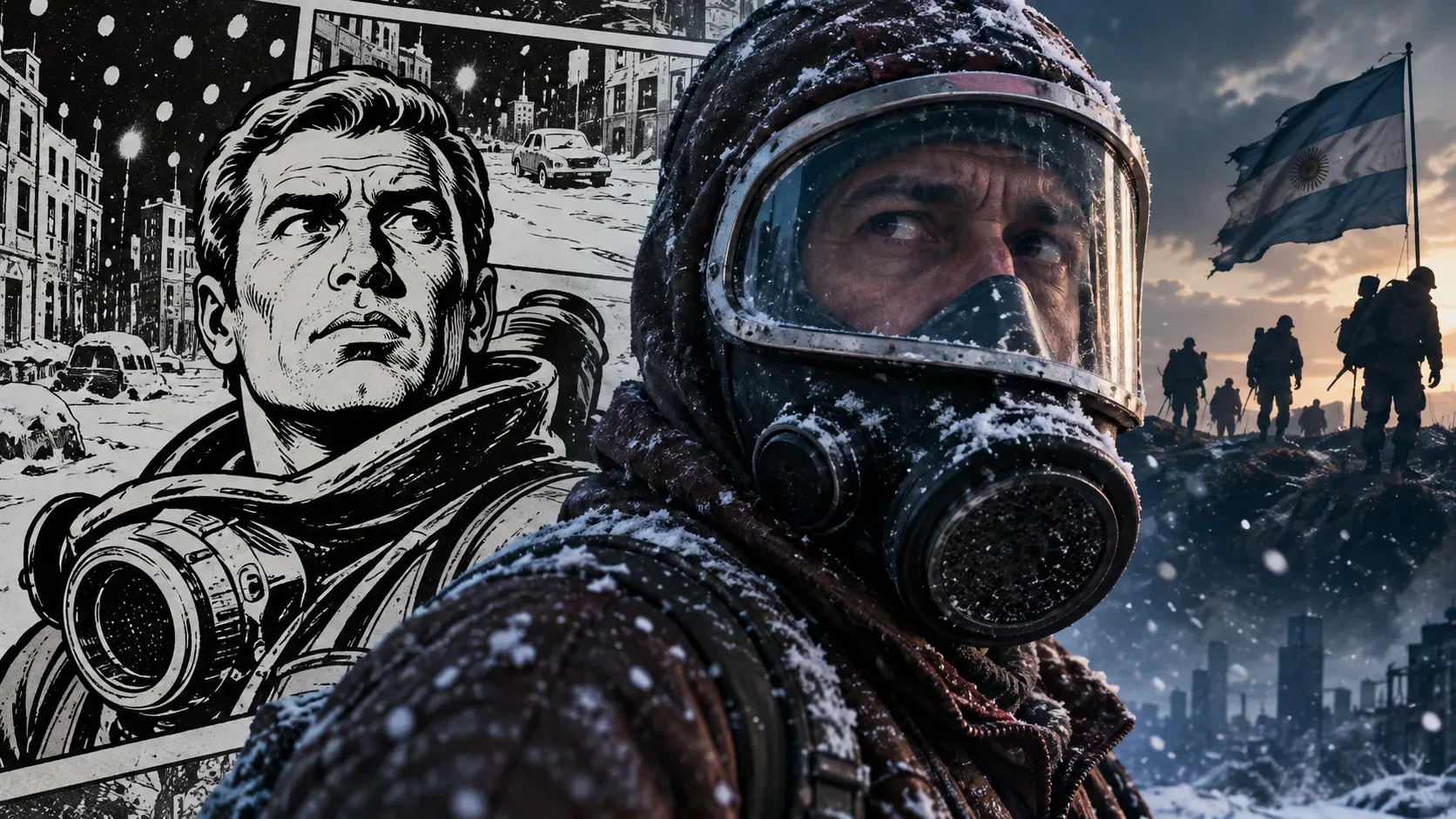
Netflix's The Eternaut made Juan Salvo a veteran of the 1982 Falklands/Malvinas War to give his familiarity with weapons a credible background and to connect the resistance against a fictional invasion with a part of Argentina's collective memory. The change also made sense of Ricardo Darín's age as the lead of the 2025 adaptation. Creator and director Bruno Stagnaro described both reasons in interviews and public discussions.
What changed between the 1957 comic and the 2025 series?
Written by Héctor Germán Oesterheld and illustrated by Francisco Solano López, the original story began serialization in 1957 and continued through 1959. Juan Salvo confronts the deadly snowfall in a Buenos Aires familiar to readers of that era. According to Stagnaro, the comic already supplied a reason for Salvo's marksmanship: he was a reservist and an accomplished shot. The television adaptation did not create an armed protagonist out of nothing. It replaced the explanation for his skills.
The series moves the action into a recognizable present and casts Darín as an older Salvo. Newsweek Argentina describes the original character as being around 40, while the television version is over 60 and has a history of combat. Since the war took place in 1982, that background cannot exist in a story originally set in the 1950s. It belongs to the new screen interpretation, not to an overlooked passage in the original comic.
| Aspect | Original comic, 1957-1959 | Series, 2025 |
|---|---|---|
| Setting | 1950s Buenos Aires, contemporary with its first readers | Buenos Aires updated to a contemporary setting |
| Juan Salvo | A younger protagonist, around 40 according to the published comparison | An older character portrayed by Ricardo Darín |
| Weapons experience | Reservist and skilled marksman, as Stagnaro explained | A fictional past as a veteran of the Falklands/Malvinas War |
| War background | Not part of Salvo's biography because the war had not yet happened | Added to the protagonist's backstory |
How did Ricardo Darín's age lead to the Malvinas connection?
Stagnaro told news agency EFE that he initially worried about casting a man approaching 60 in a physically demanding story. Later, as statements reported by Infobae make clear, he realized Darín was roughly the age someone would be if they had fought in the war as a young man. What once seemed a casting obstacle became a way to shape Salvo's history.
Credibility was another concern. In an interview with Ernesto Ise published by the Buenos Aires Times, Stagnaro contrasted the original comic's reservist explanation with the prospect of showing an ordinary civilian suddenly behaving like an expert sharpshooter. A history of military service in a real conflict offered a narrative explanation for Salvo's comfort with firearms. That does not establish that his wartime experience accounts for every decision he makes, or that he is an unbeatable soldier. It establishes the writing rationale the director described.
Why bring a real war into science fiction?
The decision also carried a historical purpose. Stagnaro told the Buenos Aires Times that he wanted to acknowledge a generation of veterans whose experiences have often received too little visibility. During a discussion covered by Infobae, he called Malvinas an enduring wound in Argentine society. Martín Oesterheld, the original creator's grandson and a creative consultant on the series, spoke at the same event about imagining Salvo as a man already shaped by survival, before the lethal snow begins to fall.
That context matters. The war, known as the Falklands War in Britain and the Malvinas War in Argentina, ran from April 2 to June 14, 1982, when Argentina was under military dictatorship and fought the United Kingdom in the South Atlantic. Argentina's Defensoría del Público cautions against separating veterans' experiences from the historical circumstances of the ruling junta that sent troops to the islands. Juan Salvo is fictional; the war, its casualties and its real veterans are not.
What does the adaptation retain from the original?
By updating the 1950s setting, Stagnaro aimed to preserve the shock of a disaster arriving in the audience's own present. He explained to the Buenos Aires Times that the comic was contemporary when first published, and that making the series strictly a period piece would not necessarily reproduce that experience. Netflix describes Juan and his friends acting together against the threat as a central part of the adaptation. His Malvinas background gives him a more specific personal history, but it does not erase the group's role in resisting the invasion.
The distinction between documented intentions and interpretation is important. The filmmakers' use of age, military experience and the memory of veterans to reshape Salvo is documented. Treating every action he takes as a direct allusion to the war would require evidence from particular scenes rather than these interviews alone. The change is best understood as a bridge between two Argentine moments: a comic conceived to speak to readers in 1957 and a series that rebuilds that dialogue for a different generation in 2025.
Sources and references
- Netflix, official series announcement
- Buenos Aires Times, Ernesto Ise interview with Bruno Stagnaro
- Infobae, Patricia Kolesnicov report on the creators discussion
- EFE news agency, interview by Laura Guarinoni and Florencia Pessarini
- Newsweek Argentina, comparison of comic and series
- Argentine Public Defender, historical context of the Falklands/Malvinas War