Spoiler warning: this article reveals the complete plot and ending of The Exorcist (1973), focusing on its original theatrical cut.
Regan MacNeil is freed from possession when Father Damien Karras demands that the entity leave the girl and enter him instead. He briefly regains control of himself and leaps through the bedroom window, falling down the Georgetown steps. His sacrifice saves Regan but costs Karras his life. The film shows these events; the idea that his choice also restores his faith is a religious reading supported by his character arc, not a literal statement made by the ending.
Directed by William Friedkin and adapted from William Peter Blatty's novel, the film follows Chris MacNeil as she searches for an explanation for her daughter's condition, first through medicine and eventually through a ritual led by two priests. The account below covers only the version released theatrically in 1973, without importing scenes restored in 2000.
How do Regan's changes begin?
The story opens in Iraq, where priest and archaeologist Lankester Merrin finds ancient objects and encounters a statue associated with the demon Pazuzu. The sequence visually anticipates his later confrontation with evil, but does not explain in detail how the entity reaches Regan.
In Georgetown, near Washington, actress Chris MacNeil lives with her daughter Regan while working on a movie. Initially affectionate, the girl says she communicates with someone called Captain Howdy through a Ouija board. Unexplained noises follow, along with the sensation that her bed moves by itself and increasingly violent behavioral changes. The story links these events, but never establishes an explicit rule proving that the board caused the possession.
Chris sees Regan come downstairs during a party, make a threatening remark to a guest and urinate on the carpet. On another night she finds her daughter's bed shaking violently. Regan's distress no longer resembles an ordinary change in mood and increasingly puts both her and those around her at risk.
Why can't the doctors solve the case?
Chris consults doctors, takes Regan for neurological examinations and agrees to psychiatric assessments. The specialists consider several explanations, including a brain abnormality or a psychological disorder, but their findings fail to provide a satisfactory answer to the phenomena witnessed by the family. The film follows this process before exorcism enters the picture as a possible course of action.
The situation grows more serious after Burke Dennings, a director and acquaintance of Chris, is found dead at the bottom of the steps beside the house. Detective Kinderman investigates and notices details that make an accidental fall doubtful. Chris fears that her daughter, or whatever controls her, may be involved. The police inquiry raises the stakes, but does not become a conclusive legal judgment against Regan.
As the girl's behavior becomes more frightening, Chris seeks religious help. Her decision comes from exhausting other options and wanting to protect her child, not from a clearly established prior religious conversion.
How does Karras investigate the suspected possession?
Damien Karras is a Jesuit priest and psychiatrist. He is experiencing a crisis of faith aggravated by his mother's illness and death, which leave him feeling guilty for living far away. When Chris approaches him, he does not immediately accept a supernatural explanation. He says the Church requires an investigation before authorizing an exorcism and worries that the ritual could harm someone with a psychiatric illness.
Karras interviews Regan, observes unusual voices and sees how the entity exploits his guilt about his mother. He also tests the manifestations: when Regan reacts to liquid as though it were holy water, he reveals that he used ordinary tap water. The test undermines that particular piece of evidence. Later, disturbing voice recordings, difficult-to-explain phenomena and a plea for help appearing on Regan's skin influence his decision to request the rite.
Permission brings in Merrin, a more experienced priest. Karras does not replace medical inquiry with instant certainty; he hesitates, searches for evidence and eventually agrees to take part in the confrontation.
What happens during the exorcism?
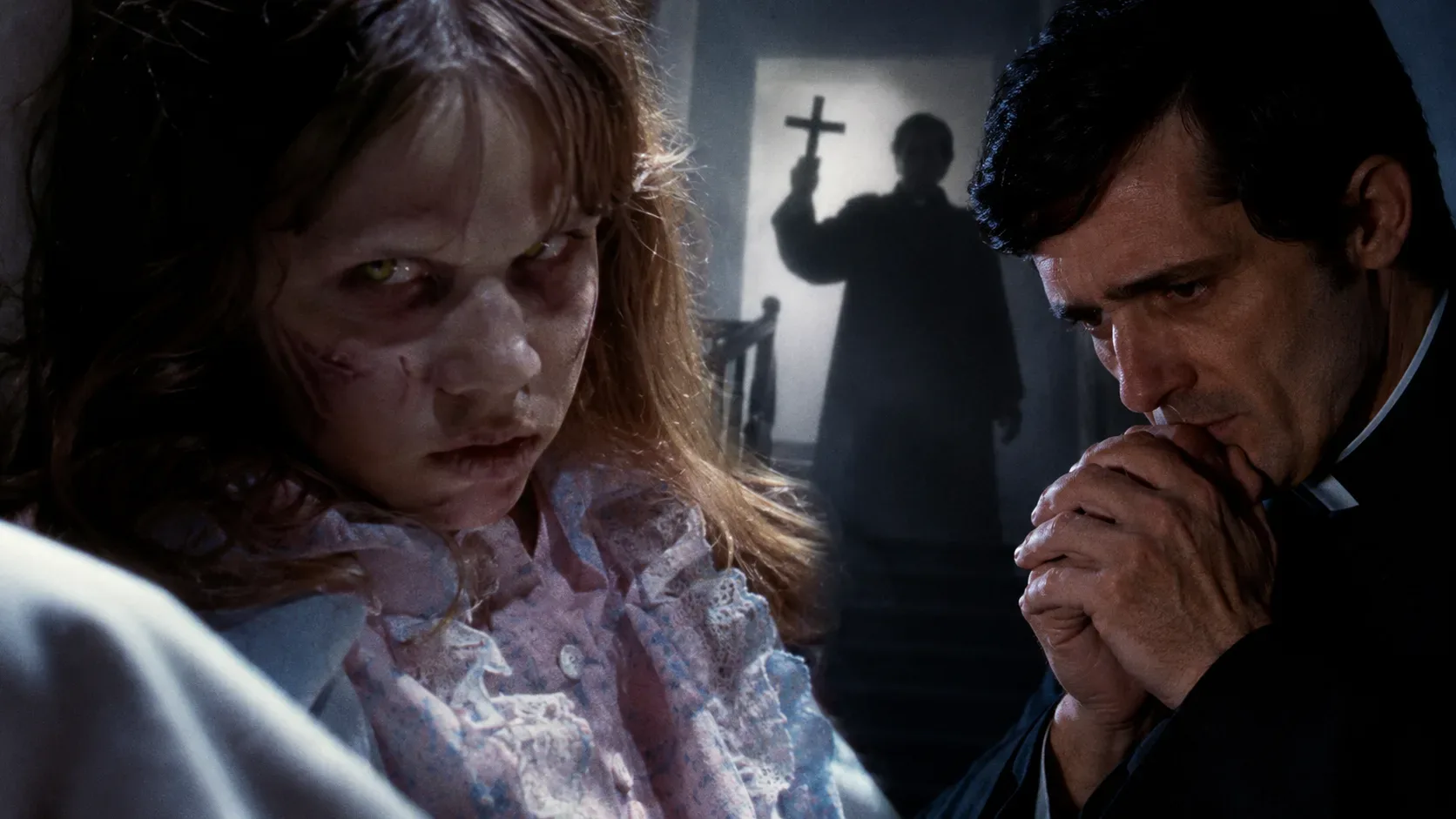
Merrin arrives at the house and warns Karras not to argue with the entity, which can mix truth and lies to attack the priests emotionally. In the freezing bedroom, they begin their prayers while Regan displays violent reactions, insults, impossible movements and levitation. The entity draws on memories of Karras's mother to weaken him.
The rite does not produce an immediate expulsion. Merrin shows signs of physical weakness and must pause. He resumes the struggle, but when Karras returns to the bedroom, he finds his colleague dead. The story suggests a collapse linked to Merrin's previously established heart condition. At that moment, the entity still controls Regan.
Why does Karras jump out the window, and what happens to Regan?
Confronted with Merrin's death, Karras loses his composure, grabs Regan and commands the evil presence to enter him. The transfer takes place: the girl loses the appearance and voice imposed by the entity, while Karras begins to show signs of possession. Realizing that he might attack Regan, he resists for a brief moment and jumps through the bedroom window, tumbling down the outside staircase.
Father Dyer finds Karras fatally injured and administers the last rites. The man who makes the sacrifice therefore does not survive. Regan, however, looks like herself again and is reunited with her mother. The film confirms her release in this episode, without showing the demon permanently destroyed or establishing a universal rule about its fate.
As they prepare to leave, Chris tells Dyer that her daughter remembers nothing of the ordeal. Seeing his clerical collar, Regan hugs and kisses him. Chris gives the priest a religious medal found in Regan's room; in the 1973 cut, Dyer keeps it. Mother and daughter depart, and the priest looks toward the steps associated with his friend's death.
Does Karras's sacrifice mean he has recovered his faith?
What the film shows: Karras willingly takes the risk to remove the entity from Regan, resists it long enough to prevent another attack and dies as a result of the fall. These events establish the immediate outcome of his action.
What remains interpretation: his choice can be read as a response to guilt over his mother's death and to the spiritual crisis running through his story. Rather than abandoning another vulnerable person, he takes her place. This can be understood as redemption or renewed faith, but the film offers no supernatural diagnosis of Karras's soul, nor does it need one to make his decision intelligible.
Pazuzu's presence and the extraordinary events belong to the narrative's supernatural framework. The notion that self-sacrificing love overcomes despair, by contrast, is a thematic reading, not a religious claim demonstrated about the real world.
What changes between the original 1973 cut and the 2000 edition?
The extended version, known as The Version You've Never Seen, adds footage and changes the closing scene. Some explanations often attributed to the 1973 film actually belong to this later edition.
| Element | 1973 theatrical cut | 2000 extended version |
|---|---|---|
| Staircase sequence | Does not include Regan's famous upside-down walk down the stairs. | Restores the scene known as the spider walk. |
| Why Regan was chosen | Does not contain the explanatory exchange between Merrin and Karras during their break. | Adds dialogue in which Merrin interprets the entity's aim as causing despair and doubt about divine love. |
| Religious medal | Dyer accepts and keeps the medal Chris gives him. | Dyer gives the medal back to Regan's mother. |
| Final interaction | Ends with the family's departure and the memory of the staircase. | Adds an encounter between Dyer and Detective Kinderman. |
Both versions preserve the essential outcome: Karras takes the entity into himself, sacrifices his life and frees Regan. The differences alter the emphasis of the epilogue and, in 2000, make a spiritual interpretation more explicit than the original cut does.
What does the film leave unresolved?
The symbolic identity of the figure seen in Iraq and Captain Howdy's presence help build the mystery, but the original cut offers no step-by-step explanation of how possession began. Nor does it show the entity destroyed forever. The supported conclusion is narrower: Regan survives and returns to her mother, while Karras and Merrin die in the attempt to save her.