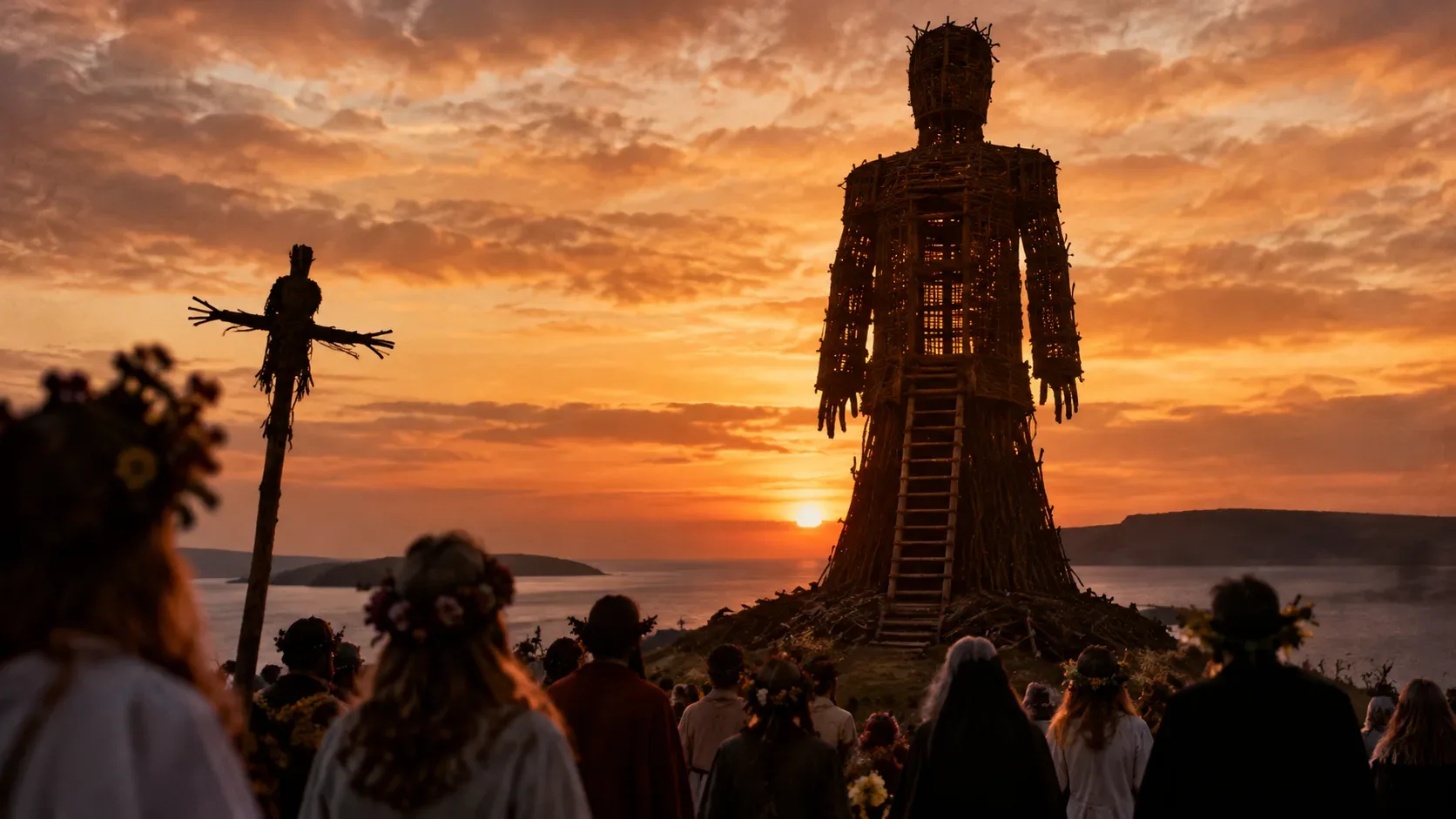
For a first viewing of The Wicker Man (1973), the most balanced choice is the 2013 Final Cut. The Theatrical Cut is the shorter edit released in British cinemas; the Director’s Cut restores more material and rearranges the story, but retains footage from visibly inferior sources. The Final Cut keeps important restored scenes and director Robin Hardy’s preferred narrative order without running as long. These three labels refer only to Hardy’s 1973 British film, not the 2006 remake.
The three cuts compared
| Cut | Reference running time | Main distinction | Best reason to choose it |
|---|---|---|---|
| Theatrical Cut (1973) | About 87 to 88 min; 87 min 30 sec in the original 1973 UK record | Opens with Howie’s journey and compresses the story, moving some events earlier. | To experience the original release and compare the suspense created by its tighter structure. |
| Director’s Cut (video reconstruction, 2001) | Usually about 99 to 100 min, depending on release | A longer mainland prologue, extra pub and island material, and a largely restored sequence of events. | To explore as much surviving footage as possible, despite obvious picture-quality changes. |
| Final Cut (2013) | Usually about 93 to 94 min; some listings say 91 min | Restores the church opening and two-night structure while omitting parts of the prologue and other additions. | For the version Hardy endorsed in his later years, and our suggested starting point. |
These ranges distinguish families of edits rather than providing a single universal runtime for every disc or digital file. A release’s cut label and technical details are more useful than its minute count alone.
Which scenes change, and why does their order matter?
Notice: the comparison below mentions situations and songs, but does not reveal the ending.
| Element | Theatrical Cut | Director’s Cut | Final Cut |
|---|---|---|---|
| Opening before Summerisle | Essentially begins with the sergeant’s journey and arrival on the island. | Includes mainland material with Howie at church, the police station, and the letter prompting his journey. | Opens with Howie at church but excludes the longer police-station and letter material. |
| Nights on the island | The re-edit brings Willow’s seduction forward and compresses the sense of elapsed time. | Restores two distinct nights and moves the seduction to its later position. | Keeps the two-night progression and later placement of the seduction. |
| Gently Johnny and Lord Summerisle | The song and associated Summerisle intervention are absent in their expanded form. | Restores the passage and other interactions revealing more of island life. | Restores the core of Gently Johnny and the intervention, but not every Director’s Cut addition. |
| Willow’s Song and dance | The scene appears earlier and uses a shorter edit. | Appears later with extra footage or alternative shots. | Appears later but does not retain the full length used in the Director’s Cut. |
| Conversation the following morning | Appears after the earlier placement of the night scene. | A subsequent exchange between Willow and Howie is absent from this reconstruction. | Restores the conversation after the seduction within the two-night progression. |
The crucial change is not simply how many scenes remain. The theatrical edit shifts Howie’s encounter with Willow earlier, changing how the investigation unfolds for viewers. Movie-Censorship’s shot-by-shot comparison documents this move, while Blueprint: Review and AVForums discuss its impact on the different cuts.
How did a 1973 film acquire three major cuts?
According to the British Board of Film Classification (BBFC), distributor British Lion shortened a roughly 99-minute edit to 87 minutes to fit a double bill with Don’t Look Now. The BBFC received an already edited film in 1973: the removal of those scenes from the theatrical release was not an instruction issued by the classification board.
Longer prints and reconstructions subsequently circulated. In 2001, Canal+ assembled discovered material for a DVD release named the Director’s Cut, bringing viewers closer to a longer edit. In 2013, the Final Cut made a further editorial selection of scenes and their order, associated with Hardy’s stated preferences. The words “Final Cut” do not mean that the complete lost negative or every shot originally filmed was found.
Why do some editions list 84, 91, or 99 minutes?
Some discrepancies reflect real editing choices, but others involve runtime measurement, playback speed, and how a master is identified. The BBFC lists 87 min 30 sec for the 1973 cinema submission and also records shorter home-video presentations. For comparison, the introduction to Blueprint: Review’s article gives 88, 99, and 94 minutes for the Theatrical, Director’s, and Final Cuts, respectively; the disc-content list for the 2023 UK release reproduced on that same page gives 84, 99, and 91 minutes.
Playback at 25 frames per second instead of 24 can shorten the listed duration without removing scenes, an effect historically linked to some PAL transfers. It would nevertheless be misleading to attribute every discrepancy to that conversion: the specific release, edit, credits, and actual playback rate must be checked. A listing of 84 minutes does not, by itself, establish a fourth cut.
What did the 2023 4K restoration actually recover?
The StudioCanal restoration, described in release documentation reproduced by Blueprint: Review and assessed by AVForums, relied mainly on the original 35 mm negative. A 1973 interpositive replaced a damaged section; extra Final Cut footage was sourced from film prints, while passages unique to the longer Director’s Cut had to rely on an older video transfer because matching film elements could not be located.
Picture quality therefore changes noticeably in some scenes, especially in the Director’s Cut. A 4K scan improves the presentation of surviving elements, but it cannot turn low-definition videotape into original camera negative or prove that a lost complete edition has reappeared. “Robin Hardy’s Script - The Lost Ending”, an extra listed for the 2023 release, concerns a screenplay: it is not evidence of a newly discovered filmed ending within the three cuts.
Which cut should you watch, and what should you check before buying?
- First viewing: Final Cut, for its balance of character development, narrative order, and surviving image quality.
- Film-history comparison: Theatrical Cut, to see how moving scenes forward changes the mystery’s pacing.
- Detailed study or completism: Director’s Cut, for added footage, while accepting a less consistent visual presentation.
- Before choosing a release: check that the listing expressly includes the cuts you want. StudioCanal’s 2023 UK collection contains all three, but the US Lionsgate 4K edition reviewed by Bloody Disgusting contains only the Final Cut. This does not establish which versions any Brazilian store or streaming service offers.
The practical answer is to choose the editing approach, not chase an allegedly complete 103-minute version. Among the three established cuts, the Final Cut balances narrative continuity with visual preservation; the other two remain valuable documents of the film’s complicated history.