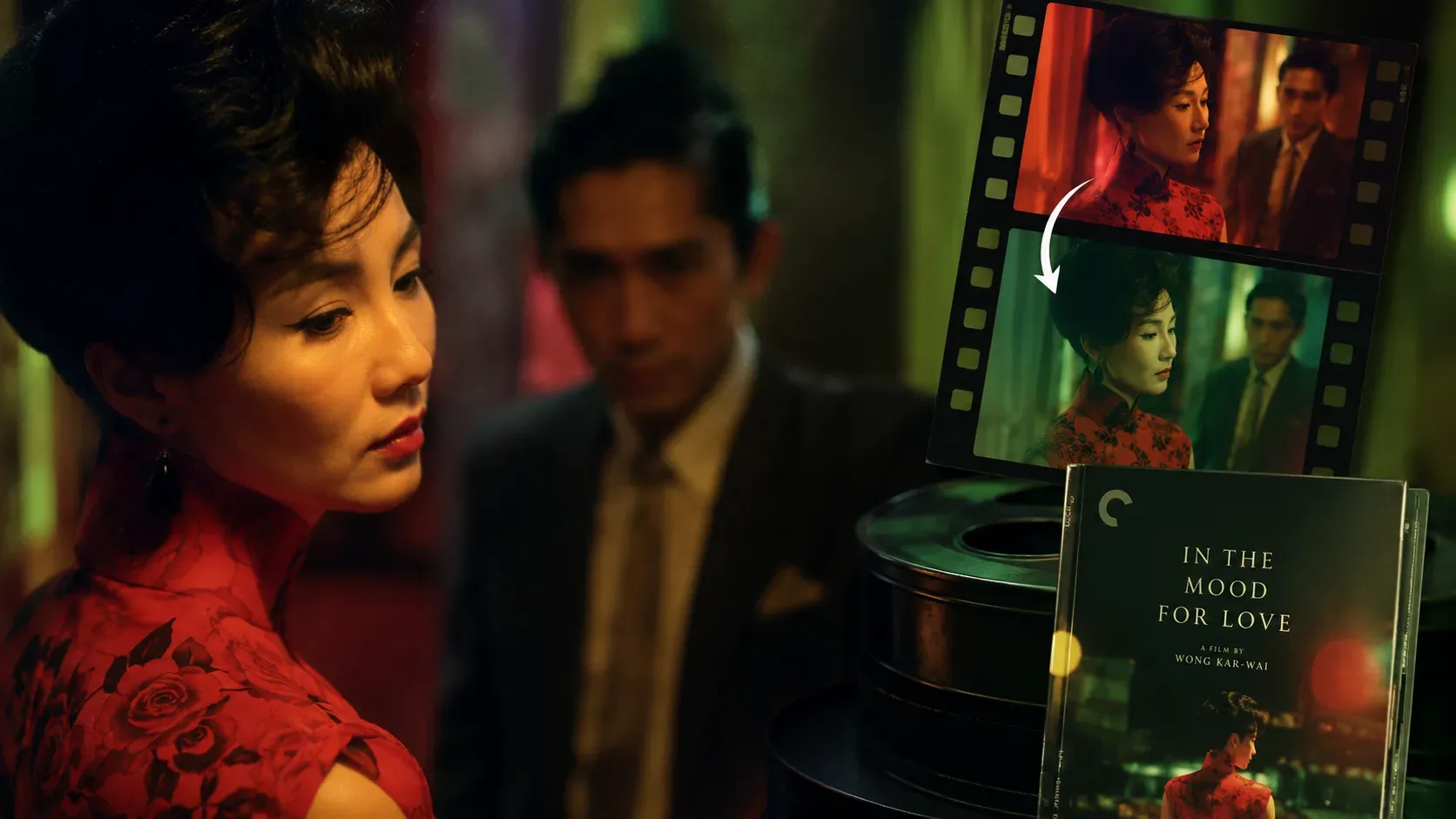
The 4K restoration of In the Mood for Love (2000) looks noticeably greener because its new master uses different color grading from earlier home-video editions. Wong Kar-wai supervised and approved the restoration. He explained that, when restoring his films, he chose to move closer to his artistic vision rather than simply reproduce the images audiences remembered. That does not mean he published an explanation for every individual color adjustment.
The difference can be seen in comparisons of Criterion editions: the reds, browns, and warm hues associated with older transfers now share the frame with a stronger green cast. Reviewers have documented this shift, but describing it as a technical mistake is, by itself, a judgment about the outcome rather than proof of a defect. One distinction matters: the restoration presented on Blu-ray in 2021 and on a 4K UHD disc in 2022 does not automatically represent every print or version of the film distributed worldwide.
What Wong Kar-wai actually said about the restorations
In a note published by Criterion on March 23, 2021, Wong Kar-wai described a choice between preserving the films as viewers remembered them and bringing them closer to what he had imagined. He said he chose the latter. Criterion reports that Jet Tone Films participated in the project, with L’Immagine Ritrovata and One Cool collaborating, and that Wong approved five of the seven restorations, including In the Mood for Love.
That statement clarifies his creative approach but requires careful interpretation. Wong does not, in that note, assign a specific meaning to the film’s green tint or provide shot-by-shot color-grading specifications. The official documentation establishes that he approved the new presentation as part of a project involving deliberate changes. The statement alone does not demonstrate that earlier editions were technically incorrect.
The note also identifies other verifiable decisions: presentation in the 1.66:1 aspect ratio, described by Wong as the original theatrical format, and a new sound mix produced with Robert Mackenzie. The update therefore extends beyond color, even if the palette is the most striking difference for viewers comparing versions.
Criterion 2012, the 2021 box set, and the 2022 UHD: what changed?
The term "4K restoration" can describe material restored at 4K resolution even if the consumer disc is a regular 1080p Blu-ray. That was the case with the 2021 World of Wong Kar Wai set. The standalone Criterion edition released in November 2022, meanwhile, included a 2160p UHD disc and a Blu-ray sourced from the same restoration used in the box set.
| Criterion edition | Presentation | Palette noted in comparisons | What to keep in mind |
|---|---|---|---|
| 2012 Blu-ray | 1080p, earlier master | Relatively stronger reds, oranges, and browns, with less dominant greens | A useful reference for the look of the earlier home-video edition |
| World of Wong Kar Wai, 2021 | 1080p Blu-ray derived from a 4K digital restoration | Stronger green cast, including in neutral areas and skin tones, according to specialist reviews | Approved by Wong; the disc itself is not UHD |
| Criterion 4K UHD + Blu-ray, 2022 | 2160p UHD disc in SDR, without HDR; includes a 1080p Blu-ray | The same overall color-grading approach as the 2021 master | UHD offers higher nominal resolution, but does not produce a different grade merely by being UHD |
These specifications and disc comparisons apply to the named Criterion editions, particularly those released in the United States. They should not be extended to releases from other distributors, theatrical screenings, or streaming catalogs without identifying which master each uses.
Why does the image look so much greener?
Reviewing the 2021 box set, Criterion Forum critic Chris Galloway described the older look as autumnal, with strong reds and browns alongside jade-like greens. In his assessment, the restoration shifts the balance toward green, affecting skin tones as well. Reviewing the UHD in 2022, he again noted green-tinted light areas and some less pronounced reds. These are comparative observations attributed to the reviewer, not colorimetric measurements published by the director.
Two processes should be distinguished. Digitizing and cleaning film elements can improve stability and remove visible damage; color grading determines the balance of shadows, midtones, and highlights. Scanning a film at 4K does not require it to retain the palette of an older transfer. The green cast therefore did not appear simply because resolution increased: it is tied to this restoration’s presentation choices.
The handling of film texture has also been debated. Galloway criticized grain management and apparent noise reduction in the newer editions; that is a transfer assessment separate from the dispute over the palette. Nor should HDR be blamed: according to Criterion Forum’s technical review, Criterion’s 2022 UHD disc is SDR, without HDR.
Is it an improvement or a controversial change?
The reviews consulted do not agree. Galloway favored the warmer color balance of earlier presentations and found the new green cast excessive. Gary Tooze of DVDBeaver, however, described initial surprise followed by growing appreciation for the 2021 Blu-ray’s yellow-green appearance and the way he felt it emphasized other colors. Both recognized a significant change; they differed over its aesthetic effect.
That makes it essential to separate three claims: the palette is visibly different in the published comparisons; Wong Kar-wai approved the restoration; and preferring one version is an aesthetic judgment. The filmmaker’s approval does not erase audiences’ visual memories, just as screenshots cannot establish on their own exactly how every theatrical screening looked in 2000.
Which version should you compare?
To explore the controversy, compare Criterion’s 2012 Blu-ray with the 2021 disc in World of Wong Kar Wai or the 2022 Criterion 4K UHD + Blu-ray package. Use corresponding scenes, and do not treat photographs of screens, compressed images, or televisions with different settings as definitive evidence of fidelity. DVDBeaver offers a clearly labeled comparison of the 2012 and 2021 editions.
When choosing an edition, the more useful question is not merely "Is it 4K?" but "Which restoration and master does this edition use?" The sources establish differences among the specified Criterion versions, not a universal change to the colors of In the Mood for Love. The result is a legitimate debate about memory, directorial intent, and film preservation, without mistaking personal preference for a technical verdict.
Sources and references
- Wong Kar-wai’s director’s note published by Criterion (2021)
- Criterion: In the Mood for Love 4K UHD edition details
- Criterion: World of Wong Kar Wai box set (2021)
- Criterion Forum: Chris Galloway’s 2021 Blu-ray review
- Criterion Forum: Chris Galloway’s 2022 4K UHD review
- DVDBeaver: edition comparisons and Gary Tooze’s assessment