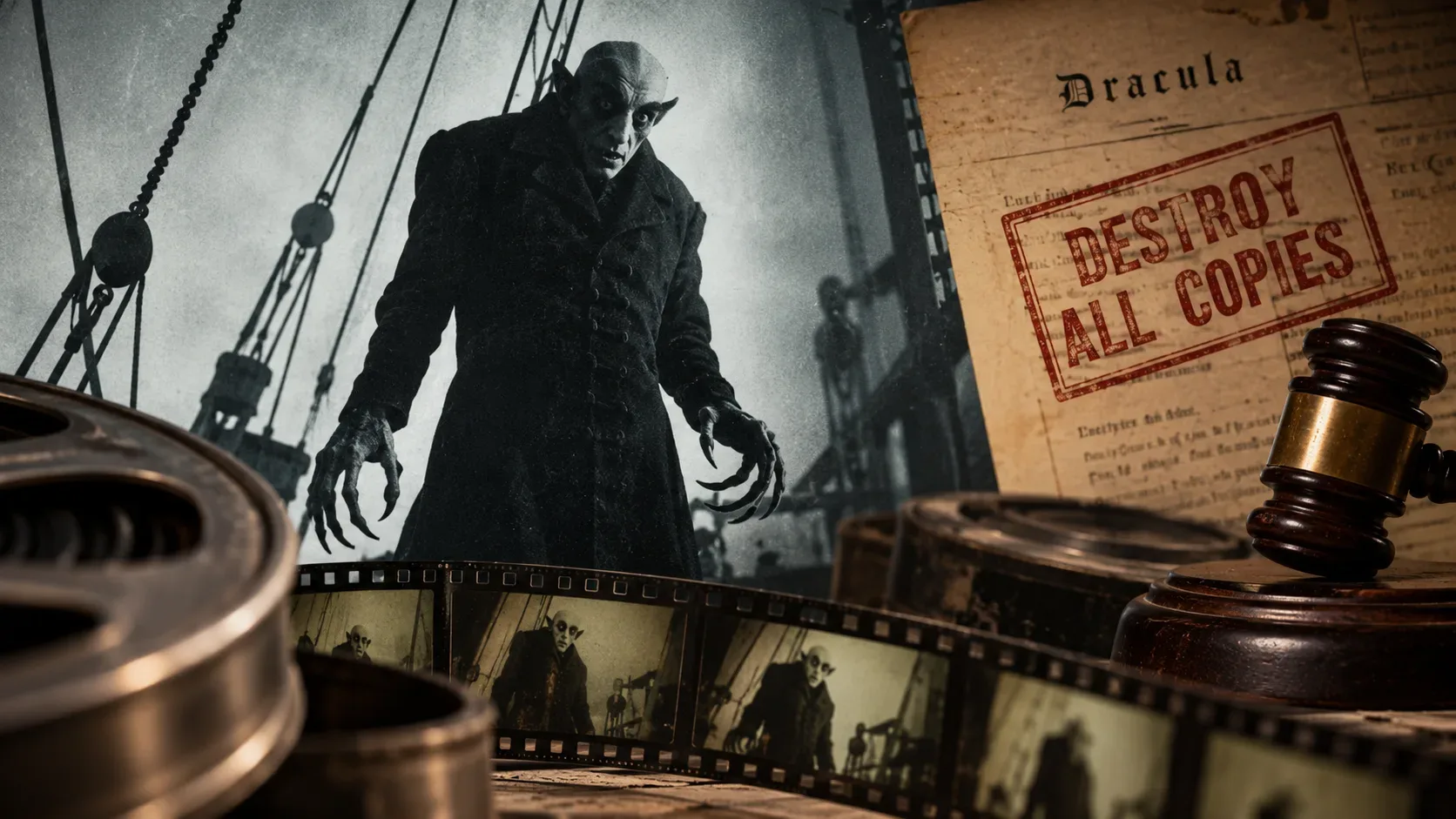
The destruction of Nosferatu (1922) was ordered because the film adapted Bram Stoker's Dracula without permission from the people who controlled the book's rights. Florence Stoker, the writer's widow and literary executor, prevailed in the dispute against German production company Prana-Film. The court order called for the prints to be destroyed, but it did not reach all the materials already in circulation. That dispersal allowed F. W. Murnau's classic to survive.
The story involves three separate developments: an unauthorized adaptation, a legal victory for the rights holders, and the later preservation of film elements that escaped destruction. Blurring them encourages the simplified story that one miraculous copy saved the entire film.
Why was Nosferatu an adaptation of Dracula?
Published in 1897, Dracula provided the narrative framework for Nosferatu: Eine Symphonie des Grauens, which premiered in Berlin on March 4, 1922. The Prana-Film production was directed by Murnau, written by Henrik Galeen, and starred Max Schreck as Count Orlok. To distance the film from Stoker's work, its makers changed the characters' names, moved the setting from England to Germany, and altered parts of the story.
The vampire became Orlok, while the film emphasized the arrival of rats and the spread of plague. These changes, described by the British Film Institute (BFI), gave the film a distinctive visual identity, but they did not erase its connection to the book. The central narrative still closely followed Stoker's novel.
There was also evidence that was hard to dismiss: according to a historical article published by the U.S. Copyright Office on the Library of Congress website, promotional materials and the opening credits of certain prints acknowledged the literary source. Changing characters and locations was not the same as securing permission to adapt a work still protected in the jurisdiction where the case was heard.
Who demanded destruction, and what did the court decide?
Florence Stoker learned of the film after its premiere and turned to the Society of Authors, a British organization supporting writers. The dispute proceeded against Prana-Film in Germany. According to the historical account published by EBSCO, a German court ruled in July 1925 that the adaptation infringed the rights to Dracula and ordered the destruction of the film's prints.
The production company had already declared bankruptcy in 1922, according to the Friedrich-Wilhelm-Murnau-Stiftung. The case was not solely about receiving payment: Florence also wanted an unlicensed screen version to stop circulating. The judgment favored the rights holders, but a recall order could not automatically locate every film print that had left the producer's control.
The distinction between a court order and its enforcement is essential. The judgment required the materials to be destroyed; it does not prove that every copy was destroyed. There are records of screenings being challenged and materials being lost, but the BFI itself states that the total destruction was never achieved.
How did the film escape? A timeline
| Period | What happened | Why it matters |
|---|---|---|
| 1897 | Bram Stoker publishes Dracula. | The novel is the literary work at the center of the adaptation dispute. |
| 1922 | Nosferatu premieres in Berlin; Florence Stoker challenges the unauthorized version. | The film begins circulating before the court's final decision. |
| July 1925 | A German court rules for Florence Stoker and orders the prints destroyed. | The ruling targets traceable materials, not every print already dispersed. |
| 1928 and 1929 | The film reappears in the context of British screenings and reaches a U.S. screening in 1929. | These records show that circulation continued after the order. |
| 2005 and 2006 | Luciano Berriatúa oversees a restoration for the Murnau Foundation using materials from different archives. | The restored version relies on multiple surviving sources, not one untouched print. |
EBSCO reports that the London Film Society planned screenings even after the judgment. A print involved in the British screenings was apparently burned in 1929; others still existed, since the film was shown in New York that same year. The claim that every print was actually eliminated is therefore contradicted by the record of later circulation.
Why was the situation different in the United States?
The best-documented proceedings took place in Germany, while a screening in the United States also depended on American copyright law at the time. The U.S. Copyright Office article explains that Stoker's novel, although eligible for protection under the reciprocity rules then in force, had not met a copy-deposit requirement necessary for protection there. Under that historical account, Dracula was in the U.S. public domain, and the estate could not prevent Nosferatu from circulating there on the same basis.
This does not mean that a U.S. court overturned the German ruling. Nor does it establish that the rights governing exhibition, distribution, or a particular restoration are identical across every territory and period. The important point is that copyright protection depended on the law applicable in each country, while physical prints could cross borders.
What did the restorations recover?
Survival did not necessarily preserve a single complete, unaltered original. Silent films circulated with intertitles in different languages, cuts, and materials of varying quality. The restoration undertaken by Luciano Berriatúa in 2005 and 2006 for the Friedrich-Wilhelm-Murnau-Stiftung shows how researchers reconstructed a presentation of the classic from complementary sources.
According to the technical credits published by the Il Cinema Ritrovato festival, the principal source was a tinted 1922 nitrate print with French intertitles held by the Cinémathèque française. Missing shots were supplemented by materials preserved at the Bundesarchiv-Filmarchiv and by another version in the French archive. To recreate the German intertitles, the team drew on a safety print made in 1962 from 1922 material; missing titles were reconstructed and marked as such.
Nosferatu, then, survived first because the destruction order did not reach every print and, later, because preservation institutions compared fragments and versions. The case combines a copyright claim that was successfully enforced in court with a preservation history that would have been impossible if every film element had vanished.
Sources and references
- U.S. Copyright Office / Library of Congress: Copyright Horror Stories
- British Film Institute: Film 2: Nosferatu (1922)
- British Film Institute: 10 great German expressionist films
- EBSCO: Nosferatu Is Found to Have Violated Dracula Copyright
- Friedrich-Wilhelm-Murnau-Stiftung: 100. Geburtstag Nosferatu
- Il Cinema Ritrovato: Nosferatu, eine Symphonie des Grauens: restoration credits