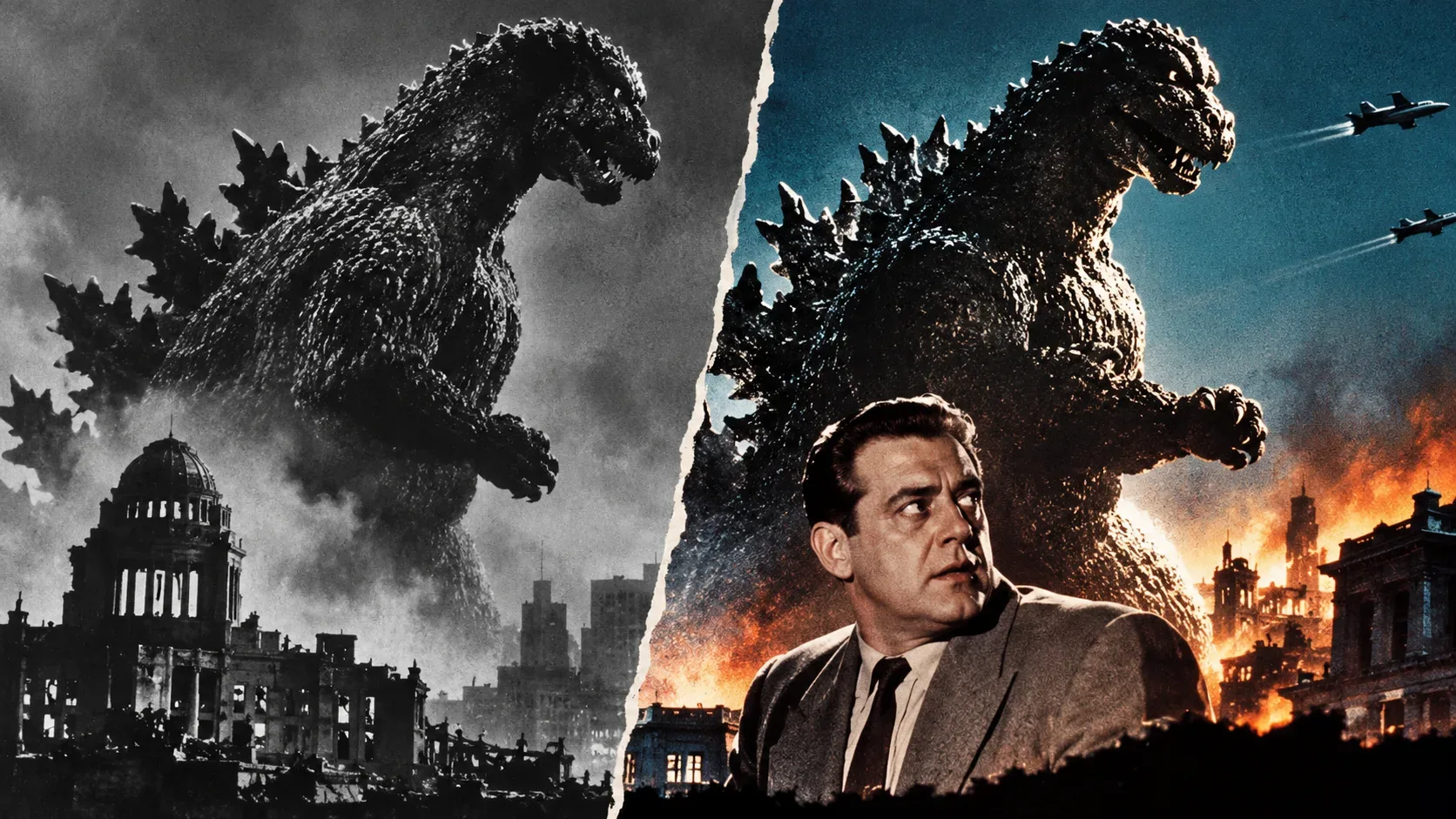
Godzilla, King of the Monsters! (1956) is not an independent remake of Godzilla (1954). It is an American re-edit of Ishirō Honda's film. Terry O. Morse reused footage from the Japanese original, changed the order of passages, reduced some of the political context, and shot new scenes with Raymond Burr as an American reporter. The monster remains the same, but the perspective on Tokyo's destruction changes considerably.
The essential difference lies in editing and point of view, not new special effects or a wholly reshot story. Toho's original foregrounds Japan's trauma in the face of the nuclear threat; the U.S. release also presents events through Steve Martin, a character created for the reworking. These changes are documented by the BFI's Sight and Sound, the Criterion Collection, and Turner Classic Movies.
Godzilla in 1954 versus 1956: what was added, removed or rearranged?
| Element | Godzilla / Gojira (1954) | Godzilla, King of the Monsters! (1956) |
|---|---|---|
| Type of film | Toho's original Japanese feature, directed by Ishirō Honda. | Terry O. Morse's U.S. re-edit of the Japanese film, incorporating newly shot footage. |
| Perspective | Japanese characters and the consequences for the population remain central. | American reporter Steve Martin, played by Raymond Burr, frames much of the story. |
| Added footage | Steve Martin does not appear. | Scenes shot specifically with Burr, interpreters and stand-ins, inserted alongside older footage. |
| Removed footage | Retains more human, social and political material. | Omits or shortens passages, including explicit references to victims and radiation. |
| Story structure | The editing follows events primarily from a Japanese perspective. | The story is reordered around the reporter's account and voice-over. |
| Sound and language | Japanese dialogue and the original score. | Some dialogue dubbed or conveyed through interpretation, with Martin's English narration. |
| Reference runtime | 96 minutes in Criterion's film details. | About 80 minutes, according to The American Scholar. |
| Color | Black and white. | Also black and white; coloring in promotional artwork is not a feature of the 1956 cut. |
The runtimes describe the films listed by the sources; they are not a direct measure of how many minutes were cut. The later version combines new footage with material from the earlier film and rearranges scenes. Subtracting 80 from 96 minutes therefore does not reveal the total length of removed material.
How was Raymond Burr inserted into an already completed film?
Burr plays Steve Martin, an American journalist who witnesses and reports on events in Tokyo. His scenes were shot after the Japanese release, under Terry O. Morse's direction. In the revised cut, shots of the reporter appear alongside footage made by Honda's team. Turner Classic Movies describes how stand-ins for the Japanese actors helped create the impression that Martin shared scenes with characters from the original.
The English voice-over is crucial: audiences receive information through Martin rather than requiring every Japanese conversation to be fully dubbed. This choice also moves the center of the story. Burr did not take part in the 1954 shoot; his presence was constructed through the 1956 edit.
The BFI also notes that the story was reordered. That matters because an image of devastation can serve a different purpose when it is framed less by Japanese characters' responses and more by a foreign correspondent's account.
Did the anti-nuclear message disappear?
Not entirely. The monster's radioactive origin and images of a devastated city remain identifiable in the American cut. What becomes less prominent is the network of direct references to Hiroshima and Nagasaki, the effects of radiation, and human responsibility for nuclear testing. It is a shift in emphasis, not a literal transformation of Godzilla into a creature unrelated to the bomb.
Ken Hollings, writing in Sight and Sound, identifies the removal of references to Nagasaki, radioactive rain, contaminated food and air-raid shelters. He also describes a change in the meaning of a children's song: a plea for nuclear disarmament in the original is reframed as a prayer for the dead in the U.S. version. These are examples reported in critical documentation, not a claim that every shot in both prints was independently checked.
The Japanese context of 1954 explains the significance. Alongside the memory of the atomic bombings, the story evokes a Japanese fishing boat exposed to radiation from an American hydrogen-bomb test in the Pacific. Criterion discusses the real-life Daigo Fukuryū Maru incident in the supplemental material for its edition. By reducing explicit references, the American re-edit makes the political interpretation behind Honda's horror less immediate.
Does the ending mean something different?
Spoiler warning: the following paragraphs discuss the endings of the 1954 and 1956 films.
The climax involving Godzilla and the extreme measure used against the creature belongs to the original story; it is not an entirely new finale filmed from scratch. The documented difference lies primarily in the final commentary. In Gojira, Dr. Yamane's warning connects the possibility of future monsters to continued nuclear testing. The film ends with unease extending beyond the creature's defeat.
As Claire Stanford explains in The American Scholar, the American cut instead emphasizes a more relieved conclusion through Steve Martin's voice. The immediate danger has passed, while the political warning is less pronounced. To say the 1956 version changes the ending is therefore not to say it invents a different defeat for Godzilla. It changes the meaning attached to the outcome.
Which version best conveys the intention of the 1954 film?
To understand the film Ishirō Honda released in Japan, choose Godzilla / Gojira (1954) in Japanese with subtitles. Godzilla, King of the Monsters! (1956) is valuable as a record of the character's international circulation: it shows how the same work was reshaped for another market and how Raymond Burr became part of its story.
The cuts can be compared legally in editions that include both. The Criterion Collection's film listing and the BFI Shop page identify the 1954 Japanese feature and the 1956 Americanized cut in the same physical-media release. That establishes their inclusion in those editions, but it does not confirm current streaming availability in Brazil.
The distinction is straightforward: 1954 presents the disaster through a specifically Japanese historical experience; 1956 preserves the monster and much of the action but inserts an American narrator and reduces part of the explicit nuclear critique. Treating them as two cuts of one work is more accurate than treating them as unrelated films.
Sources and references
- BFI / Sight and Sound: Remake/remodel, comparison of alternate cuts
- BFI / Sight and Sound: Godzilla mon amour, historical context and changes
- Criterion Collection: Godzilla, film information and edition containing both cuts
- Turner Classic Movies: Godzilla, King of the Monsters!, background on the 1956 cut
- The American Scholar: A Monstrous Burden, analysis of the ending and allegory
- BFI Shop: Criterion Blu-ray edition containing the 1954 and 1956 cuts