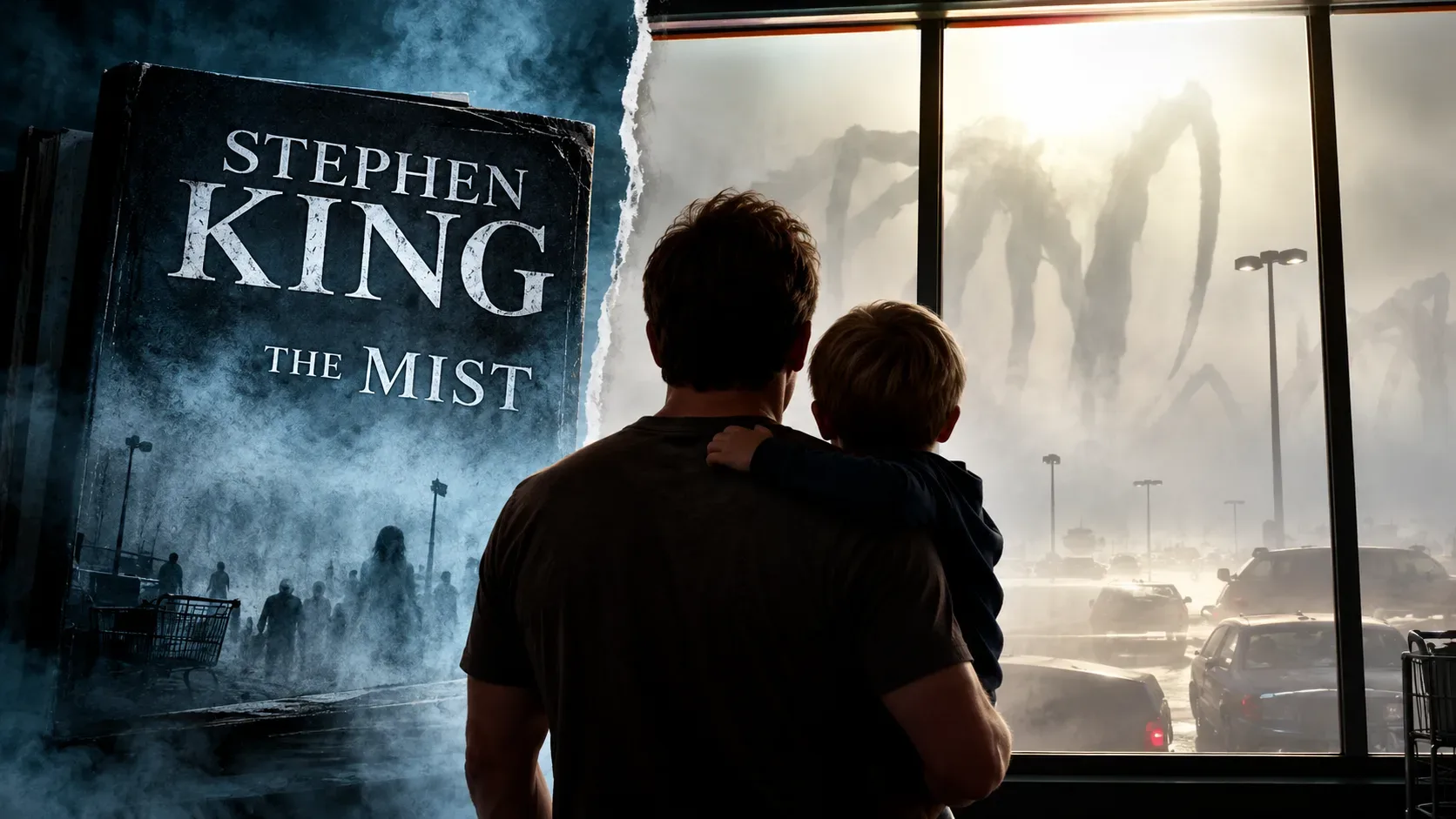
Frank Darabont changed the ending of The Mist (2007) because he felt a film needed a more definitive conclusion than the uncertainty Stephen King left on the page. His solution was to turn a dark possibility that King had already placed in David Drayton’s mind into an irreversible decision. King read the screenplay, approved the ending, and later acknowledged how shocking it was on screen.
Full spoilers ahead for both Stephen King’s novella and the 2007 film.
How does Stephen King’s original story end?
The Mist is a novella, not a novel originally published as a standalone book. It first appeared in the 1980 anthology Dark Forces and was later collected in 1985’s Skeleton Crew. In the written story, David escapes the supermarket with his son Billy, Amanda Dumfries, and Mrs. Reppler. The threat remains outside, but the narration never establishes the four characters’ ultimate fate.
While traveling, David picks up what he believes is the word Hartford on the radio, the name of a city in Connecticut. It might point toward refuge, but the story does not confirm that the transmission is reliable or that the survivors will reach safety. Hope is the note on which the novella ends: the characters are alive when the account stops, but their survival afterward is not guaranteed.
What happens at the end of the 2007 movie?
In the adaptation, David, played by Thomas Jane, leaves the supermarket with Billy, Amanda, Irene Reppler, and Dan Miller. When their car runs out of fuel in the mist, they have four bullets left for five people. Believing there is no escape and that the creatures will soon attack, David shoots the other four passengers, including his son, to spare them the even worse death he expects.
With no bullet left for himself, he steps outside expecting to be killed. Instead of monsters, military vehicles and soldiers arrive, fighting the creatures and evacuating survivors. Rescue comes just after the shots. David realizes his decision was not inevitable and collapses under the weight of what he has done. The film thus settles the car passengers’ immediate fate in the opposite way to the written story: on the page, four people continue trying to live; on screen, David is the group’s sole survivor.
Among the people being evacuated is the woman who left the supermarket to find her children, now reunited with them. Her return contrasts with David’s choice and sharpens the irony, without proving that everyone who simply stayed put would have survived. Darabont credited actor Jeffrey DeMunn, who played Dan Miller, with suggesting that the woman reappear among those rescued.
Where did the much crueler ending come from?
Darabont did not describe the sequence as an idea disconnected from King’s work. In a 2008 interview with Lilja’s Library, he identified a passage that inspired him: David checks the gun and considers the extreme possibility of using the remaining bullets to spare his companions a horrific death if no other option remains. In the novella, it remains a hypothetical thought. The filmmaker turns it into the screenplay’s defining event.
In a November 2007 interview, Darabont had already explained his approach to adaptation: finding hints and unrealized possibilities in King’s prose, then developing them cinematically. His change therefore carries forward a thought present in the original, while profoundly altering the characters’ actions and how much the reader or viewer learns about their future.
Why did Darabont want a conclusive ending?
According to the director, an open ending could work in literature but did not provide the decisive effect he sought for a feature film. The choice also reflects the bitter twists of The Twilight Zone and horror films such as Night of the Living Dead, influences Darabont discussed in interviews. The horror was not supposed to come only from the monsters: fear, lost hope, and the rush to assume the worst would bring about the tragedy.
There was a documented practical obstacle as well. Darabont said a potential financier offered a larger budget on the condition that he change the ending. He declined and made the film for less money while keeping his chosen conclusion. The bleak finale, then, was not forced on an unwilling director by the studio. The struggle was to get that ending made without softening it.
Did Stephen King approve the change?
Yes. In a joint interview published in November 2007, King said he loved the ending Darabont had written and felt it gave the story a clear conclusion. He also acknowledged that seeing it filmed made him hesitate momentarily because of its brutality. In other interviews, Darabont recalled King saying he wished he had come up with that solution for his own story.
That approval does not mean King wrote the movie ending, or that the novella secretly confirms a military rescue. King’s text provides the seed of the dilemma; the decision, the arrival of the soldiers, and the cruel timing between them belong to the film adaptation.
How does the change affect the story’s meaning?
In the novella, horror leaves open the possibility of carrying on: the word heard over the radio could be a real glimmer of hope or David’s desperate interpretation of noise. In the film, viewers receive an immediate answer about the threat in that location and see that the worst act occurs just as rescue approaches. Physical danger gives way to an irreversible human mistake.
The two endings can thus be read as variations on the same question: how does someone decide when vital information is missing? The written version stops short of the final decision; Darabont shows what can happen when it is made too soon. There is no need to treat Mrs. Carmody’s claims as proven supernatural prophecy, or to assume the novella confirms the group’s eventual rescue: neither conclusion is established by its respective narrative.
Sources and references
- Stephen King: The Mist (novella)
- Stephen King: The Mist (film, 2007)
- Brad Balfour / PopEntertainment: Stephen King and Frank Darabont Step Out of The Mist (2007)
- Lilja’s Library: Interview with Frank Darabont (2008)
- Josh Weiss / SYFY WIRE: Why Stephen King Actually Prefers the Ending of The Mist Film Adaptation (2023)
- Debopriyaa Dutta / /Film: The Mist's Most Brutal Detail Wasn't Even in the Script (2022)
- Ain’t It Cool News: Capone Interviews Frank Darabont! (2007)