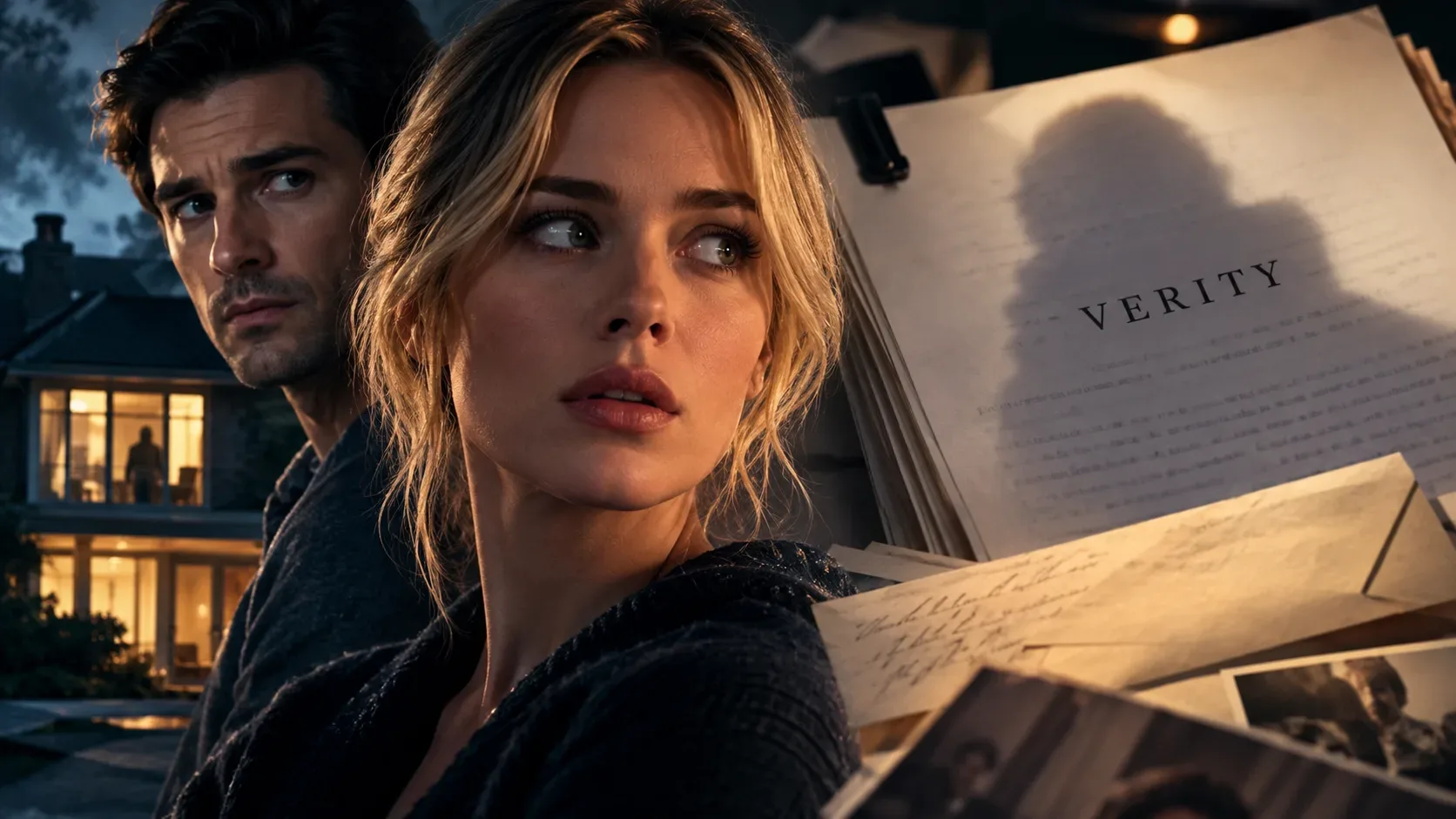
The 2026 film Verity preserves the central uncertainty of Colleen Hoover’s novel: is the manuscript a confession, or does the letter reveal a woman who was wrongly accused? The adaptation changes what happens to the letter itself, reshapes the Crawford family tragedy, and adds one final image of Verity. None of those choices establishes which document tells the truth.
Directed by Michael Showalter and produced by Amazon MGM Studios, the film opened in Brazilian theaters on October 1, 2026, and in the United States on October 2. Dakota Johnson plays Lowen Ashleigh, Anne Hathaway plays Verity Crawford, and Josh Hartnett plays Jeremy.
Spoiler warning: from this point onward, the article reveals deaths, the letter, and the endings of both the film and the novel, including major differences between them.
What does the manuscript lead Lowen to believe?
Lowen is hired to continue a successful author’s book series after a car crash has seemingly left that author unable to work. At the Crawford house, she finds an autobiographical text attributed to Verity. In it, the novelist describes resenting motherhood and claims to have caused her daughter Harper’s death by drowning during an outing on the lake. The document makes Verity seem dangerous to Lowen, but these events are, first and foremost, the manuscript’s account.
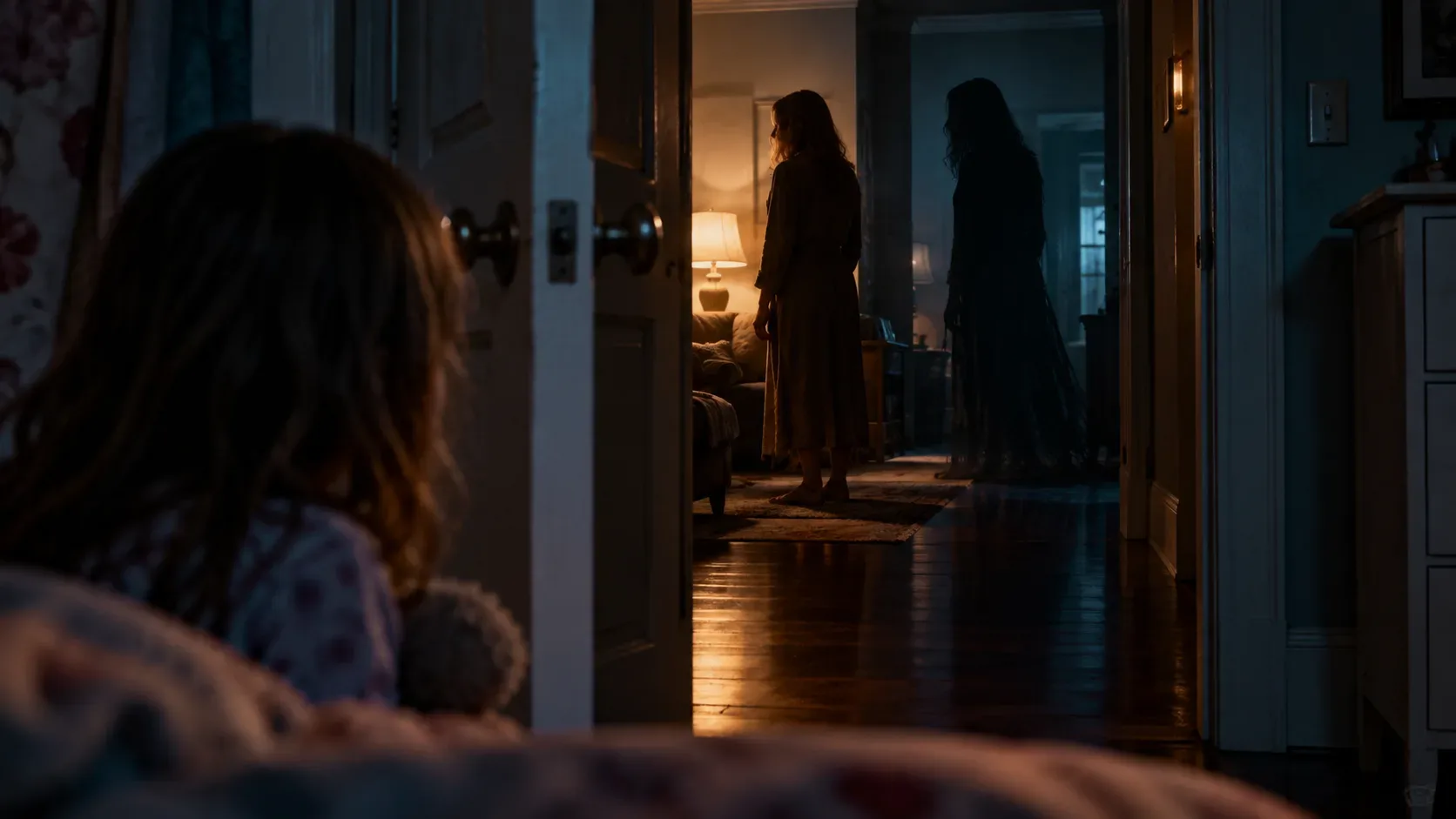
The film dramatizes passages from the text, with Verity’s voice and presence shaping Lowen’s reading experience. Their appearance as memories does not settle the matter: the images dramatize words whose reliability remains in dispute. That distinction matters because viewers watch horrifying events before learning that the document may have been written as fiction.
How are Jeremy and Lowen involved in Verity’s death?
When Lowen shows Jeremy the manuscript, he confronts his wife. Verity reacts, revealing that she was not as incapacitated as she appeared. Jeremy tries to kill her, and Lowen suggests disguising the death as an accident. He suffocates her, and the two take her body to the lake, giving police a false account of her disappearance and death.
There is one certainty that the mystery surrounding Harper cannot erase: Verity dies because of Jeremy’s actions and Lowen’s involvement. What remains uncertain is whether they killed a woman guilty of the crime described in the manuscript or a woman trying to survive her own husband. The screenplay leaves both possibilities open without excusing the couple’s actions.
What does the hidden letter say about the crash?
Months later, Lowen is pregnant and preparing to leave the property with Jeremy and Crew, the surviving son. Beneath a loose floorboard, she finds a letter from Verity addressed to her husband. In it, the writer says her supposed autobiography was an exercise in antagonistic journaling: retelling experiences from the cruelest possible perspective to create convincing characters. According to this account, the passages about violence toward her daughter were not confessions.
The letter makes an even more serious allegation: Jeremy had supposedly discovered the manuscript before Lowen, believed it, drugged Verity, and caused the crash that nearly killed her. Fearing another attempt on her life, she allegedly continued pretending to be unresponsive while looking for a way to escape with Crew. If the letter is truthful, Jeremy’s apparent shock when Lowen hands him the manuscript may also have been an act.
None of these claims receives independent verification in the ending. Verity is responsible, in different ways, for both conflicting accounts. The revelation that she feigned her incapacitation confirms the deception but not her reason for it. Jeremy’s alleged role in the crash likewise comes from the letter, not from an answer the film independently proves.
Book vs. movie: which changes affect the ending?
The adaptation does not simply replace one answer with another. It preserves the clash between the two documents while redistributing information and responsibility. The table highlights the main changes between the novel, originally published in 2018, and the 2026 film.
| Aspect | Colleen Hoover's novel | 2026 film |
|---|---|---|
| The Crawford family | The couple has three children: Harper, Chastin, and Crew. Two children die. | The story centers the tragedy on Harper. She and Crew are twins; Chastin is omitted. |
| Lowen’s sleepwalking | Sleepwalking is part of her characterization and the household tension. | That subplot was removed from the final cut. |
| Verity’s death | The death is concealed in bed to resemble a medical event. | Jeremy suffocates her, and the body is taken to the lake to stage an accident. |
| What happens to the letter | Lowen destroys the letter and does not show it to Jeremy. | Lowen keeps it. Showalter confirmed it remains in her pocket at the end. |
| The final word | The novel ends focused on Lowen’s doubts and choices. | The film returns to Verity’s public interview, ending with her remarks about audience certainty. |
| Tension between the women | Their rivalry emerges largely through the narration and Lowen’s place in the household. | A kissing scene and imagery of replacement heighten attraction and unsettling identification. |
Why does Lowen keeping the letter matter so much?
In the novel, destroying the paper removes the physical evidence that could challenge the account the couple has chosen to accept. In the film, Lowen also keeps her discovery from Jeremy, but she preserves the document. Speaking to ScreenRant in an interview syndicated by AOL, Michael Showalter explicitly confirmed that the letter is still in her pocket in the final scene. Some published summaries mistakenly attribute the book’s destruction of the letter to the movie; the director’s direct statement clarifies the adaptation’s choice.
Keeping the letter does not mean believing it, reporting Jeremy, or deciding to investigate. It means leaving the house carrying a version of events that could undermine her new life. Lowen has gained a husband, a career tied to Verity’s work, and a family with Crew and the baby she is expecting, but she cannot escape the possibility that she misread everything.
What does Verity’s interview mean in the final scene?
After Lowen, Jeremy, and Crew leave the property, the film returns to an earlier interview with Verity on Hot Ones. The novelist discusses her interest in manipulating readers’ perception of truth and certainty. It is neither a recorded confession nor a supernatural revelation: it is a public statement made before the decisive events, now repositioned as the ending.
This changes the final point of view. Rather than ending solely with Lowen attempting to live with uncertainty, the film gives Verity the last word on how stories can lead an audience toward premature conclusions. In an interview with TIME, Showalter said he intended to preserve an ambiguous ending. The sequence raises the possibility of manipulation without identifying which document is false.
Why did Showalter cut and change parts of the book?
The director explained that Lowen’s sleepwalking scenes were filmed but removed to maintain focus and pace. The family was also simplified: in the novel, Harper and Chastin are twins, and Crew is their brother; in the film, Harper and Crew are twins. Colleen Hoover acknowledged in interviews that removing one child helped concentrate the tragedy without reproducing the novel’s entire sequence of losses.
In his ScreenRant interview, Showalter also said some screenplay drafts had very different endings, but he pushed to retain the antagonistic-journaling idea. For both him and Hoover, the essential effect was not to reproduce every event, but to leave audiences facing incompatible accounts. Keeping the letter and giving the fictional author the final word follow that approach.
Was the novel’s bonus chapter adapted?
No. The bonus chapter added to a 2022 edition of the novel is not part of the film adaptation. Hoover told Entertainment Weekly that she regarded it as extra material for readers and preferred the movie to end at the point corresponding to the original conclusion. Events from that additional chapter therefore should not be described as scenes audiences watched in the 2026 film.
So is the manuscript or the letter true?
The film confirms neither account. The manuscript combines known events with purported confessions by Verity, yet it might be an intentionally monstrous work of fiction. The letter offers a motive for her feigned incapacitation and accuses Jeremy of attempted murder, but it could also be one last attempt to control whoever finds it.
The “Team Manuscript” versus “Team Letter” debate continues because the verdict depends on accounts that cannot be conclusively verified. Hoover has expressed a preference for the manuscript, but later said working with the film made her reconsider her interpretation. An author’s or actor’s opinion can inform the discussion, but it cannot replace what the story actually establishes.
The most revealing change, then, is not the identification of a hidden culprit. It is Lowen’s position: in the novel, she destroys the inconvenient document; on screen, she chooses to take it with her. Both versions follow someone trying to move forward after taking part in Verity’s death. Only the film leaves the physical evidence of her doubt intact.
Sources and references
- Amazon MGM Studios: official film information
- CNN Brasil: the letter and the manuscript explained
- Omelete: events in the film's ending
- Exame: changes from the novel to the adaptation
- TIME: Showalter and Hoover interview about the ending
- ScreenRant via AOL: interviews on the letter and antagonistic journaling
- Entertainment Weekly: why the bonus chapter is not in the film