Spoiler warning: this article reveals the major twists and ending of Digger (2026).
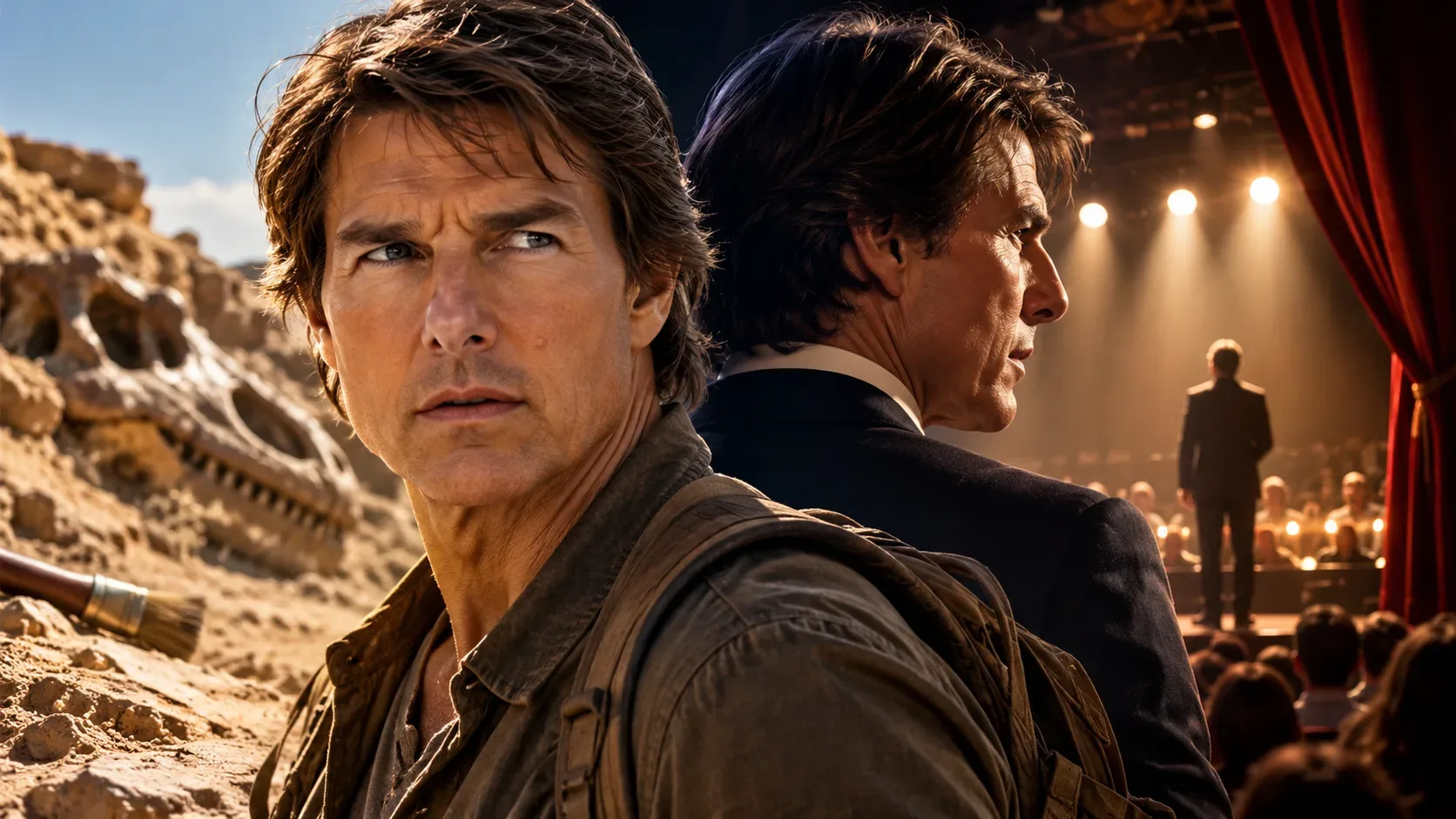
Curtis Markson is the actor played by Tom Cruise who takes on the role of oil tycoon Digger Rockwell in the play Fossil Fools. His identity is disclosed roughly half an hour in, when the film reveals that the opening disaster has been staged. A second twist matters just as much: the events portrayed by the play stem from a catastrophe that really happened within the film’s fictional universe, decades before this theatrical production.
Directed by Alejandro G. Iñárritu and distributed by Warner Bros., Digger opened in Brazilian theaters on October 1, 2026, and in North America on October 2. Understanding its ending means distinguishing the dramatized past from the lives of the actors and audience members still dealing with its consequences.
Who is Curtis Markson, and why does Tom Cruise seem to play two people?
On the first narrative level, Cruise appears in character as Digger Rockwell, a billionaire with deep ties to the oil business. An operation run by his company in Greenland sets an enormous mass of ice loose. The accident threatens parts of Europe and intensifies an environmental crisis that political leaders cannot contain. The farcical dialogue and Digger’s exaggerated behavior belong to the way these events are being performed.
Behind the characterization is Curtis Markson, the lead performer in a satirical stage production. Curtis disputes the play’s approach with its director, Hannah, played by Sophie Wilde, and questions whether turning those responsible for the disaster into caricatures helps tell the truth. Cruise therefore plays Curtis in the film’s present and, inside Curtis’s performance, Digger. These are two narrative identities, not two separate tycoons.
Digger’s timeline across two narrative levels
The film initially presents the past as though it were unfolding directly before the camera. Only later does it reveal the backstage world. The sequence below shows when viewers discover each layer without mistaking in-universe history for the liberties taken by a stage production.
| Point in the movie | Narrative level | What happens and what we know |
|---|---|---|
| Opening | Play: dramatized past | Digger and government officials confront a disaster caused by oil drilling in Greenland; the ice threatens Europe. |
| Around the 30-minute mark | Present: rehearsal and backstage | A tree falls in the set and a seemingly gigantic stagehand puts it back. The illusion breaks: the characters were rehearsing. |
| Middle section | Alternating play and backstage scenes | The play follows the worsening catastrophe; Curtis tries to find his daughter, whose flight has gone missing during severe weather. |
| Near the ending | Present: Kenny’s reveal | The financier discloses his family connection to the real Digger and explains why he is reviving Fossil Fools. |
| Final performance | Play: Digger’s dramatized fate | After a jump of several years, Digger is stranded on a rig without support and leaps into the sea. The audience responds to his character’s end. |
| Final minutes and credits | Present: outside the theater | Curtis gets news of his daughter; patrons must put on masks after a Level Four warning. The city outside is flooded and damaged. |
The crucial distinction is that Fossil Fools did not invent the planetary devastation from scratch. The play satirizes events that took place decades earlier in the film’s own reality. That does not make every line or action performed onstage a literal historical record.
The moment the story becomes a play
The first break comes as Digger talks with the US president, played by John Goodman. A tree visible through the window tips over, and a member of the stage crew appears to set it upright. The apparent shift in scale exposes the scenic trick. What looked like a conventional story about a billionaire in trouble has actually been the dress rehearsal for a production about to open to the public.
From that point onward, the editing moves between scenes from the satire and Curtis’s problems. The actor is uncomfortable with his grotesque portrayal of Digger, while his most immediate concern is his daughter, whose plane has stopped reporting in amid dangerous weather. That personal emergency links the backstage story to the ongoing consequences of the disaster represented onstage.
Who is Kenny Rockwell, and what does he know about Fossil Fools?
Kenny, played by Jesse Plemons, turns out to be the real Digger Rockwell’s nephew and the main backer of the new production. He saw an earlier, more modest version of the play that became a cult favorite. Kenny believes reviving it can help society remember how the recklessness of businesspeople and political leaders contributed to the tragedy. This is the character’s stated rationale, not proof that the satire reproduces every event faithfully.
Kenny also affects Curtis’s life away from the stage. With resources from his intelligence company, he helps track down the actor’s daughter’s flight. Near the end, Curtis learns that she has been located and is expected to land safely. The relief felt by one family contrasts with a society that remains in crisis.
Does Digger die? What happens in the play’s last act?
In Fossil Fools, the catastrophe worsens when an attempt to destroy another ice mass breaks it into pieces, spreading damage across different regions. The play then jumps ahead several years: Digger and relatives are exiled on an oil rig after the government withdraws supplies and protection. The tycoon ends by jumping into the sea, and the theater audience applauds the symbolic death of a man blamed for environmental ruin.
This death is shown inside the play. The story establishes that Digger Rockwell existed in that universe’s past, but the stage production is a satirical reconstruction. That revelation alone does not independently verify every detail of the historical man’s supposed suicide. Curtis, meanwhile, survives the performance: he rises from the water tank used for the stage effect and takes his bow.
Why does the Level Four warning change the ending?
After the performance, an announcement of “Level Four” prompts audience members to cover their faces with filtration masks before leaving. Exterior shots reveal a New York City of filthy floodwater, gray skies, surveillance, and signs of social unrest. This is the story’s actual present, not another scene from Fossil Fools. The environmental threat did not end with a play about events long ago.
The movie does not identify the precise substance that triggers this particular alert. Still, the required masks and the state of the streets establish that the crisis has left lasting consequences for the people living there. The meta-theatrical reading comes from the contrast: inside the auditorium, people can cheer the downfall of a culprit, but outside no curtain can bring the catastrophe to an end. Art can preserve memory and create a space for shared response; it cannot undo the damage.
Sources and references
- Warner Bros. Pictures: official movie website, synopsis and release information
- VEJA: Lucas Almeida on the ending and Brazilian release
- Entertainment Weekly: Wesley Stenzel on the film’s twists and ending
- TheWrap: Casey Loving on the theatrical twist
- /Film: Bill Bria on the narrative and Cruise’s two roles