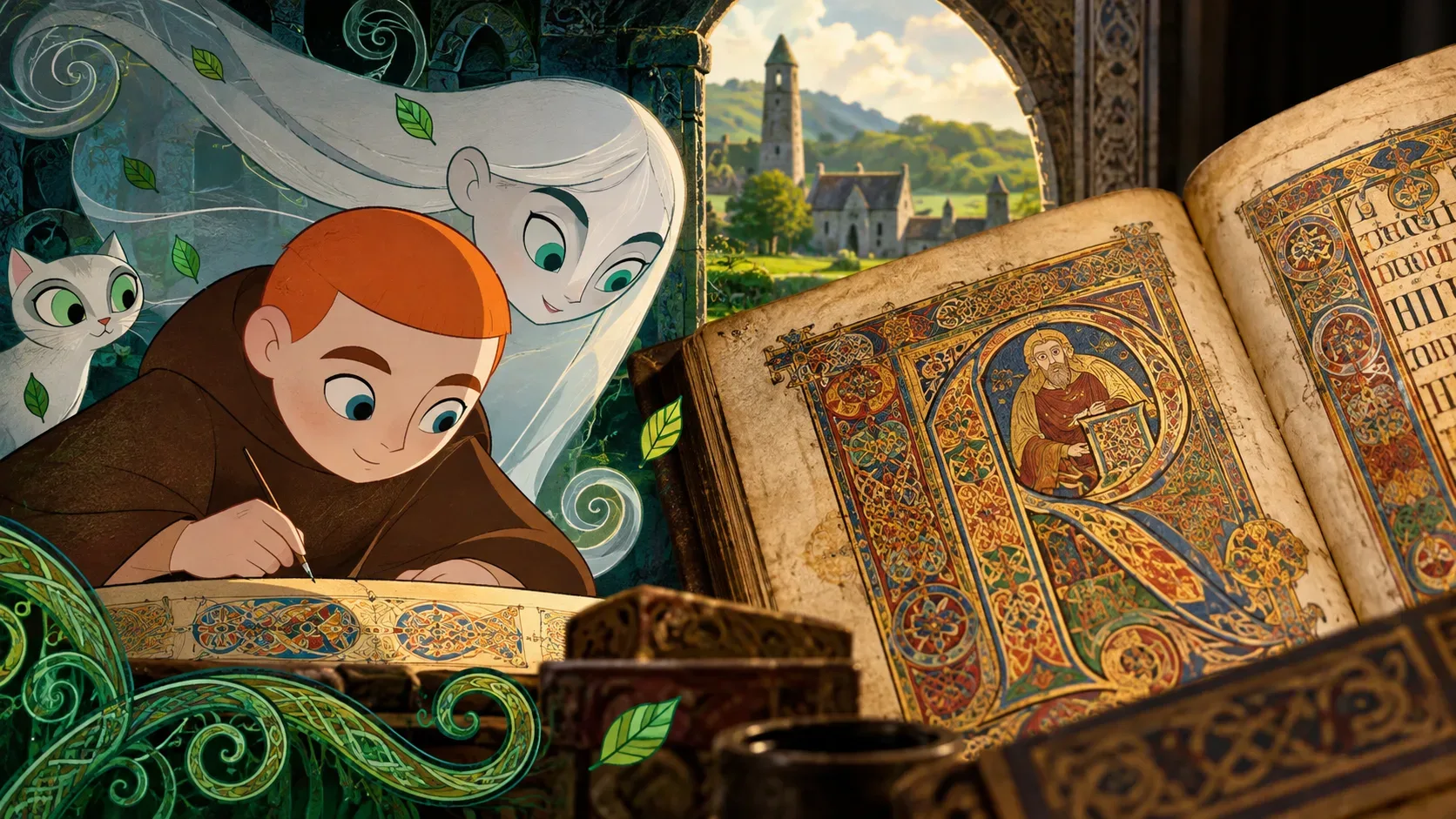
The Secret of Kells (2009) draws on a real historical object: the Book of Kells, a Christian manuscript produced around AD 800 and preserved by Trinity College Dublin. Its illuminated artwork, scribal practices and monastic setting have a documentary basis; Brendan’s adventures, the fairy Aisling and the magical elements are fictional. The university itself made that distinction when introducing the animated film on 3 March 2009.
The closest connection between the film and the manuscript is visual. Tomm Moore and Nora Twomey bring to life a world of ornamental letters, interlacing patterns and figures found across its pages, without claiming to reconstruct the lives of the people who made it.
What is the real Book of Kells?
The Book of Kells, catalogued as Trinity College Dublin MS 58, contains the four Gospels in Latin, with introductory material and tables cross-referencing biblical passages. It has 340 folios, or 680 pages, made from vellum, specially prepared calfskin. Its lettering is an accomplished form of insular majuscule script.
It is particularly celebrated for its decoration: monumental initials, geometric forms, interlacing, human and animal figures, and religious images. One of its best-known leaves is folio 34r, the Chi Rho page, which decorates the beginning of a passage in Matthew’s Gospel. Such elaborate artistry offers a better explanation for the film’s style than any supposedly magical quality of the object.
The manuscript was a collaborative undertaking, but the makers’ names are unknown. The library identifies four principal scribes and tentatively distinguishes three artists responsible for the major decorated pages. No historical record identifies the film’s Brendan or the master illuminator Aidan as the manuscript’s creators.
Six elements from the film compared with the manuscript
| Element in the film | Historical basis | Creative invention |
|---|---|---|
| Pages filled with spirals and interlacing | Intricate ornament and animal and plant motifs are present in the actual book. | Animation lets the patterns move and spread into the characters’ world. |
| Letters that become pictures | Illuminated initials and embellished lettering are central to the manuscript; the Chi Rho page is a clear example. | The film turns calligraphy into settings and visual rhythm. |
| Scribes and illuminators working in a monastery | Monastic workshops with scribes and artists making religious books are historically documented. | Brendan’s specific apprenticeship under Aidan is a fictional plotline. |
| Parchment, ink and vivid colours | The book uses vellum and pigments, including plant-derived blues, yellow orpiment and red and green compounds. | A magical quest for supplies is not a historically documented ink-making recipe. |
| The threat of Viking raids | Raids on Iona and the movement of religious communities to Kells in the early ninth century belong to the historical setting. | The dramatized siege and each character’s decisions are not a documentary account of those attacks. |
| An extraordinary book that must be protected | The manuscript survived journeys, a recorded theft in 1006 and centuries of preservation. | Supernatural powers and a chosen young rescuer are storytelling devices. |
Iona, Kells and the Vikings: what can history establish?
The story uses a real threat as its backdrop. According to Trinity College Dublin Library, a Viking attack on Iona, an island in present-day Scotland, in 806 led monks from St Columba’s community to seek refuge in Kells, Ireland. The two religious houses remained closely connected.
That does not settle where every page of the Book of Kells was made. Scholarship tends to link its origins to the scriptorium on Iona, yet the university stresses that it is unknown whether the book was produced wholly on Iona, wholly at Kells or across both sites. A particular fictional character arriving with the manuscript cannot therefore be treated as an established account of events.
Its subsequent history was much longer than a ninth-century adventure could encompass: the book was stolen in 1006, remained associated with Kells for centuries and arrived at Trinity College Dublin in the seventeenth century. The film compresses that historical memory into a coming-of-age story about protecting art.
Were Brendan and Aisling real? What about the magic?
There is no historical evidence that the film’s Brendan illustrated the Book of Kells. Trinity College’s 2009 announcement explicitly calls his adventures fictional. The official synopsis from distributor GKIDS describes Aisling as a fairy inhabiting an enchanted forest and presents the boy’s quest as fantasy.
The distinction matters: illuminated manuscripts, pigments and monastic communities belong to history; named characters, supernatural creatures and magical trials structure the animated story. Decorative motifs associated with medieval visual culture do not establish that the beings or events depicted in the plot actually existed.
How to spot the visual inspiration without confusing art with evidence
Three comparisons are especially revealing: the Chi Rho page, whose letters almost become an image; animal figures and interlacing patterns in decorated initials and margins; and the contrast between tiny calligraphic details and large decorated surfaces. These features help explain why the film’s spaces and figures appear to follow the visual logic of an illuminated page.
The film interprets the look of the Book of Kells; it does not faithfully reproduce each folio or establish who authored the manuscript. That distinction respects both works: the animation as a fantasy inspired by medieval traditions, and the codex as a material record of the artistic and religious practices of its time, still under study.