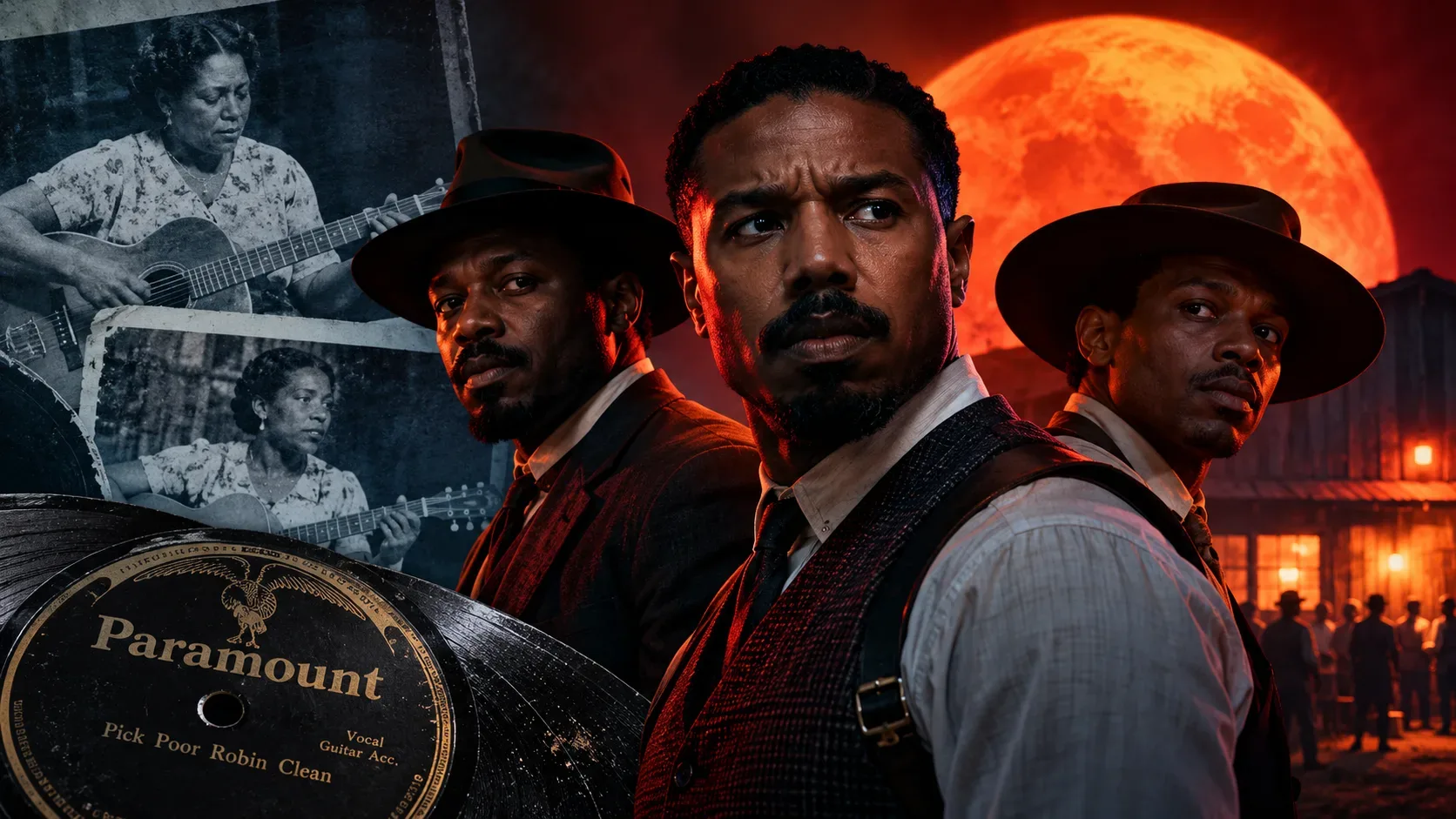
Luke Jordan made the earliest known recording of "Pick Poor Robin Clean" in 1927, but that does not prove he wrote the song. Geeshie Wiley and Elvie (L.V.) Thomas recorded a different rendition several years later, around 1930 or 1931. That historical performance was the recording Document Records says it was initially asked to license for Sinners (2025). The film's vampire trio performs a newly recorded version. First recording, songwriting, licensing and on-screen performance are separate credits.
Minor spoiler warning. This article identifies the characters involved in the musical performance outside the club, without revealing the film's ending.
Jordan recorded it first, but who wrote it?
Document Records dates two takes of "Pick Poor Robin Clean" by Virginia-born singer and guitarist Luke Jordan to 1927. One was released on Victor. It is the earliest sound recording identified in the sources consulted, but a recording date is not proof of authorship. There is insufficient evidence to say that Jordan invented the song, and the earlier origins of its words and melody remain uncertain.
Geeshie Wiley and Elvie Thomas later recorded their duet for Paramount, issued as Paramount 13074. Sources differ on the precise date: Stefan Wirz's discography places the session around March 1931, while the Oxford American's accompanying notes group all six of the women's recordings under 1930. 1930 or 1931 is therefore more responsible than presenting either year as an undisputed date.
In an Oxford American essay, scholar Daphne A. Brooks explicitly acknowledges Jordan's 1927 recording while examining Wiley and Thomas's distinctive rhythm, interplay and meanings. She also cautions that classifying the song as a blackface-stage number does not establish its actual origin. Oral tradition, sharp humor and imagery of dispossession remain subjects of interpretation, not proof of one identifiable songwriter.
What did Document Records investigate for Sinners?
In an account published on May 26, 2025, the label says Warner Bros. initially approached it to license Wiley and Thomas's recording. The research went beyond the audio itself: it examined the competing spellings Geeshie, Geechie and Geetchie and the identity behind "Elvie." According to Document Records, a letter from researcher Robert "Mack" McCormick to blues historian Paul Oliver helped identify the performers as Lillie Mae "Geetchie" Wiley and Sister L.V. Thomas.
The label says it and the film's music supervisor agreed on a performance credit naming both women and acknowledging the licensed recording. That does not establish that they originally composed the piece together or that Paramount made its first recording. A name in a track's metadata or legal credits does not necessarily capture the full history of a song that circulated and changed over time.
Which version do the vampires sing, and which is on the soundtrack?
In Sinners, Remmick (Jack O'Connell), Joan (Lola Kirke) and Bert (Peter Dreimanis, billed as Peter Dreams on the music release) sing "Pick Poor Robin Clean" outside the club to gain entry. Their performance was made for the film. It is neither Jordan's 1927 record nor the historical duo performing on screen.
| Recording | What is documented | What it does not establish |
|---|---|---|
| Luke Jordan, 1927 | Earliest known recording; Document Records identifies two takes | That he necessarily wrote the original song |
| Wiley and Thomas, around 1930/1931 | Historic Paramount duet, subsequently restored through reissues | That it was recorded first or proves joint songwriting |
| Track 9 on the 2025 album | New performance by Jack O'Connell, Lola Kirke and Peter Dreams, associated with the scene | That it is the licensed archive recording |
| Track 22 on the 2025 album | Historic recording credited to Lillie Mae "Geetchie" Wiley, with L.V. Thomas listed in Qobuz metadata | That its composer field settles the song's original authorship |
Qobuz lists Lillie Mae "Geetchie" Wiley as a composer in the metadata for both soundtrack tracks and lists L.V. Thomas as an associated performer on the historic recording. These are release and catalog credits, not definitive historical evidence that no form of the song existed before Wiley, particularly given Jordan's 1927 record. Document Records's account separately explains the request to license the archive performance and the newly recorded version for the film.
Why does an old blues song matter in that scene?
The story is set in 1932, after the early recordings had been made. The sequence's irony lies in three white vampires using a song rooted in Black musical experience to seek access to a Black gathering space. Writing for Reactor, Leah Schnelbach interprets the performance as appropriation. That is an attributed critical reading, not evidence of songwriting ownership or a direct statement from the director explaining every lyric.
UCLA ethnomusicologist Cheryl Keyes also emphasizes the blues and cultural exploitation in Sinners. In discussing the scene, she describes the song as written by two Black women. That wording reflects her framing of the moment, but it does not settle the historical question: Jordan recorded it earlier, and the available documents do not securely identify its first creator. Brooks, meanwhile, draws attention to the particular artistry of Wiley and Thomas's duet, in which humor, power and survival matter far more than the catch-all label of an "old song."
So what does "Pick Poor Robin Clean" mean?
The central image is a robin, a bird, stripped of every feather. Document Records discusses interpretations involving gambling losses, exploitation and humiliation; Brooks hears wit and a reversal of power in the women's performance. A suggested connection with the old English rhyme about Cock Robin has not been demonstrated as a direct musical lineage. That ambiguity makes the song unsettling in the film, but none of these readings is an established single meaning of the lyrics.
The documented answer has three layers: Jordan is the earliest known recorded performer; Wiley and Thomas made the historic duet behind the licensing research; and O'Connell, Kirke and Dreimanis recorded the vampire trio's version for the film. The song's original authorship remains unresolved.