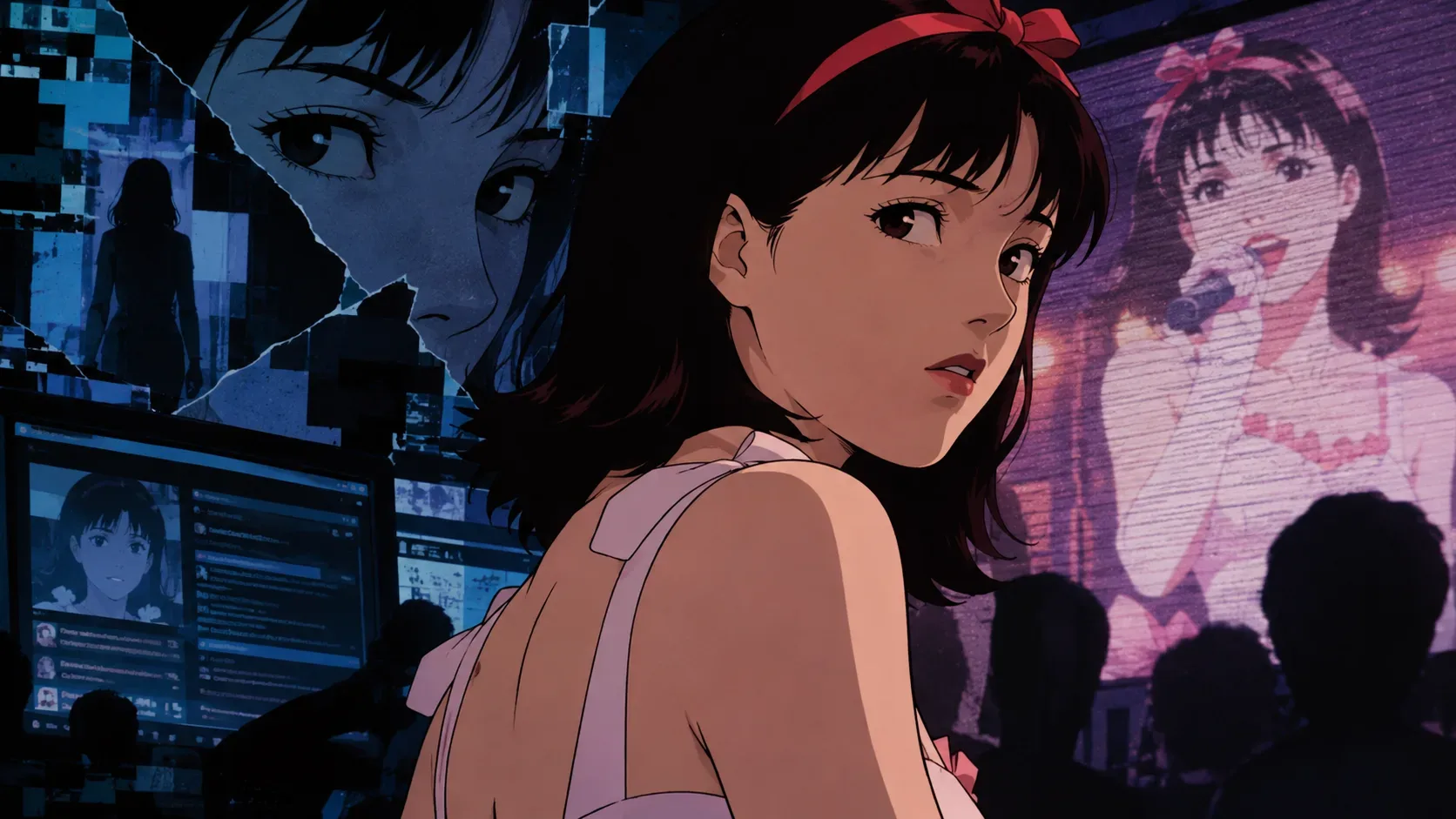
In Perfect Blue (1997), Satoshi Kon created Mima's online presence to show how a public image can come to seem more convincing than the person herself. According to the director, the website attributed to the singer was absent from Yoshikazu Takeuchi's novel. The story-within-a-story device and the deliberate uncertainty between reality and imagination were also introduced for the adaptation. Rather than a faithful transfer of the book, the film is a substantial reworking with its own dramatic aims.
Content notice: this article discusses the film's suspense techniques and its fictional television series, without revealing the ending or identifying the person behind the website.
Why was Kon able to change so much?
The starting point was Yoshikazu Takeuchi's novel, published in 1991. The adaptation project was initially conceived as a live-action video film and reached Kon only after a decision had been made to turn it into animation. In an interview with Tom Mes for Midnight Eye, published on February 11, 2002, the director said he received a screenplay written by the novelist and agreed to participate only if he could alter it.
The production asked him to retain three elements: an idol, horror and a stalker. Beyond those requirements, Kon said he could even change the plot. One qualification is essential to any book-to-film comparison: he stated that he had not read the complete novel. In another interview, originally published in 1999 and later republished by All the Anime, he said he had seen a project outline described as close to the source. It would therefore be misleading to present his decisions as the result of a detailed, chapter-by-chapter reading.
Why create an online version of Mima?
Kon told Midnight Eye that the story needed a place where a supposedly more authentic Mima could appear. In effect, this identity would be closer to the image the public wanted to preserve than to the woman trying to pursue a different career. Crucially, someone other than Mima had to create it. His chosen device was a website.
That choice changes how the suspense operates. Mima is not merely pressured by fans who want the singer they once knew to remain unchanged. She encounters a public version of herself that seems to speak on her behalf and challenges her own experience as the basis of her identity. This is an interpretation of the website's dramatic role grounded in Kon's explanation, not a claim that the novel contained the same online plot.
Kon also said he had neither internet experience nor a computer before production; he bought one to learn about the medium. His personal website came after the film and did not inspire this idea. Reading Perfect Blue today as anticipating manufactured online identities is consistent with a 2025 BFI discussion, but it should not be mistaken for a statement by Kon about modern social networks.
What did the fictional series Double Bind add?
The fiction staged inside Perfect Blue includes Double Bind, a fictional television crime drama in which Mima works as an actress. Although Kon used the broader notion of a work within a work when discussing his changes, Double Bind is not a second feature film: it is a TV series within the story. Its acting scenes begin to echo Mima's experiences and doubts, creating transitions that make the boundary between a performed role, personal perception and external events uncertain to viewers.
Kon credited himself with introducing this layered structure and the blurring of imagination and reality. In statements from 1998 preserved on his website, he said he brought a pre-existing interest in the intersection of dreams and everyday life to the project, and acknowledged screenwriter Sadayuki Murai's role in shaping that proposal into a script. In Midnight Eye, he explained that he contributed ideas during writing despite not receiving a screenplay credit, and that storyboarding further refined dialogue and shot composition.
The disorientation does not mean the filmmakers lost track of which events were real. Speaking to Andrew Osmond, Kon said he distinguished objective and subjective material while drawing the storyboards, but did not intend the audience's experience to be reduced to mechanically classifying every scene. That instability is part of the film language he chose to follow Mima.
The emphasis shifted to a crisis of identity
Kon also distinguished his aims from a general denunciation of the idol industry. In 2002 he said he wanted to follow the transformation of a young woman whose former values no longer gave her stability. In 1998 he explained that he preferred to examine how stalking damages the victim's mind rather than concentrate on the supposed abnormality of the stalker. Those statements help explain why Mima's virtual identity and the editing that mixes different layers of experience matter more to this adaptation than a detailed depiction of the music business.
Which differences from the novel are actually established?
The interviews reliably identify the three elements retained from the project, idol, horror and stalking, and three additions Kon explicitly described: the website that constructs another Mima, the fiction within the fiction, and the unstable boundary between imagination and reality. They also establish his freedom to rebuild the plot with Murai. The BFI describes the result as a loose adaptation and highlights its online identity theme.
These sources, however, are not a close reading of the 1991 edition. By themselves they do not establish every change to characters, dialogue, murders or the ending compared with Takeuchi's text. The more defensible conclusion is that Kon retained an idol-horror-stalker premise to tell, through animation's particular storytelling possibilities, a story about the gap between a person and the image others construct of them.