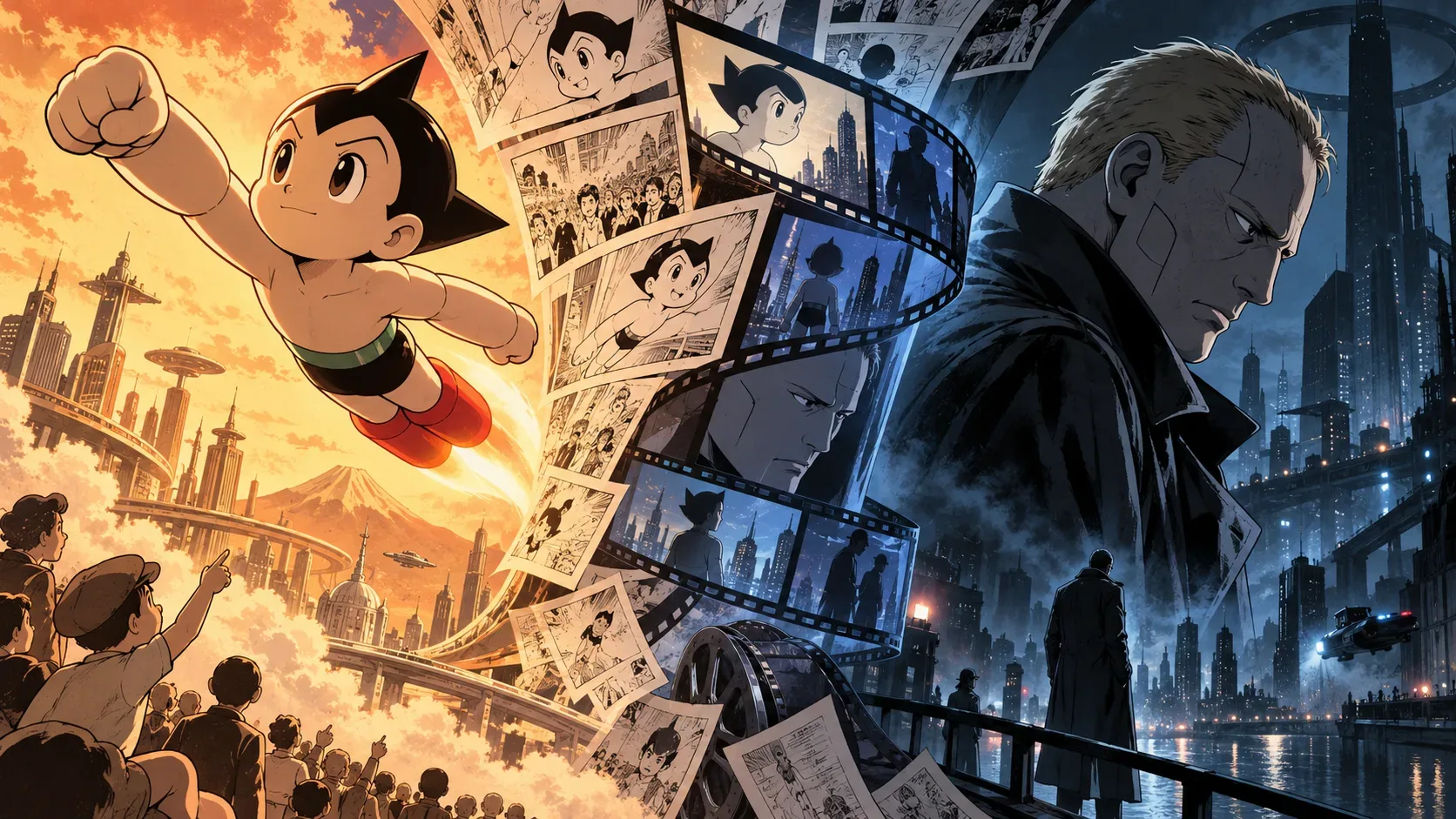
PLUTO is not a remake of Astro Boy as a whole. Naoki Urasawa's manga, published from 2003 to 2009, reimagines one particular story arc created by Osamu Tezuka for Astro Boy (Tetsuwan Atom) in 1964 and 1965. The PLUTO anime, released on Netflix in 2023, adapts that later manga. The connection is direct, but each work tells its own version of the story.
The clearest change is whose perspective drives the action. In Tezuka's arc, Atom is at the center of the struggle against the powerful robot Pluto. In PLUTO, the investigation is led primarily by Gesicht, a robot detective working for Europol. Urasawa did not invent Gesicht: the character was already part of the original story, but the retelling gives him a far larger role.
The original Astro Boy story came first
Tezuka launched Tetsuwan Atom as a manga series in 1952, having introduced the character in Atom Taishi in 1951. The first Astro Boy animated television series started in 1963. Within that world, he published a story in the Japanese magazine Shōnen from 1964 to 1965, initially called Shijō Saidai no Robot, roughly meaning 'the greatest robot in history.' When collected in book form in May 1965, it was renamed Chijō Saidai no Robot, internationally known as The Greatest Robot on Earth.
In the original plot, Pluto is sent to challenge some of the world's most powerful robots to prove his superiority. Atom must deal with the threat, while the story questions the idea of turning intelligent beings into weapons. The German detective Gesicht, along with Montblanc, North No. 2, Brando, Hercules and Epsilon, already appears in that arc. The cast's foundations therefore come from Tezuka, rather than being invented solely for the recent anime.
Timeline: six versions and milestones that are often confused
The timeline below follows the history published on the Japanese production website for PLUTO. It brings together publications and broadcasts connected to the same story, but it does not describe a single fictional continuity.
| Period | Work and medium | What happened |
|---|---|---|
| 1964 to 1965 | Astro Boy, Tezuka manga | The arc was published under its original title, Shijō Saidai no Robot, then renamed Chijō Saidai no Robot in May 1965. |
| April 24 and May 1, 1965 | 1963 Astro Boy, anime | The arc aired as a two-part story in the first television series. |
| March 18 and 25, 1981 | 1980 Astro Boy, anime | Another two-part animated version appeared within the second television series. |
| August 3 and 10, 2003 | 2003 Astro Boy, anime | The third television series revisited the material in two episodes with their own Japanese titles. |
| September 2003 to 2009 | PLUTO, manga | Urasawa retold and expanded Tezuka's story, placing detective Gesicht in the foreground. |
| October 26, 2023 | PLUTO, Netflix anime | The animated adaptation of Urasawa's manga premiered with eight episodes. |
One detail matters especially in 2003: the new Astro Boy television series presented its version in August, while serialization of the PLUTO manga began in September. These are distinct productions drawing on the same Tezuka material. Neither should be described as an adaptation of the other.
Who is Gesicht, and why did he become the lead?
Gesicht is a German robot investigator associated with European law enforcement. In Tezuka's original story, he is one of the robots drawn into the conflict with Pluto and has a secondary role compared with Atom. The claim that Urasawa invented Gesicht exclusively for his series is therefore incorrect.
In the retelling, Gesicht becomes the narrative's organizing figure. He investigates the destruction of advanced robots and the murders of people connected to robot law. His position as both investigator and potential target draws readers into the central questions of the mystery: who is responsible for the crimes, how do humans and machines coexist, and what does violence leave behind in beings capable of feeling?
The anime's official site describes Gesicht as a Europol special agent with a body made of a zeronium alloy, investigative equipment and recurring nightmares. Those details help explain why Urasawa's version spends time on his identity and on his life beyond police work. Atom remains essential, but he no longer holds the story's perspective all to himself.
What actually changes between Astro Boy and PLUTO?
| Aspect | Tezuka's arc | Urasawa's retelling |
|---|---|---|
| Point of view | Atom takes the leading role in the confrontation with Pluto. | Gesicht drives much of the investigation, while Atom retains a crucial role. |
| Structure | The conflict among extremely powerful robots moves the story forward. | The attacks become a mystery investigated across a longer narrative. |
| Characters | Gesicht and the other robots appear in the original arc. | The same characters receive fuller individual stories and more detailed relationships. |
| Themes | War, obedience and the futility of violence are already present. | The retelling expands those questions through memory, prejudice, grief and human-robot coexistence. |
The change in tone does not mean Tezuka wrote a story without criticism or emotion. In the production site's explanation of the original arc, Pluto is portrayed as a tragic character forced into combat by orders he did not choose. In an interview published on the PLUTO website, Urasawa said the sadness of Tezuka's story had stayed with him since childhood, particularly because winning a battle did not erase the suffering it caused.
Calling PLUTO a 'remake' can therefore work in a broad sense, but a reinterpretation of one specific Astro Boy story arc is more precise. The manga retains central characters and ideas while developing a different approach; it does not retell the entire franchise from the beginning.
Which work does the 2023 anime adapt?
The series released by Netflix on October 26, 2023 adapts Urasawa's PLUTO manga, developed with Takashi Nagasaki under the supervision of Macoto Tezka and in cooperation with Tezuka Productions. Studio M2 handled animation, with GENCO producing. Netflix's Brazilian listing shows eight episodes.
It is not a fourth season of Astro Boy, a sequel to the 1965, 1981 or 2003 cartoons, or a direct animated version of Tezuka's original arc that bypasses Urasawa's work. The adaptation path is: Tezuka's story, the PLUTO manga, then the PLUTO anime. Earlier Astro Boy animated versions form other branches of that family tree.
Do I need to watch Astro Boy before PLUTO?
No. The 2023 series establishes its own investigation and provides context for Gesicht, Atom and the other characters. Familiarity with Astro Boy makes the shifts in perspective easier to appreciate, but it is not a narrative requirement for following the anime.
For comparing the works without mixing up their continuities, this order is especially helpful:
- Start with Tezuka's The Greatest Robot on Earth arc to understand the original conflict and Atom's role.
- Next, read the PLUTO manga, published from 2003 to 2009, and note how Gesicht becomes central to the story.
- Finally, watch the 2023 PLUTO anime and, if interested, separately compare the Astro Boy episodes broadcast in 1965, 1981 and 2003.
This is a suggested order for historical comparison, not a required sequence of events within the same fictional universe. Different adaptations may share characters and ideas without being consecutive chapters of one timeline.
Sources and references
- Official PLUTO production: historical timeline
- Official PLUTO production: explanation of the original arc
- Official PLUTO production: story and episode outlines
- Official PLUTO production: characters
- Official interview with Naoki Urasawa
- Netflix: announcement of the PLUTO adaptation
- Netflix Brazil: PLUTO anime listing