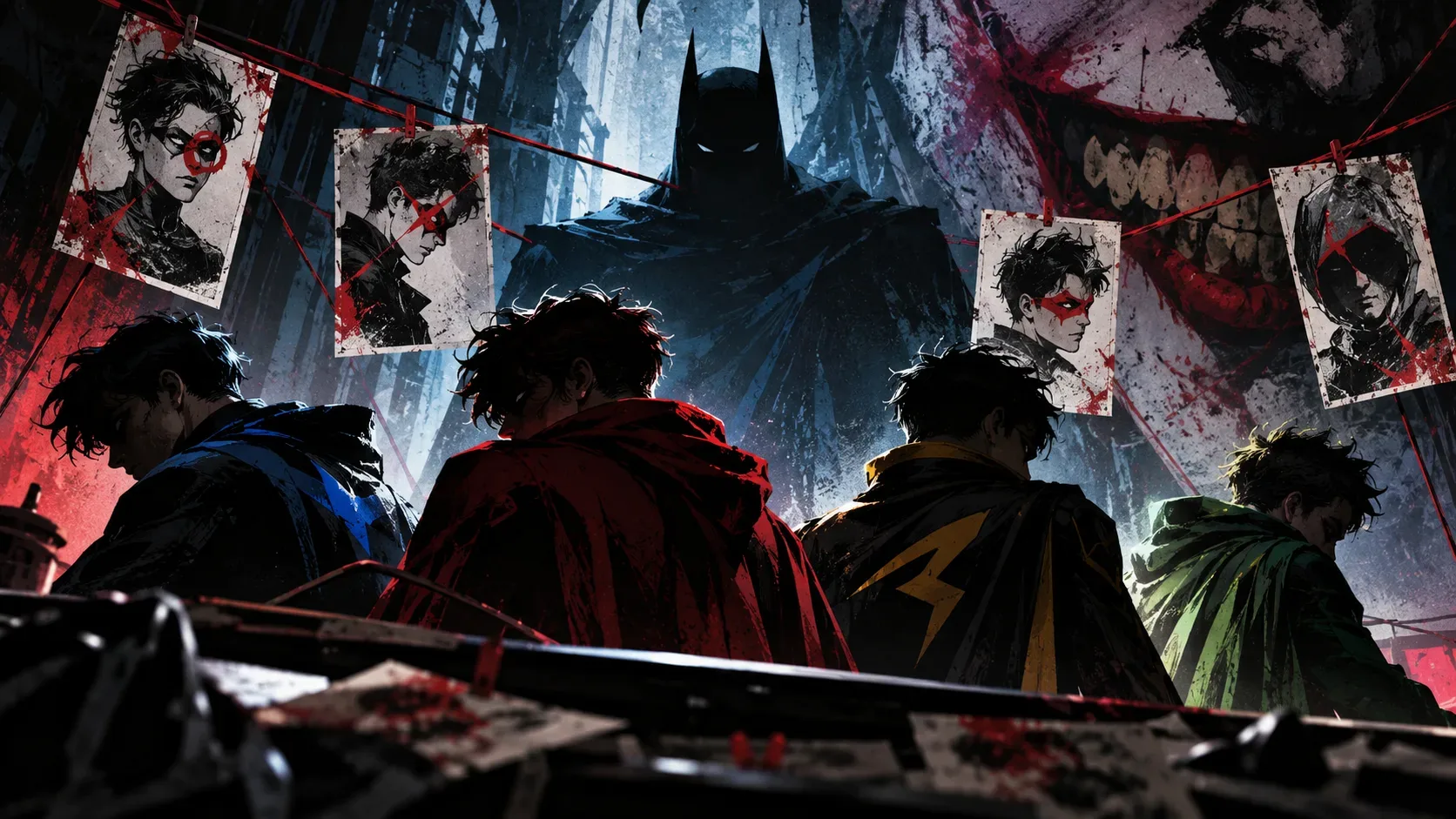
Spoiler warning: this guide reveals information from Absolute Batman #19 and #20. It does not cover subsequent story revelations.
The Absolute Universe Robins are Dick Grayson, Jason Todd, Tim Drake, Stephanie Brown, and Duke Thomas. Unlike their better-known counterparts, they are not sidekicks trained by Batman. They belong to the Robin Program, created by Jack Grimm, this continuity’s Joker, and trained by Slade Wilson. The team’s public mission is to protect Gotham, but that mission includes hunting down and stopping Batman.
This reversal appears in Absolute Batman #19, released in the United States on April 15, 2026, and develops into direct action in issue #20, released on May 13, 2026. Both issues belong to the series written by Scott Snyder and illustrated by Nick Dragotta. The guide below distinguishes what these two comics establish from later revelations.
Why do the Robins follow the Joker and fight Batman?
To the public, Jack Grimm is a billionaire philanthropist who shelters and mentors vulnerable young people. That respectable persona provides the foundation for the Robin Program. Slade Wilson, also known as Deathstroke, introduces its members as people whom Grimm supported and who were subsequently prepared to help secure the city.
The organization is militarized: all five use large mechanized suits and advanced weapons. Wilson trains the team, while Grimm founded it. As far as their assignment is concerned, fighting Batman is part of maintaining order. The reader knows a crucial fact that complicates this narrative: Grimm is the Joker, regardless of the respectable image he projects across Gotham.
In an interview with DC, Snyder explained that the young people see Grimm as a good man because of his involvement in their lives as a benefactor. Their opposition to Batman therefore does not require assuming that every member knows their sponsor’s true nature. This is a distorted relationship of trust, not a former Batman family deciding to betray him.
Who is who? The five Absolute Robins versus their familiar counterparts
The comparisons below concern character identities, not identical biographies. In mainstream DC continuity, several heroes have shared the Robin name. In the Absolute Universe, it identifies members of an organized effort against Batman.
| Character | Best-known role in DC comics | What issues #19 and #20 establish in the Absolute Universe |
|---|---|---|
| Dick Grayson | The first Robin, who later became Nightwing. | A member of the Robin Program connected to Grimm and Wilson. He had already appeared in the series, including issues #9 and #17. In #19 he is shown with a dog, recalling Haley’s presence; #20 places him among Batman’s opponents. |
| Jason Todd | The second Robin, later known as Red Hood. | One of the program’s five agents. In #20 he impulsively fires at Batman and nearly hits his teammates, a concrete example of this version’s violent behavior. |
| Tim Drake | The third Robin in the main line of succession, also associated with the Red Robin identity. | Identified as one of the five members in #19 and #20. Those issues do not justify assigning him the same origin, training, or relationship with Bruce as his mainstream counterpart. |
| Stephanie Brown | Introduced as Spoiler, briefly served as Robin, and also became Batgirl. | Part of the Robin Program, although #19 and #20 do not yet provide an individual backstory equivalent to mainstream Stephanie’s. |
| Duke Thomas | Participated in the We Are Robin movement and later operated as the Signal. He does not hold the same historical position as one of Batman’s individual Robins. | The fifth confirmed member. His enrollment in Grimm’s program does not automatically make the original We Are Robin movement part of his Absolute origin. |
The comparison also clarifies one absence: Damian Wayne belongs to the familiar Robin lineage in the mainstream universe but is not among the five introduced by DC within this scope. That does not establish that he can never appear in Absolute continuity.
What happens in issues #19 and #20?
- Absolute Batman #19 (April 15, 2026): introduces the team in this configuration and places its members within Gotham’s power struggle. Dick had appeared earlier, but the new development is the connection between these familiar names and Grimm’s sponsored operation.
- Absolute Batman #20 (May 13, 2026): shows the Robins in action with mechanized equipment and establishes the direct threat they pose to Batman. Jason nearly hitting his allies while firing is the clearest individual behavioral difference singled out by DC’s published explainer.
- The confrontation setup: the end of #20 sets up a clash between Batman and all five Robins. This article does not cover outcomes depicted from #21 onward.
What changes most about the Batman and Robin relationship?
In the familiar DC mythology, Bruce Wayne commonly mentors younger heroes, even when the relationships are strained. Here, his enemy publicly fills that mentoring role. These Robins do not enter the story as former Batman partners nursing a grudge. They see him as the target of an organization to which they owe allegiance.
The contrast is integral to the series’ creative premise. Snyder has described Batman as the under-resourced challenger to the established order, while the wealthy, influential Joker stands for the system. In his newsletter, the writer also stressed that these Robins should not be reduced to straightforward villains and that each has individual motivations. That is an attributed statement of creative intent, not confirmation of a future redemption or particular outcome.
What should you read to understand the Robin Program?
- Essential reading for this question: Absolute Batman #19 and #20, which introduce the team and its mission against Batman.
- Optional background: Absolute Batman #1 establishes the new continuity and its Bruce Wayne without his traditional wealth.
- Earlier clues about Dick: issues #9 and #17, cited by Snyder when discussing the buildup to the Robins’ arrival.
Later issues expand this part of the story, but they are outside this guide’s spoiler boundaries. The Robin Program should not be confused with Batman’s traditional team, nor should individual backstories be invented where #19 and #20 do not explain them. The essential difference is allegiance: these five have been shaped by the Joker’s system to face the very hero their other versions usually come to know.
Sources and references
- DC, Joshua Lapin-Bertone: The Absolute Robins are Here (and Batman Has Plenty of Reasons to Worry)
- DC, Joseph McCabe: Send in the Mechs: Scott Snyder’s Absolute Robins Take Flight
- DC: Absolute Batman #19, official issue page
- DC: Absolute Batman #20, official issue page
- DC: Robin Revealed: Fun Facts About the Boy (and Girl) Wonder
- Scott Snyder: Newsletter #231: Absolute Robins
- DC: Absolute Batman #1, official issue page