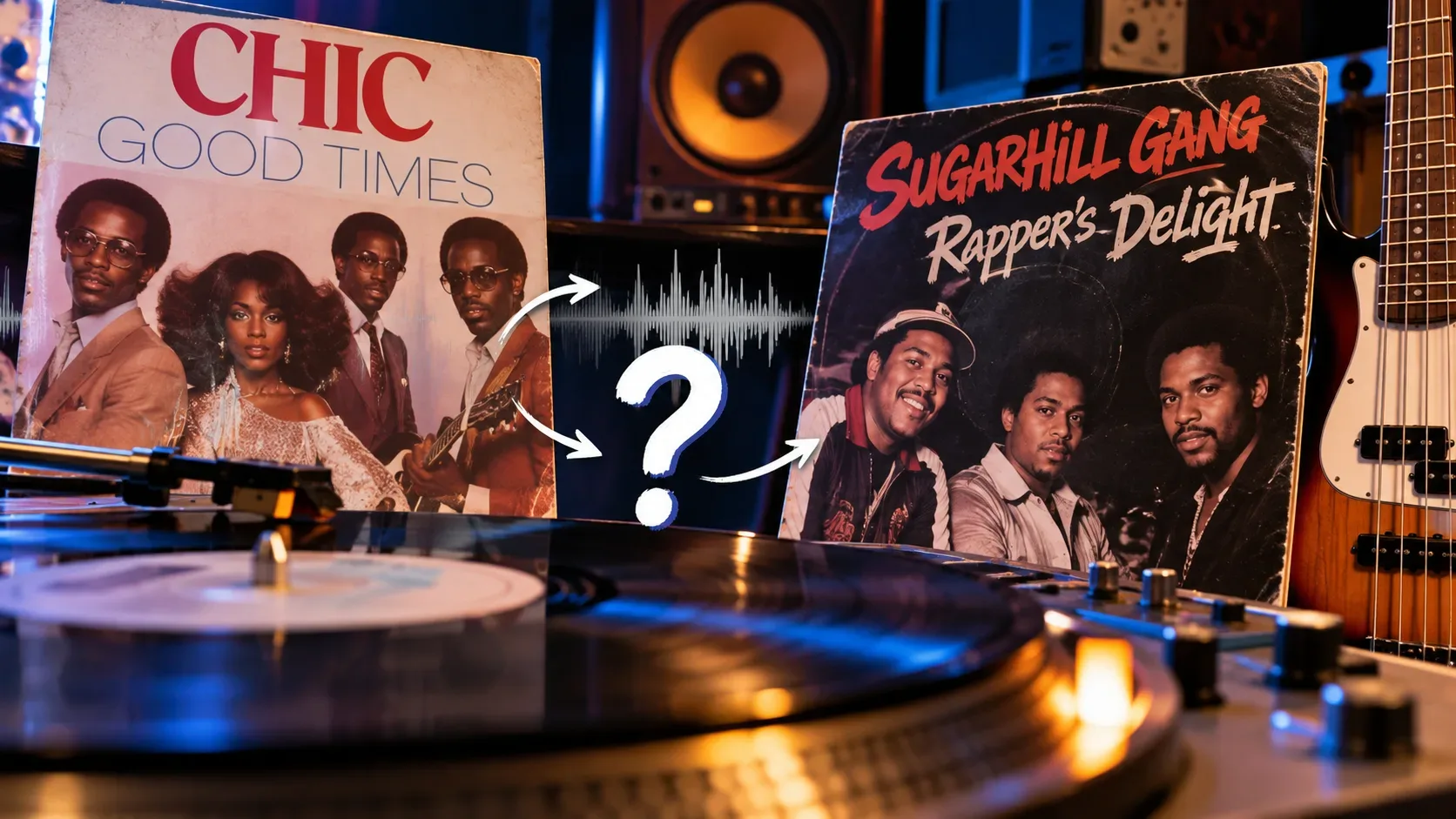
On Rapper’s Delight (1979), the bass line borrowed from Chic’s same-year hit Good Times was performed and recorded again. It was not simply lifted from Bernard Edwards’s bass performance on the original master. But that distinction does not cover every sound: Nile Rodgers and session bassist Chip Shearin both recalled portions of Chic’s recorded strings being incorporated into the Sugarhill Gang track. The difference between replaying music and reusing recorded audio is central to what happened.
How the Good Times groove was rebuilt in the studio
Producer Sylvia Robinson brought together Wonder Mike, Master Gee, and Big Bank Hank to record rap vocals over a rhythm already familiar from parties. She chose the groove of Good Times, written by Nile Rodgers and Bernard Edwards. In an interview with The Guardian, Master Gee said musicians associated with Positive Force performed the backing track under their vocals. The Washington Post also identifies those musicians in its historical account of the recording.
A particularly detailed account comes from Chip Shearin, the bassist who took part in the session. In a 2015 interview with Kevin Johnson for No Treble, he recalled Robinson asking him to play the Good Times bass part for roughly 15 minutes. Shearin said he played alongside a drummer, followed a flashing timing light, and completed the performance in one take. Their extended repetition served much the same purpose as a DJ keeping a record’s rhythmic break going.
Shearin also described shifting a rhythmic accent in Edwards’s line, which he attributed to Robinson’s instructions. That helps explain why the recordings follow such a similar pattern without being the same performance. No digital sampler needed to extract the original bass: a musician played the figure again.
The bass was interpolated. What about the strings?
In music-production terms, a sample uses audio taken from an existing recording. An interpolation recreates part of an existing musical composition as a new performance. The Rapper’s Delight bass line is therefore most accurately called a replay or interpolation of the Good Times figure.
| Element | What the accounts support |
|---|---|
| Bass | Chip Shearin performed the Bernard Edwards-associated line again. |
| Guitar and rhythm backing | Rodgers said the bass and guitar were replayed; Shearin recalled a drummer at the session. |
| Strings | Rodgers identified passages taken from Chic’s recording; Shearin also recalled those sounds being added later using tape techniques. |
The final distinction matters. Speaking to Terry Gross on Fresh Air, Rodgers said he recognized his composition but could tell that neither he nor Edwards was playing the guitar and bass parts. Listening more closely, he identified material from the original string arrangement. Shearin said he first heard those strings when the finished song reached him and described analog tape-editing methods. Their accounts agree on the distinction between a replayed bass line and reused string passages, although they do not provide a complete, second-by-second track sheet for the recording.
Calling Rapper’s Delight a song that simply “sampled the bass” is therefore misleading. Equally, claiming that everything was replayed would overlook what the people involved said about the strings.
Why the distinction matters for songwriting credits
Good Times and Rapper’s Delight are separate sound recordings, but the latter uses material from the former’s musical composition. Composition rights concern the underlying song, while master rights concern a particular recorded performance. Broadly speaking, replaying a passage does not remove the need to address rights in the composition; using original audio also raises rights issues concerning that recording. This is a general technical distinction, not a reconstruction of every license negotiated in 1979.
Rodgers and Edwards challenged the use of Good Times. According to The Washington Post, the dispute ended in a settlement and the two became credited writers of Rapper’s Delight. That credit recognizes the underlying musical contribution; it does not mean Edwards played bass on the Sugarhill Gang master. Shearin’s testimony identifies the musician who replayed the part in the studio.
This episode shows why “where did the riff come from?”, “who performed it on this record?”, and “which recorded sounds were reused?” are three separate questions. The bass on Rapper’s Delight was replayed. For the string passages described by Rodgers and Shearin, there is testimony that Chic’s audio was reused. The 1979 recording is best understood through that combination rather than a single blanket label.
Sources and references
- No Treble: Kevin Johnson interview with Chip Shearin
- Fresh Air: Terry Gross interview with Nile Rodgers
- The Guardian: Master Gee and Wonder Mike interviews
- The Washington Post: Rapper’s Delight origins and credits
- InterSpace: distinction between sampling and interpolation
- MusicRadar: comparison of the two bass recordings