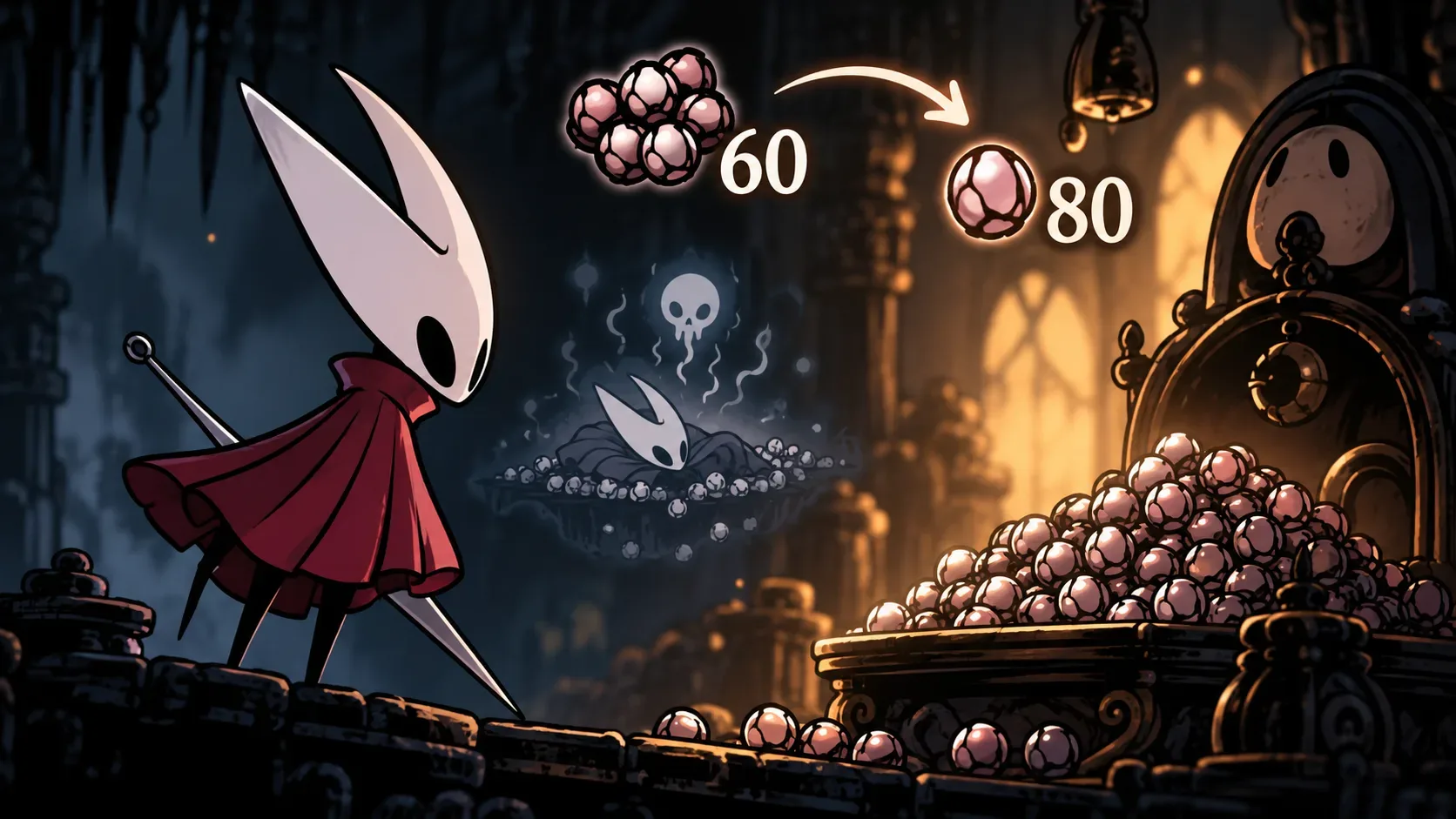
In Hollow Knight: Silksong, the guides consulted describe a simple but counterintuitive exchange: spend 80 loose Rosaries to get a Rosary String holding 60. The missing 20 are the price of protection, not a refundable deposit. The String stays in Hornet's inventory when she dies, whereas loose Rosaries must be recovered where she fell. So storing them is worthwhile when the risk of losing the currency permanently outweighs that protection cost, particularly before a dangerous section.
Why does a String holding 60 cost 80 Rosaries?
A merchant or machine converts vulnerable currency into a protected consumable item. Handing over 80 Rosaries does not create a stash of 80: it gives Hornet a String that releases exactly 60 when broken in the inventory. The fixed difference of 20 is 25% of the amount paid. Protection neither multiplies your money nor earns interest; it reduces the spendable total in exchange for keeping part of it safe through death.
The stored currency is also unavailable for purchases while the String remains intact. To pay for a map, tool or passage, you must break it first. At that point, the 60 Rosaries become loose again and follow the normal loss rules. Nintendo Life and Destructoid describe merchants and exchange points across Pharloom; Pebb in Bone Bottom is one merchant they identify.
What happens to Rosaries when you die?
On the first death, loose Rosaries stop being available and can be recovered by returning to the silk cocoon Hornet leaves behind. If Hornet dies a second time before recovering them, the earlier amount is lost for good. In other words, dying once does not necessarily mean losing your money forever: the storage decision depends mainly on how difficult it will be to retrieve the cocoon, not simply on the chance of dying.
An intact Rosary String is not dropped during this process because it remains an inventory item. Only currency already converted receives that protection. If Hornet carries 100 loose Rosaries alongside a String holding 60, the loose 100 remain at risk while the stored 60 are protected.
When is the 20-Rosary fee worth paying?
Consider two options for 80 Rosaries you do not need to spend immediately. Carrying them loose preserves the full 80 if you manage to reclaim them after any deaths. Turning them into a String guarantees 60 regardless of that risk. In a purely mathematical illustration, if the probability of permanently losing all 80 loose Rosaries before the next purchase were greater than 25%, the 60 protected Rosaries would have the higher expected value. That percentage is a hypothetical benchmark, not a measured death rate in the game.
In practice, a String makes more sense before exploring unfamiliar paths, repeatedly attempting a tough fight or crossing an area where retrieving the cocoon would be dangerous. It may not be worthwhile when the next purchase is close, the route is safe or you can easily return to the cocoon. Losing 20 in the conversion is also not the same as losing 80 after a second death: these are different outcomes, and the latter is not inevitable.
How to use Strings without wasting Rosaries
- Check immediate purchases. If you need a map or a paid bench right now, consider buying it before paying to protect currency you will soon spend.
- Store currency before danger. Use a merchant or conversion device when you have enough Rosaries and a risky stretch ahead.
- Do not break a String too early. Keep it in your inventory until you have a specific purchase to make; breaking it removes the protection.
- Prioritize recovery after death. Loose Rosaries from the first defeat may still be in the cocoon. Dying again before collecting them makes the loss permanent.
Does this rule apply to every Silksong version?
The 80-for-60 price and String behavior are documented in guides published after the game's 2025 release, but that is not a direct test of every update or platform. Team Cherry identifies Patch 5 for PC as version 1.0.30000 in a note dated March 16, 2026. Its patch notes do not describe a specific change to String pricing; however, silence does not prove that every build uses identical values. Check the price displayed by the merchant or machine in the version you are playing.