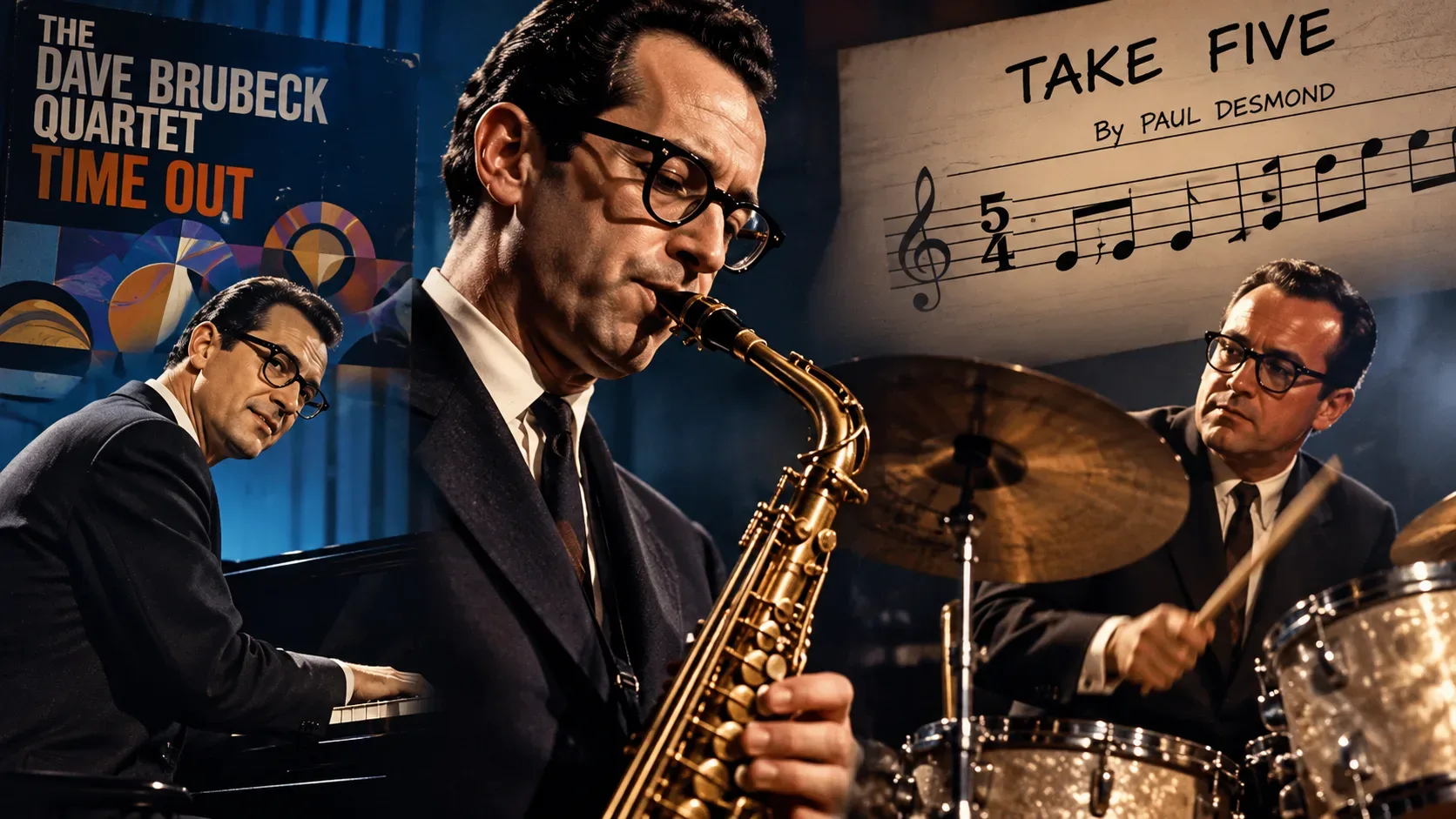
“Take Five” was composed by Paul Desmond, the Dave Brubeck Quartet's alto saxophonist, and appeared on the 1959 album Time Out. Joe Morello is not credited as the composer of the recording, but his 5/4 drum groove was central to the tune's creation. Dave Brubeck, the quartet's leader and pianist, helped shape Desmond's ideas into a musical form. Those are three distinct contributions, often mistakenly grouped together under the pianist's name.
Why is “Take Five” associated with Dave Brubeck if Paul Desmond wrote it?
The composition credit is clear. The Library of Congress identifies Paul Desmond as the writer of “Take Five”, and the track's Apple Music credits list the saxophonist as composer. The confusion stems from the performing artist: the recording became famous through the Dave Brubeck Quartet, an ensemble named after its leader.
Referring to the record as “Take Five” by the Dave Brubeck Quartet is accurate. Saying that Dave Brubeck single-handedly wrote the 1959 composition is a different claim. Keeping songwriting credit separate from recording performance is the key to understanding its history.
What did drummer Joe Morello create?
Morello was already experimenting with rhythmic patterns beyond the time signatures commonly heard in jazz, including 5/4. In an interview originally published in Rhythm and republished by MusicRadar, the drummer identified himself as the source of the “Take Five” groove. He recalled practising meters such as 5/4 and 7/4 before the tune took shape.
A 5/4 time signature means five quarter-note beats per bar, rather than the four beats common in much popular music. It does not mean that the piece has five bars, nor does it determine the playing speed on its own. The musical interest lies in keeping a steady pulse while the placement of accents creates a different rhythmic feel.
Morello's idea was more than a technical curiosity. His pattern supported the music Desmond went on to write and provided room for the drum solo at the heart of the recording. The Library of Congress notes that the tune was initially envisioned as a showcase for Morello. That makes his creative role more significant than mere accompaniment, without changing the formal composition credit given to Desmond.
How did Brubeck shape Desmond's themes into the finished piece?
In an interview published by PBS as part of Rediscovering Dave Brubeck, the pianist recalled hearing Morello play the unusual rhythm backstage while Desmond improvised saxophone phrases over it. Brubeck then asked the saxophonist to develop those ideas for an album devoted to unusual meters.
Desmond brought in two themes. Brubeck said he suggested repeating and arranging them in an AABA form, using a contrasting section before the main theme returned. This is firsthand testimony about the arrangement and organization of the piece. It establishes the bandleader's input into its form, but does not replace Desmond's documented composer credit.
On the recording, Brubeck plays piano, Morello plays drums, Desmond plays alto saxophone and Eugene Wright plays bass. Wright's playing, together with the piano accompaniment, helps anchor the quartet while the saxophone carries the melody and the drummer moves into the spotlight.
What do the credits on the 1959 recording actually say?
| Musician | Credit or role | Contribution to “Take Five” |
|---|---|---|
| Paul Desmond | Composer and alto saxophone | Wrote the composition and played its melodic line. |
| Joe Morello | Drums | Developed the inspiring 5/4 groove and performed the drum solo. |
| Dave Brubeck | Piano and quartet leader | Organized the themes, according to his account, and contributed to the arrangement and performance. |
| Eugene Wright | Bass | Forms part of the quartet's rhythmic foundation on the recording. |
Time Out was released in 1959 and featured compositions built around rhythmic experiments. Apple Music's album notes likewise identify Desmond as the writer of “Take Five”. The answer, then, is not a choice among the saxophonist, drummer and pianist: Desmond holds the composer credit, Morello supplied the crucial rhythmic idea, and Brubeck helped guide and shape the ensemble's work. Keeping those roles separate recognizes all four musicians without assigning any one of them contributions the sources treat differently.