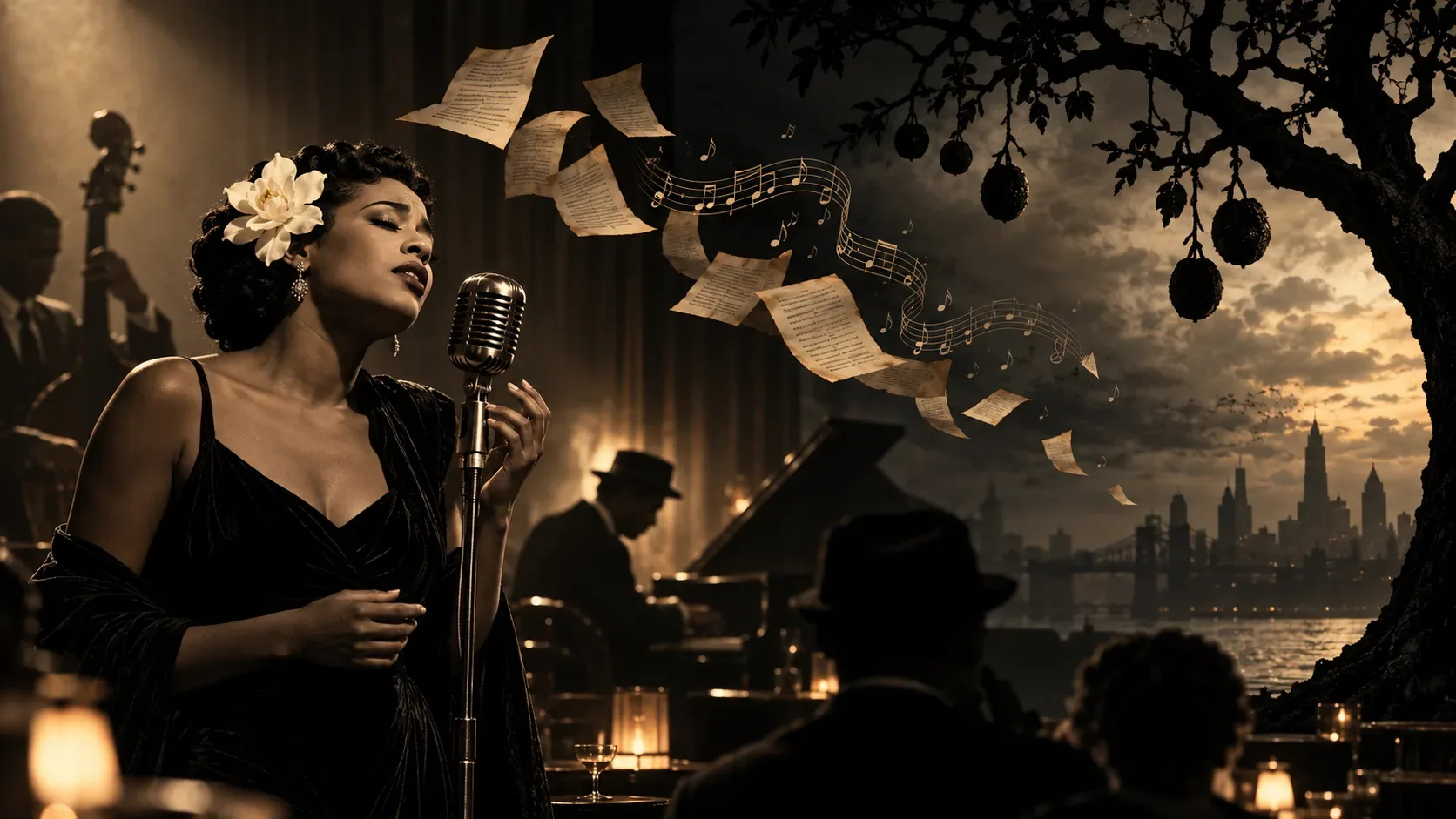
“Strange Fruit” began as a protest poem by Abel Meeropol, published in 1937 under the title “Bitter Fruit.” Meeropol also wrote the music. Billie Holiday did not compose the song, but her performance and 1939 recording brought its condemnation of racist lynching in the United States into the wider history of popular music.
Three stages are often blurred together: Meeropol's response to a photograph of racial violence, the song's circulation as a protest piece before Holiday, and her decision to perform and record it. Sources disagree about the year of her first Café Society performance, but not about the 1939 commercial recording.
The 1930 photograph and the poem published in 1937
Abel Meeropol (1903-1986), an English teacher in the Bronx, New York, wrote the poem after being profoundly disturbed by a photograph of the 1930 lynching of Thomas Shipp and Abram Smith in Marion, Indiana. The image documented racist violence beyond the American South as well.
In 1937, the piece appeared as “Bitter Fruit” in The New York Teacher, a teachers' union publication. The Library of Congress also documents its publication in The New Masses under Meeropol's pen name, Lewis Allan. The strange-fruit metaphor evokes Black victims of lynching, contrasting a seemingly idyllic landscape with the brutality of racism.
Who wrote the music before Billie Holiday?
Meeropol wrote both the words and the melody. According to his adopted son Robert Meeropol, he retitled the poem “Strange Fruit” and set it to music in November 1938. His wife, Anne Meeropol, was already singing it at teachers' gatherings in late 1938 and early 1939.
Billie Holiday's official website also describes earlier performances involving Anne and singer Laura Duncan, including public events in New York. The story therefore did not begin with Holiday's record or with a poem she was asked to turn into music. The composition already existed; its reach and the power of its interpretation were about to change.
How did “Strange Fruit” reach Café Society?
Holiday was performing at Café Society, an integrated club in Greenwich Village. Sources agree that she encountered the song in this setting, but the exact intermediary is disputed: the Library of Congress names club owner Barney Josephson, while Holiday's official website also records an account crediting show director Robert Gordon.
The way it was staged gave the song particular weight. Holiday performed it at the end of her set; service stopped, and the lighting drew attention to her. It was not simply another selection among love songs. The pause and silence asked the audience to face the subject of the poem.
The 1939 record: Columbia, Commodore and Holiday's contribution
According to the historical account on Holiday's official website, Columbia feared the reaction to the material and declined to record it, while allowing a one-session exception to her contract. Holiday then recorded “Strange Fruit” for Milt Gabler's Commodore label in 1939.
The Smithsonian collection documents a Commodore 78 rpm record, catalogue number 526, pairing “Strange Fruit” with “Fine and Mellow.” This surviving object attests to the commercial recording and helps distinguish the 1939 disc from the 1937 poem.
Holiday's vocal interpretation was a decisive artistic contribution, but it does not change the songwriting credits. Her website's historical account also credits pianist Sonny White with the recording's instrumental introduction. An arrangement decision or vocal phrasing is not the same thing as writing the original poem and melody.
Why did Holiday's version carry such weight?
The song addresses the terror of lynching without speaking like a news report. Its central image places natural beauty beside a concrete history of violence. In Holiday's voice, restrained phrasing and deliberate, austere staging allowed the protest to reach listeners who might never have encountered the poem in political or union publications.
This impact can be examined without inventing personal experiences or statements for the singer. In an academic article, Samuel Galen Ng analyzes Holiday's performances as a form of collective mourning and an expression of Black vulnerability. That is the scholar's interpretation, not a documented intention behind every performance.
In 2002, the 1939 recording was selected for the Library of Congress National Recording Registry. The recognition preserves Holiday's performance, while the literary and musical authorship remains Meeropol's.
Why do accounts differ about the first performance?
A historical article from the Library of Congress places a Holiday performance at Café Society in 1938. Her official website and the Smithsonian's collection description instead identify 1939 as the year she first performed it at the club. Without conclusive additional documentation, the precise debut year should not be presented as settled.
The secure sequence for the central question is: a poem published in 1937, a melody written before the record, performances before and by Billie Holiday, then the 1939 commercial recording. Meeropol wrote the work; Holiday introduced it to a broader audience through an unmistakable musical interpretation.
Sources and references
- Library of Congress: The Power of a Poem
- Robert Meeropol, Rosenberg Fund for Children: About Abel Meeropol
- The Official Website of Billie Holiday: Strange Fruit
- Smithsonian National Museum of American History: Strange Fruit; Fine and Mellow
- Library of Congress: National Recording Registry, 2002
- Smith College: Professional Mourning, Samuel Galen Ng