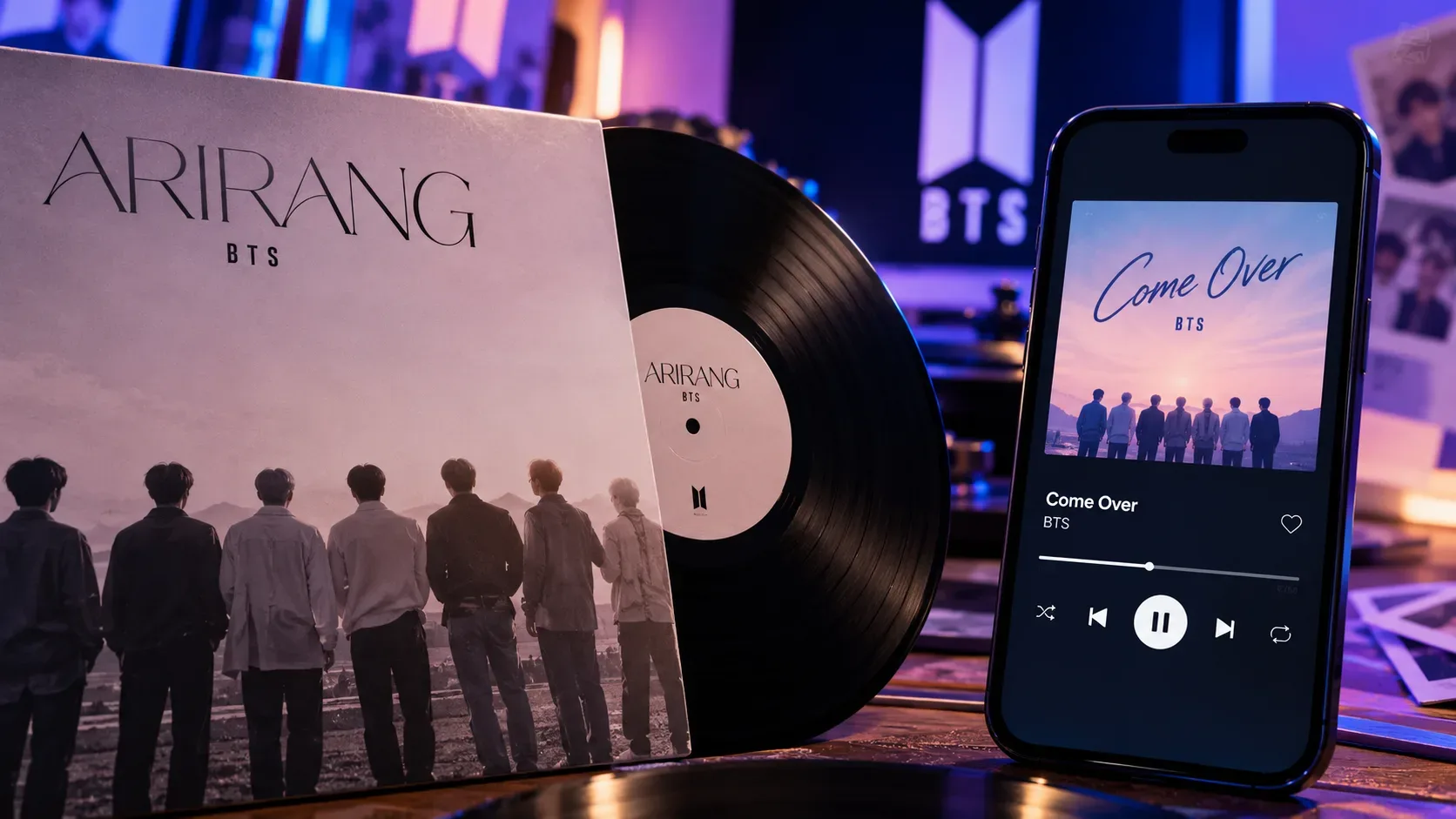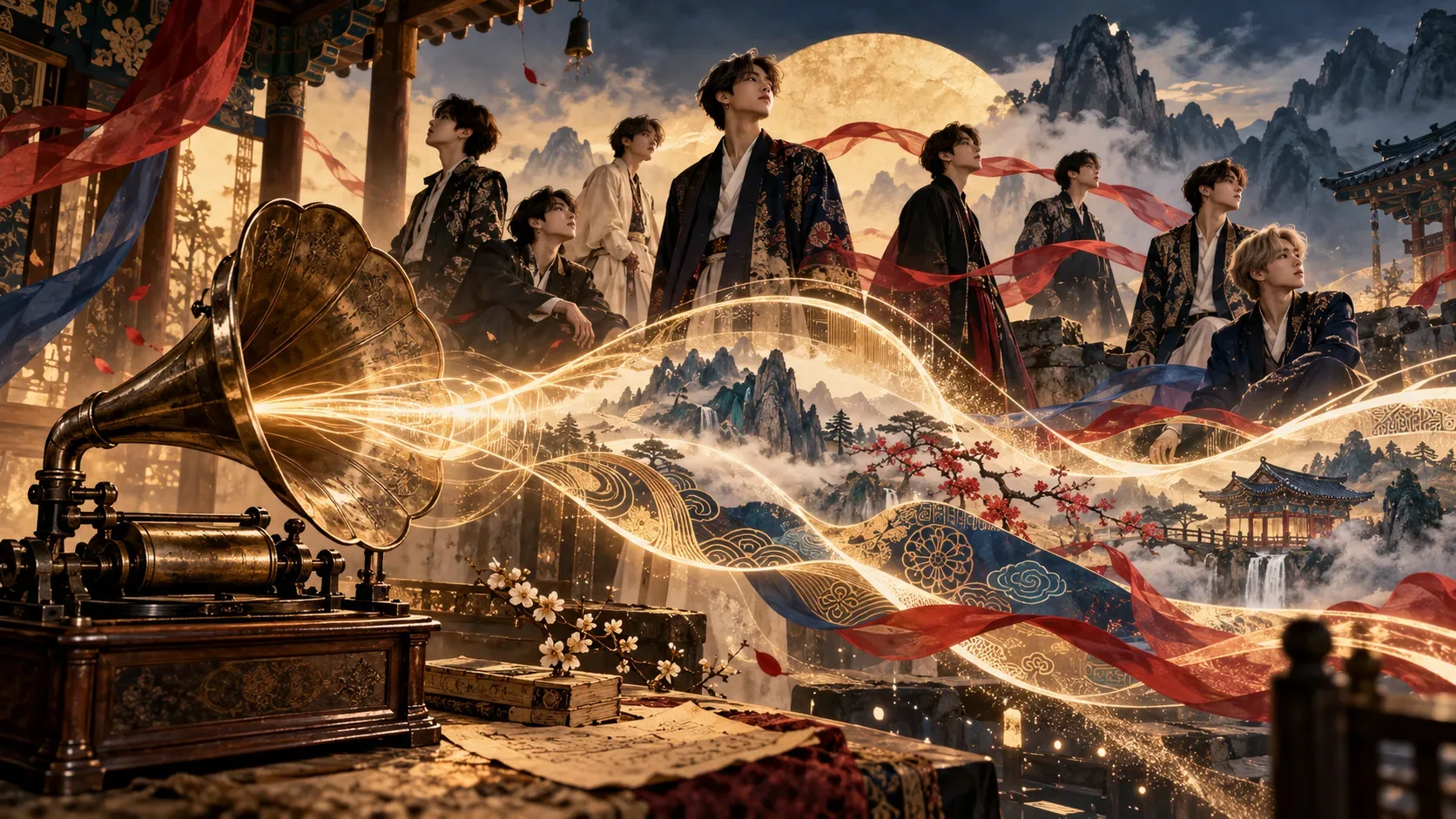
A recording of Arirang made in the United States on July 24, 1896, helped inspire the concept of ARIRANG, BTS's fifth studio album. Bang Si-hyuk, the project's executive producer and HYBE's founder, said he came across the story of young Koreans recording their music far from home and saw a parallel with the seven members returning to the global stage. That creative connection is described by the producer and acknowledged by the U.S. Library of Congress, which holds the recordings.
One historical distinction matters: seven young men appear in a contemporary newspaper report and in BTS's creative reimagining, but only three singers are identified on the surviving recordings. Distinguishing the group reported in 1896 from the participants in the recording session keeps an album metaphor from turning into an inaccurate archival claim.
Released on March 20, 2026, ARIRANG contains 14 tracks, according to BIGHIT MUSIC. The 1896 story helps explain why the group adopted the traditional song's name, but it does not mean every sound on the album came from that archive.
Why did Bang Si-hyuk connect the recording to BTS's return?
In an interview with Billboard journalist Leila Cobo, published in April 2026, Bang said he discovered the historical account while preparing the new album. Production took shape during 2025, as the musicians completed their compulsory military service and resumed working as a group. To the producer, the experience of Koreans expressing themselves through music in another country echoed that of a group that began in South Korea and had to establish its identity before an international audience.
Bang invoked the idea of diaspora as a creative interpretation of that connection. This does not establish that BTS experienced the same circumstances as the nineteenth-century students. Rather, it explains the artistic choice: a song associated with separation, belonging and reunion provided a vocabulary for seven artists returning after a period away from group activities.
The producer said he was the one who proposed Arirang as the central concept. RM, meanwhile, linked Korean identity to the seven members' shared roots in a label interview reported by Yonhap, calling for a contemporary interpretation rather than treating traditional elements as obligatory decoration.
Seven young men in the story, three voices on wax: what do the records show?
The Library of Congress dates the recording session to July 24, 1896, in Washington, D.C., and identifies the recordist as American anthropologist and ethnologist Alice Cunningham Fletcher. She used wax cylinders, an early sound-recording medium that preceded the widespread popularity of disc records. Six surviving cylinders contain songs performed by Korean students and are now part of the American Folklife Center's collection.
The archive identifies three performers, whose names appear in varying romanizations: Jeong-sik Ahn, He Chel Ye and Son Rong. The material includes three recordings of Arirang, one of them an approximately ten-second segment that may represent a false start. The institution calls the cylinders the earliest known recordings of Korean music. That is an archival statement, not a claim that the song itself was composed in 1896.
Where did the number seven come from? BTS's animated promotional short refers to a Washington Post report of May 8, 1896, titled Seven Koreans at Howard, and explicitly says that some of those young men took part in the earliest known recordings of Korean voices. The short reimagines BTS's seven members within that setting. A newspaper account of seven people and recorded performances by three singers are related but different kinds of evidence.
The different records from 1896 are not the same recording
Another source of confusion is that 1896 was also the year Homer B. Hulbert published a musical transcription of a version of the song, identified as A-ra-rúng, in The Korean Repository. Hulbert's work is a written document, whereas Fletcher created sound recordings on wax cylinders. A 2015 study by Yu Daean, summarized in the Korea Citation Index, compares these two historical sources and their musical characteristics.
So any reference to the 'first Arirang of 1896' needs to specify the item: a printed score, a newspaper story about Korean students or an audio recording. These documents establish that the music was circulating in the late nineteenth century, but none pinpoints when the oral tradition began.
| Date | Document or event | What it establishes |
|---|---|---|
| 1896 | Homer B. Hulbert publishes the notation of A-ra-rúng | A written record of a melodic version, not audio. |
| May 8, 1896 | The Washington Post publishes Seven Koreans at Howard | A historical reference to the group of seven young men. |
| July 24, 1896 | Alice C. Fletcher makes recordings in Washington | Wax cylinders featuring three identified singers. |
| March 13, 2026 | BTS releases an animated teaser | An artistic retelling of the story and cylinders. |
| March 20, 2026 | BIGHIT MUSIC releases ARIRANG | The 14-track album using the cultural reference. |
| April 2026 | Bang Si-hyuk explains the concept to Billboard | The producer's account of the creative inspiration. |
What does Arirang mean in Korean musical tradition?
Arirang is not a composition with a single set of lyrics, an established individual author and one fixed meaning. UNESCO describes a folk-song tradition transmitted and reshaped over generations, with a recognizable refrain and verses that change across regions and singers. Its documentation cites estimates of roughly 3,600 variations across about 60 versions. In 2012, the Republic of Korea's Arirang tradition was inscribed on UNESCO's Representative List of the Intangible Cultural Heritage of Humanity.
Different versions can evoke departure, longing, love, loss, resilience and reunion. An isolated translation of the title or refrain therefore cannot capture the tradition's full cultural meaning. In his interview, Bang emphasized the movement from the sadness of separation toward a collective energy of resilience, referring to Korean ideas such as han, associated with sorrow and longing, and heung, associated with liveliness and enthusiasm. These are broad cultural concepts, not exact translations that work in every context.
This distinction helps explain the significance of the title for BTS: the album can draw on shared cultural memory without assuming that a single definitive version of the folk song exists.
How does the reference appear in the album beyond its title?
Bang discusses a recognizable Arirang folk element in Body to Body, including the effect of audiences singing the Korean reference together. That is a concrete musical example, separate from the story of the cylinders. The consulted sources do not establish that Fletcher's original audio was sampled on this track. Recognizing a traditional song is not the same as identifying the technical source of a studio recording.
Another Korean sound-heritage reference appears in No. 29. Bang said the interlude features the sound of the Sacred Bell of Great King Seongdeok, which he encountered during a visit to the National Museum of Korea. According to his explanation, it provides a contemplative transition between parts of the album. The bell and the 1896 cylinders have distinct histories and should not be conflated.
BIGHIT's official album presentation stresses that the members took part in songwriting and production, and that the 14 tracks reflect their experiences and identities. Modern repertoire, a living song tradition and historical documentation thus meet in the concept without becoming one and the same audio source.
Where can you hear the 1896 Arirang, and what can it tell us?
The American Folklife Center at the Library of Congress makes three Arirang audio excerpts from the Fletcher collection available in its article about BTS. Indiana University also describes a later reproduction in its traditional-music archive. The Korea JoongAng Daily has documented displays of replicas and access to digital copies at museums in South Korea.
Listening to these recordings offers a way to encounter Korean singing voices preserved in 1896 and to hear older forms of the song. Comparing them with the 2026 album may reveal connections in repertoire or artistic intent, but it does not in itself prove that the cylinders were used as an audio sample. The documented connection between the two periods is the historical inspiration described by Bang and developed in BTS's artistic presentation.
Sources and references
- BIGHIT MUSIC: official ARIRANG album page
- BIGHIT MUSIC: release notice on Weverse
- Billboard Korea: interview with Bang Si-hyuk
- Billboard, by Leila Cobo: full republication of Bang Si-hyuk interview
- Library of Congress: the 1896 cylinders and their connection to BTS
- Indiana University: archival record of the Arirang cylinders
- UNESCO: Arirang, lyrical folk song in the Republic of Korea
- Korea Citation Index: abstract of Yu Daean's study on Hulbert and Fletcher
- Korea JoongAng Daily: reporting on the collection and cylinder replicas
- Yonhap: statements from RM and BTS on Korean identity