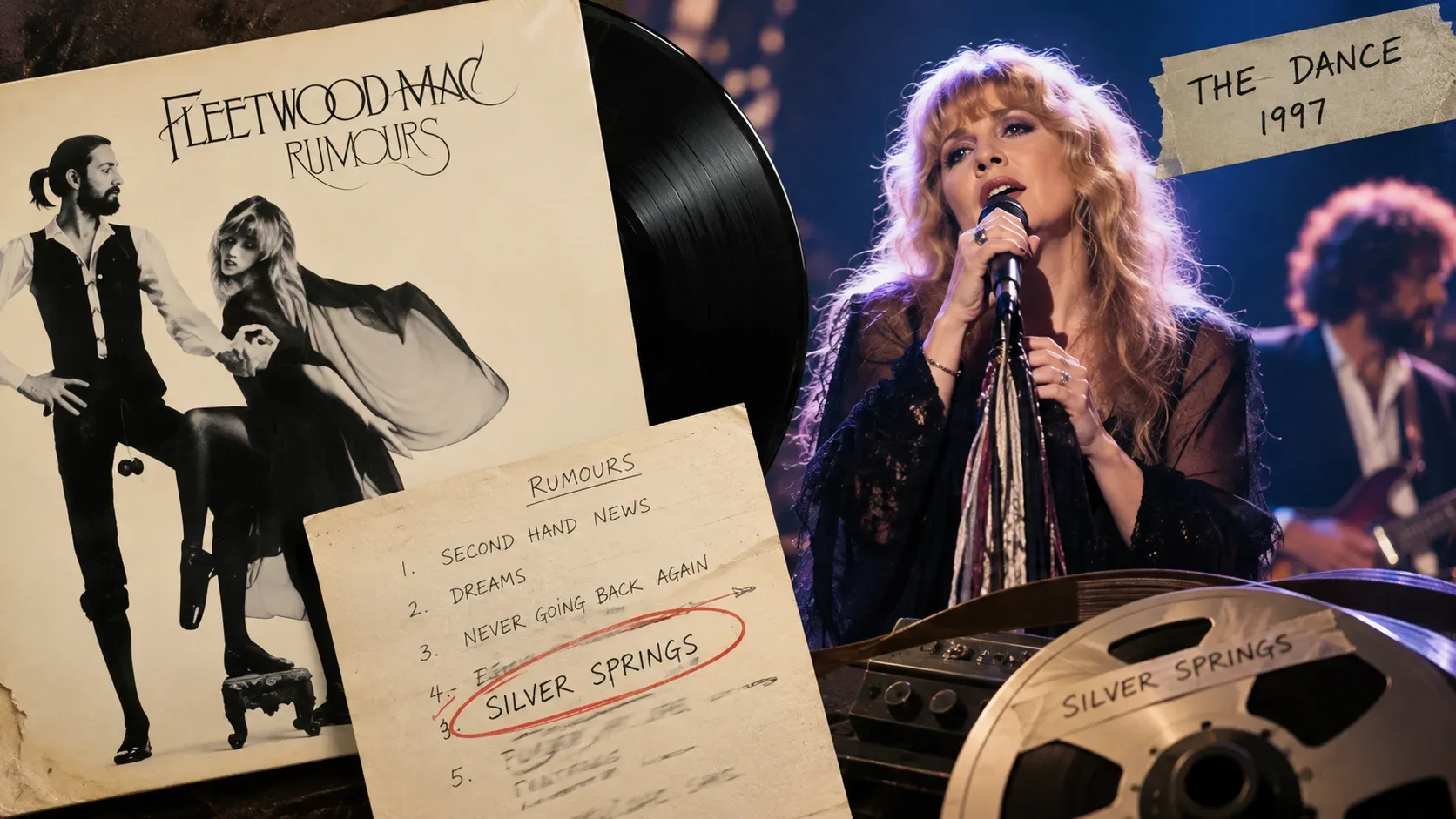
“Silver Springs” was left off the original 1977 release of Rumours because Fleetwood Mac had to balance vinyl running time with the album's sequencing. The band kept the brisker “I Don't Want to Know” in the track list and issued Stevie Nicks' composition as the B-side of “Go Your Own Way”. Twenty years later, the classic lineup brought it back for the 1997 live album and television special The Dance, turning a song largely unfamiliar to the wider public into one of the reunion's most memorable performances.
This was not a case of a recording disappearing completely and then being rediscovered. The original studio track circulated from the 1970s onward and appeared on a compilation in 1992. What changed in 1997 was the visibility of a new performance, sung in front of Lindsey Buckingham, whom Nicks has explicitly identified as the subject of the song.
A song written amid Nicks and Buckingham's breakup
“Silver Springs” was recorded during the Rumours sessions, as Stevie Nicks and Lindsey Buckingham were ending their romantic relationship while continuing to work together. In the Classic Albums documentary, as quoted by Rolling Stone, Nicks said the title came from seeing a road sign for Silver Spring, Maryland. By her own account, the name became a symbol of the future she had imagined with Buckingham.
Co-producer Ken Caillat told Rolling Stone that the band recorded the track roughly six months into the sessions. He praised Buckingham's contributions on acoustic and electric guitar. In comments included with the Rumours DVD-A release, Buckingham himself discussed the layered guitar textures he brought to the recording. These are documented accounts of a musical process, not grounds for inventing private motives beyond what the musicians said.
Why couldn't “Silver Springs” fit on Rumours?
Mick Fleetwood explained in the DVD-A commentary that the group treated approximately 22 minutes per vinyl side as a guideline for good sound quality. Lindsey Buckingham also cited concerns about how the album would flow. Caillat told Rolling Stone that early running orders concentrated too many slower songs and failed to solve both the running-time and listening-pace problems at once.
The durations published on the band's official site make the issue easier to visualize. Adding up the listed times for the original album gives roughly 19 minutes 8 seconds on side A and 19 minutes 55 seconds on side B. Adding the 4-minute-33-second “Silver Springs” track listed on the expanded edition would push those figures to 23 minutes 41 seconds or 24 minutes 28 seconds, respectively. This is an illustrative calculation, not proof that a record physically could not hold the song: different substitutions, sequencing or mastering could change the result.
The decision involved musical judgment as well as arithmetic. The original Rumours includes “I Don't Want to Know”, a Nicks composition sung by her and Buckingham, whereas “Silver Springs” was excluded. In later reissue notes cited by Rolling Stone, Nicks recalled that the band had already prepared “I Don't Want to Know” and that she strongly opposed the switch. Caillat's account emphasizes the selection of material; Nicks' emphasizes her lack of consent. Treating these as attributed recollections avoids presenting their disagreement as a shared version of events.
In the 2007 Crystal Visions liner notes, Nicks also recalled that Fleetwood and Buckingham took her aside in the studio parking lot near the completion of Rumours. She wrote that the news upset her deeply. For the singer, exclusion from the LP carried an additional consequence: she had intended the song as a gift to her mother, Barbara.
The B-side, a later dispute and the road back to the stage
Even after being cut, the original recording did not remain locked away: it came out on the B-side of Buckingham's “Go Your Own Way”. That lower-profile release helped it acquire cult status among fans. According to Brittany Spanos' Rolling Stone feature, the band also performed it a handful of times in 1976 and 1977 before largely dropping it from concerts for many years.
Another disagreement came before The Dance. In the early 1990s, Nicks wanted to use the track on her solo compilation Timespace, while Fleetwood had earmarked it for a band retrospective. The studio recording was included in 25 Years - The Chain (1992). Rolling Stone documented the conflict surrounding that choice and linked it to Nicks' departure from the band. It would therefore be inaccurate to say the recording was not released again until 1997.
What made the performance on The Dance so memorable?
In 1997, Nicks, Buckingham, Mick Fleetwood, Christine McVie and John McVie performed together again. The official The Dance track listing identifies “Silver Springs” as a live recording made on May 23, 1997, at Warner Bros. Studios in Burbank, California. It is part of the CD and the reunion television special associated with MTV, not the original edition of Rumours.
In the filmed performance, Nicks turns toward Buckingham near the song's climax. Fred Schruers' 1997 Rolling Stone report described the moment and documented both musicians' comments. Nicks said she had saved that level of intensity for the performance she wanted preserved. Buckingham acknowledged how difficult it was not to become emotionally involved in the song's ending, even after so many years.
The exchanged looks support a powerful reading of their shared past, but they do not establish a romantic reconciliation. In the same 1997 interview, both artists rejected the idea that they were getting back together. The performance's significance lies in what was presented and what the musicians actually said, not speculation about what a gesture revealed about their private lives.
The live recording later received industry recognition: “Silver Springs” was nominated at the 1998 Grammy Awards for Best Pop Performance by a Duo or Group with Vocal. The Recording Academy confirms that Jamiroquai's “Virtual Insanity” won that category. “Silver Springs” was a nominee, not the winner.
Which release contains which version?
| Period | Release | What it contains |
|---|---|---|
| 1976/1977 | “Go Your Own Way” single | The original “Silver Springs” studio recording, issued as the B-side. |
| 1992 | 25 Years - The Chain | The studio recording restored to the band's compilation catalogue. |
| 1997 | The Dance | A new live performance by the reunited classic lineup. |
| 2013 | Rumours, expanded edition | “Silver Springs” as an additional track, not part of the original 1977 sequence. |
That distinction resolves the apparent contradiction: “Silver Springs” belongs to the Rumours sessions, but not to the original album's running order. The Dance neither created the song nor recovered it from total obscurity. It provided a new recording, a televised performance and a much larger audience, with the band's 1997 artistic reunion as its setting.
Sources and references
- Fleetwood Mac: Rumours track lists and editions
- Stevie Nicks: Crystal Visions liner notes (2007 booklet, PDF)
- Fleetwood Mac: interview excerpts from the Rumours DVD-A commentary
- Rolling Stone, Brittany Spanos: the history of Silver Springs (2017)
- Rolling Stone, Jordan Runtagh: Rumours recording background (2017 reprint)
- Fleetwood Mac: official The Dance CD track listing
- Rolling Stone, Fred Schruers: 1997 interview and performance (reprint)
- Recording Academy: 1998 Grammy award category
- Fleetwood Mac: 25 Years - The Chain box-set track list (1992)