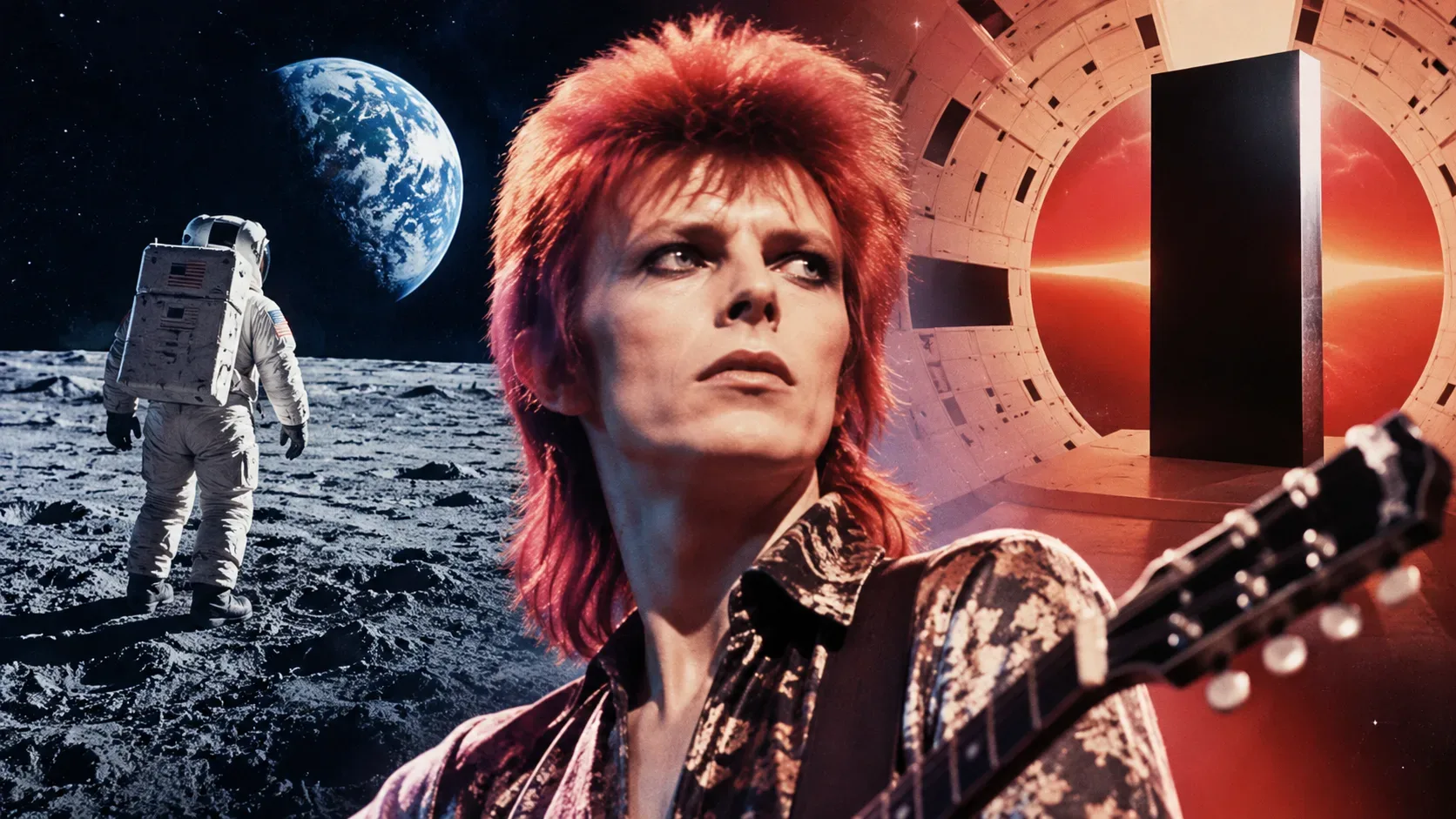
“Space Oddity” grew out of David Bowie’s encounter with Stanley Kubrick’s 2001: A Space Odyssey (1968), not from a commission connected to Apollo 11. Bowie later explained that origin himself. Its association with the Moon mission came through timing: the single appeared on July 11, 1969, five days before the spacecraft launched, and was used in British television coverage of the Moon landing. That does not make it an official NASA tribute.
What Bowie said about the influence of 2001
In a 2003 interview with Bill DeMain, reproduced on Bowie’s official website, the singer rejected the assumption that he had written the track about the Moon landing. He said the creative spark came from watching 2001: A Space Odyssey, released in 1968. Even the sound of “Space Oddity” echoes “Space Odyssey,” but the decisive link is the songwriter’s account, rather than a similarity between titles on its own.
Kubrick’s film explores space travel, technology, solitude, and questions without easy answers. Bowie turned some of that atmosphere into a song with its own character, Major Tom. This was artistic influence, not a direct adaptation of the film’s plot. The official notes for the song’s anniversary edition confirm that it had already been written and demoed in November 1968, before the Apollo 11 mission.
From composition to Moon landing: the key dates
Keeping the writing, commercial release, and television use separate prevents distinct events from being mistaken for a single origin story.
- 1968: 2001: A Space Odyssey opens. Bowie draws on the film and records a demo of “Space Oddity” in November.
- July 11, 1969: “Space Oddity” comes out as a single produced by Gus Dudgeon. Its proximity to the lunar flight helps shape its promotion.
- July 16: Apollo 11 launches with Neil Armstrong, Buzz Aldrin, and Michael Collins, according to NASA’s mission history.
- July 20: Armstrong and Aldrin reach the lunar surface. The song becomes associated with British television coverage of the mission.
- July 24: all three astronauts return safely to Earth, a significant date in accounts of when BBC radio resumed playing the song.
- November 1969: the track appears on Bowie’s second album, originally titled David Bowie, and reaches No. 5 on the UK singles chart.
The record company recognized a commercial opportunity. The Smithsonian notes that the single’s release was brought forward to benefit from interest in Apollo 11. That explains the release strategy, but it does not change the inspiration Bowie identified.
Did the BBC use the song or stop it from being played?
Both accounts appear in the sources, but they concern broadcast contexts that need to be distinguished. In his 2003 interview, Bowie said British television selected the song as background music for coverage of the landing. The Smithsonian’s National Air and Space Museum also records its use in the July 20 broadcast.
At the same time, the Recording Academy reports that the BBC avoided airing the single during the mission because of the character’s bleak fate. The Smithsonian specifies that, after its use in the television coverage, BBC radio did not play it again until the crew returned. Simply saying “the BBC banned the song” overlooks its television appearance; claiming it was played without restriction throughout the flight overlooks the documented radio limitation.
The concern arose from the story itself. The real lunar mission depended on bringing its astronauts home, whereas “Space Oddity” tells a fictional story of broken communication and isolation. Bowie said he found it an uneasy pairing with the successful historic landing.
Major Tom was not an Apollo 11 astronaut
Major Tom is fictional. In the song, his journey begins with contact with ground control, then becomes uncertain as that connection is lost. This leaves room for interpretations involving detachment, vulnerability, and alienation; it neither recounts Armstrong, Aldrin, and Collins’s mission nor records the fate of a real crew member. Reading it simply as a celebration of space exploration removes that central tension.
The contrast is audible in the recording as well. As the Smithsonian explains, instruments such as the Stylophone and Mellotron helped create a space-age atmosphere alongside the song’s folk elements. The Recording Academy also credits Rick Wakeman’s Mellotron playing and Paul Buckmaster’s arrangements, in addition to Gus Dudgeon’s production.
Why did Space Oddity become so closely linked to Apollo 11?
Three stories converged within days: a song inspired by a science-fiction film, a label releasing it amid excitement about the Moon, and a television broadcast placing it alongside real images. Its success was not immediate: the Recording Academy places its climb to No. 5 in the UK months after the July release. The song developed its own legacy, and Bowie would return to Major Tom in later work, including “Ashes to Ashes.”
The historical answer is therefore more precise than simply choosing “the film” or “Apollo”: 2001 explains Bowie’s stated creative inspiration; Apollo 11 explains the release timing and an important part of the song’s public reception. The consulted sources do not support calling it a NASA-commissioned track or an official agency anthem.
Sources and references
- David Bowie official website: 2001: A Space Odyssey is fifty, featuring Bowie’s 2003 interview with Bill DeMain
- David Bowie official store: historical notes for the 50th-anniversary Space Oddity release
- Recording Academy: seven facts about Space Oddity (2018)
- Smithsonian National Air and Space Museum: how the song accompanied Moon-landing coverage (2023)
- NASA: official Apollo 11 mission chronology