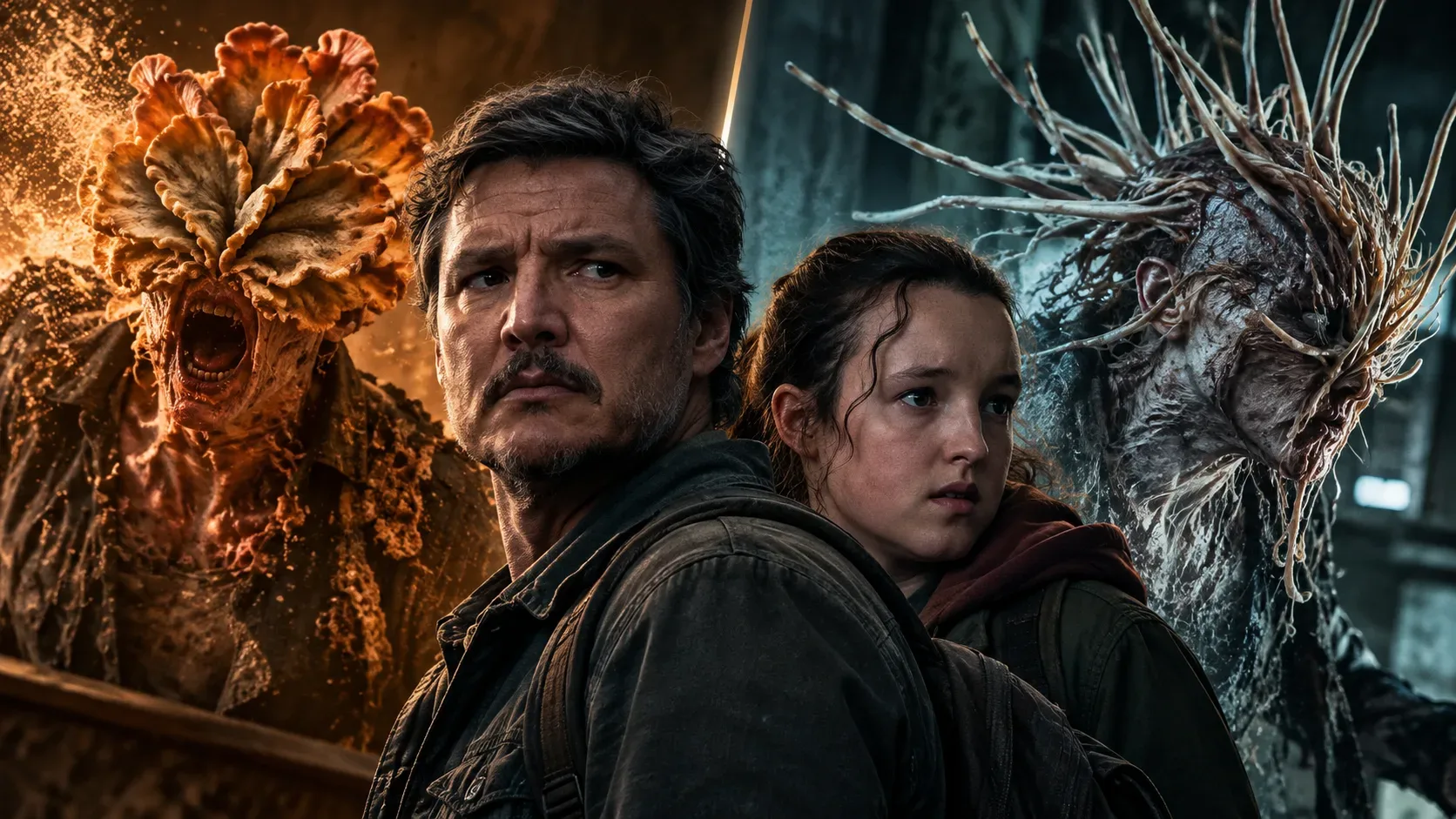
The Last of Us left airborne spores out of its first season to avoid making the air itself a constant threat and to develop a more physical, visually distinctive method of transmission: fungal tendrils. Season 2 introduces spores under specific circumstances, inside a sealed underground space, because they serve a crucial purpose in Ellie's story. The series has not removed tendrils or simply restored every rule from the games.
Warning: mild spoilers for Seasons 1 and 2, particularly Season 2, Episode 5.
In the games, spores make certain areas dangerous to breathe in
In the original The Last of Us, released in 2013, and The Last of Us Part II, released in 2020, Cordyceps can spread through attacks by the Infected and through inhaling spores in contaminated locations. Vulnerable characters need protective masks in those environments. The danger is location-specific: the games do not depict every outdoor space as a cloud of infectious particles.
That rule also provides a storytelling device. When Ellie enters contaminated areas without becoming infected, her immunity becomes visible to the people around her. It is not enough for the audience to know she is immune; other characters can witness evidence of it directly.
Why did Season 1 favor tendrils?
For HBO's adaptation, the creators chose not to establish spore-filled environments from the outset. One concern was specific to television: if airborne infection were widespread, characters would need masks very frequently, concealing much of the actors' expressions. Craig Mazin also questioned the logic of filling the world with spores without making exposure almost inevitable.
Tendrils gave the show a different visual language of horror. Thin fungal filaments emerging from an Infected person's mouth can transmit the fungus through contact, while an underground fungal network can alert Infected individuals some distance away. Season 1's second episode introduces that connection. The underground network and contact-based filaments are related features of the fungus, but neither is the same as airborne transmission.
In a January 2023 interview with The Washington Post, Mazin said he wanted to explore a form of transmission beyond an ordinary bite. The filaments' design drew on fungal biology and, according to him, images of jellyfish stings sent by director Jasmila Žbanić. In that same interview, he explicitly left open the possibility of introducing spores later. Season 1 therefore did not impose a permanent ban on them within the show's world.
What changes when spores appear in Season 2?
Spores make their proper on-screen entrance in Season 2, Episode 5, Feel Her Love, which aired in 2025. In Seattle, the WLF (Washington Liberation Front) discovers an airborne threat in a lower section of Lakehill Hospital. The survivors seal off access. As Craig Mazin explains in HBO's official companion podcast, the identified spore-filled area is on basement level B2, not across the entire city.
The story ties the discovery to a painful decision: commander Elise Park keeps the area sealed even though her son is among those trapped inside. In behind-the-scenes remarks reported by GameSpot, Mazin describes Infected people who have remained belowground for years, breathing in air and releasing spores. The new danger has a clear setting and a dramatic boundary instead of appearing without explanation on every street.
Later, Ellie pursues Nora into the contaminated area. Nora inhales the spores and expects Ellie to suffer the same fate. When Ellie remains unaffected, Nora immediately realizes she has found the immune girl. That recognition is the central storytelling reason for bringing back the game's mechanic.
In the episode's podcast, Neil Druckmann explains the specific requirement: the story needed clear and immediate proof for Nora, since a bite would not demonstrate Ellie's immunity instantly. Mazin adds that the writers looked for a setting where spores would make sense and feel more threatening. In a March 2025 interview with Inverse, he had already explained that their return would be connected to the plot and affect a relationship between characters.
Spores, tendrils, and immunity: comparing the versions
| Version | How the threat works | Storytelling purpose |
|---|---|---|
| The Last of Us and Part II games | Bites and spores in contaminated areas; protective masks are needed there. | Spores help demonstrate Ellie's immunity and add hazards to exploration. |
| TV series, Season 1 (2023) | Bites, contact-based tendrils, and underground fungal connections; spores are not used as an environmental hazard. | Emphasizes contact-based danger and lets actors perform without recurring masks. |
| TV series, Season 2 (2025) | Tendrils still exist; spores also appear in an enclosed area beneath the hospital. | Nora's encounter uses spore exposure to make Ellie's immunity immediately apparent. |
Do returning spores contradict Season 1?
Not necessarily. The first season mainly presented other ways Cordyceps could spread, while the second reveals a specific circumstance the central characters had not encountered before. That does not establish that every open-air location has become dangerous to breathe in, nor does it mean the network of fungal tendrils is gone.
The change in emphasis can be understood as an adaptation choice: first, the show establishes a distinctive visual mechanism; later, it brings back an element from the games when a scene involving Ellie and Nora needs it. That reading follows Mazin and Druckmann's explanations without treating a creative decision as a scientific discovery about real fungi.
Sources and references
- The Washington Post: Elise Favis interview with Craig Mazin (2023)
- Inverse: Dais Johnston interview with Craig Mazin and Neil Druckmann (2025)
- Inverse: Dais Johnston on the return of spores (2025)
- HBO: official Season 2 Episode 5 companion podcast (2025)
- GameSpot: creators explain Season 2 Episode 5 (2025)
- Sky: Season 2 Episode 5 recap