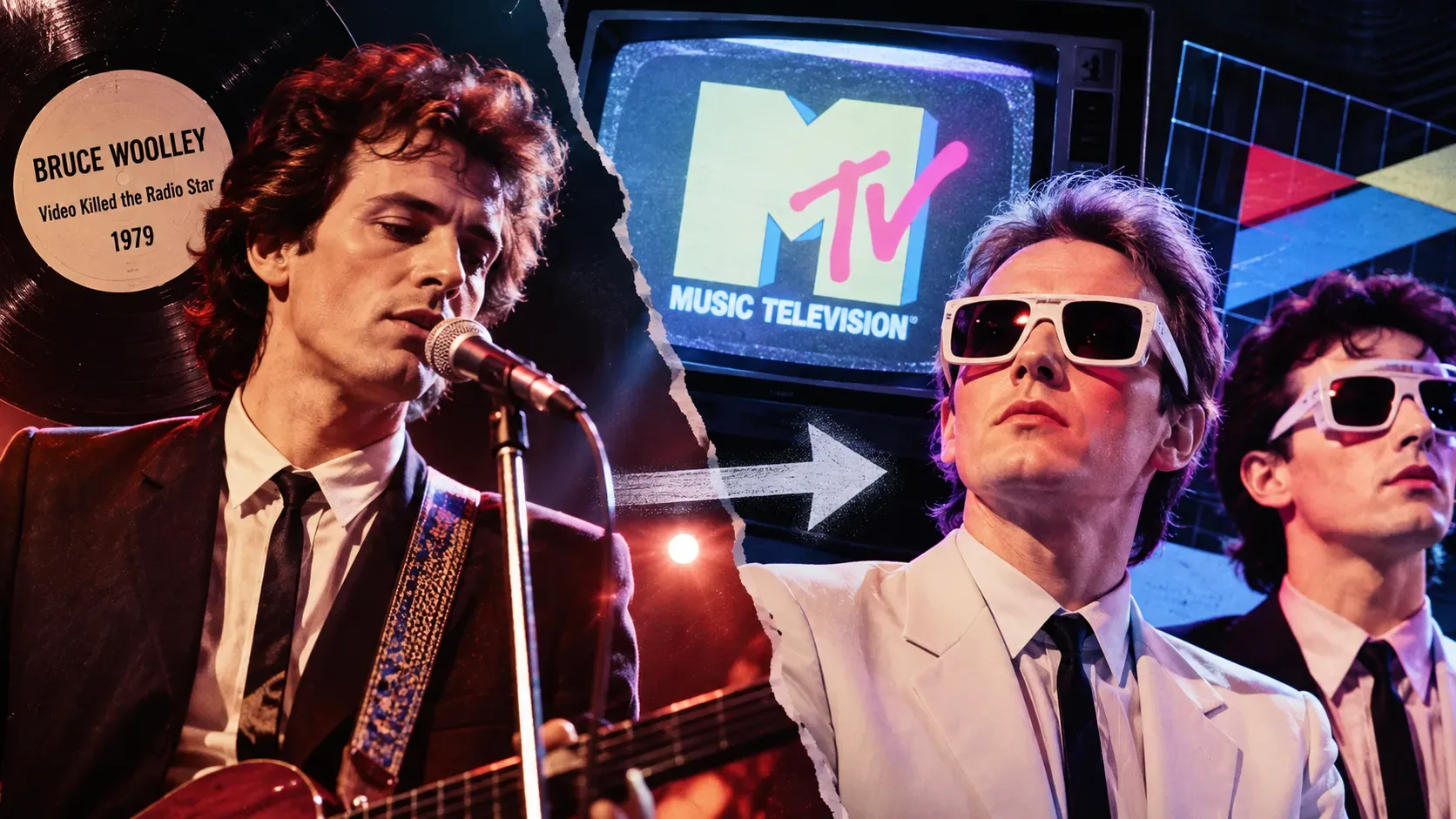
Bruce Woolley released his recording of Video Killed the Radio Star with the Camera Club before the Buggles made the song a hit in 1979 because he had co-written it with Trevor Horn and Geoff Downes before moving on to his own project. The Buggles, by then built around Horn and Downes, developed a different recording and arrangement. Woolley's claim to being first concerns the commercially released version, not the first time the song was put on tape: demos already existed before either single.
Who wrote the song, and where does Bruce Woolley fit in?
Songwriting credit belongs to Bruce Woolley, Trevor Horn and Geoff Downes. In a 2018 interview with The Guardian, Horn described meeting Downes and Woolley while working among musicians backing singer Tina Charles. The three began writing their own material; when Woolley secured a deal for a solo career, Horn and Downes carried on as the Buggles.
In the same interview, Downes explained that Horn and Woolley had already written much of Video Killed the Radio Star by the time he became involved, and that he helped shape the finished song. This is not the story of an unknown musician covering somebody else's hit: Woolley was one of the song's writers and chose to record it with his new band.
There is an earlier stage that often disappears from brief accounts. Downes remembered a demo with Tina Charles on vocals, made before the definitive recording for Island Records. That separates three distinct steps: collaborative songwriting, development demos and the singles released to the public.
Why did Woolley's version come out first in 1979?
After forming the Camera Club, Woolley brought the song into his own repertoire. The group included keyboardist Thomas Dolby and guitarist Dave Birch, among others, as documented by Cherry Red in its notes for the band's anthology. Video Killed the Radio Star appeared on the 1979 album English Garden and was also issued as an Epic single.
As Geoff Downes recalled to The Guardian, Woolley tried to prevent the duo from putting out their interpretation and released a more straightforward recording ahead of the Buggles. That is Downes's account of a creative disagreement, not independent evidence of an enforceable contractual ban. The documented context explains how both records came about: the collaborators moved into separate projects while retaining shared songwriting credit.
The exact date of Woolley's release needs a qualification. The collector discography 45cat lists an Italian Epic single, catalogue number EPC 7926, dated June 17, 1979. A Gold Radio feature published in January 2026 notes that other discographies also place some releases in October. The Italian listing and Downes's testimony support an earlier Woolley release, but they do not establish one worldwide release date for every pressing.
How was the Buggles recording different?
The Buggles' single, released by Island in September 1979, was not merely Woolley's tape with a different singer. Downes said the duo rebuilt the arrangement, added a different introduction and middle section, and extended the verses. The finished record emphasized keyboards, studio layering and an electronic sensibility, in contrast to the Camera Club's more direct band performance.
Engineer Gary Langan told Sound On Sound how Horn's distinctive vocal sound was created using compression, equalization and re-amplification. The production relied on carefully assembled sessions and overdubs rather than modern computers. Interestingly, Langan also recalled Woolley contributing guitar overdubs to the Buggles record itself, suggesting that the separate projects did not create an absolute divide between the musicians.
The commercial outcomes were very different. According to Official Charts, the Buggles' version reached number one in the UK singles chart for the week of October 20, 1979. Woolley's recording did not enjoy comparable success. Releasing a song first and turning it into a hit are two separate historical achievements.
From composition to MTV: the essential timeline
- Before the singles: Horn, Woolley and Downes develop the song, and a demo features Tina Charles on vocals.
- 1979, Camera Club version: Woolley puts out his interpretation as a single and on English Garden; an Italian release is listed in June, with qualifications for other editions.
- September and October 1979: the Buggles release their recording, which tops the UK singles chart in October.
- August 1, 1981: the Buggles video is the first music video played at the launch of MTV in the United States.
Was the MTV video made specifically to launch the channel?
No. The Buggles' song and record date from 1979, whereas MTV began broadcasting in the United States on August 1, 1981. The channel chose a video that already existed; that later decision permanently linked the song to the emergence of music television. In a 2014 Guardian interview, Trevor Horn described the MTV connection as a coincidence rather than something the band had planned.
HISTORY's account confirms that Video Killed the Radio Star was the new channel's inaugural music video. Being the first video broadcast by MTV is not the same as being the first music video ever made, and the lyrics were not a specific prediction of the network's creation. Horn connected the song to technological change and the fiction of J. G. Ballard, interests that predated MTV.
The sequence becomes clearer when the milestones are kept separate: Woolley helped write the song and released an early version of his own; Horn and Downes turned another recording into an international hit; nearly two years later, MTV selected the Buggles video for its debut. The televised milestone does not erase the earlier authorship and recording.
Sources and references
- The Guardian: The Buggles: how we made Video Killed the Radio Star
- Sound On Sound: Classic Tracks: The Buggles 'Video Killed The Radio Star'
- Cherry Red Records: Bruce Woolley & The Camera Club: The Definitive Anthology
- Gold Radio: The making of the era-defining MTV hit
- 45cat: Bruce Woolley and the Camera Club, Epic EPC 7926
- Official Charts: Video Killed the Radio Star: UK singles chart
- HISTORY: MTV launches, August 1, 1981
- The Guardian: Trevor Horn: I had delusions the label would be a hub of creativity